
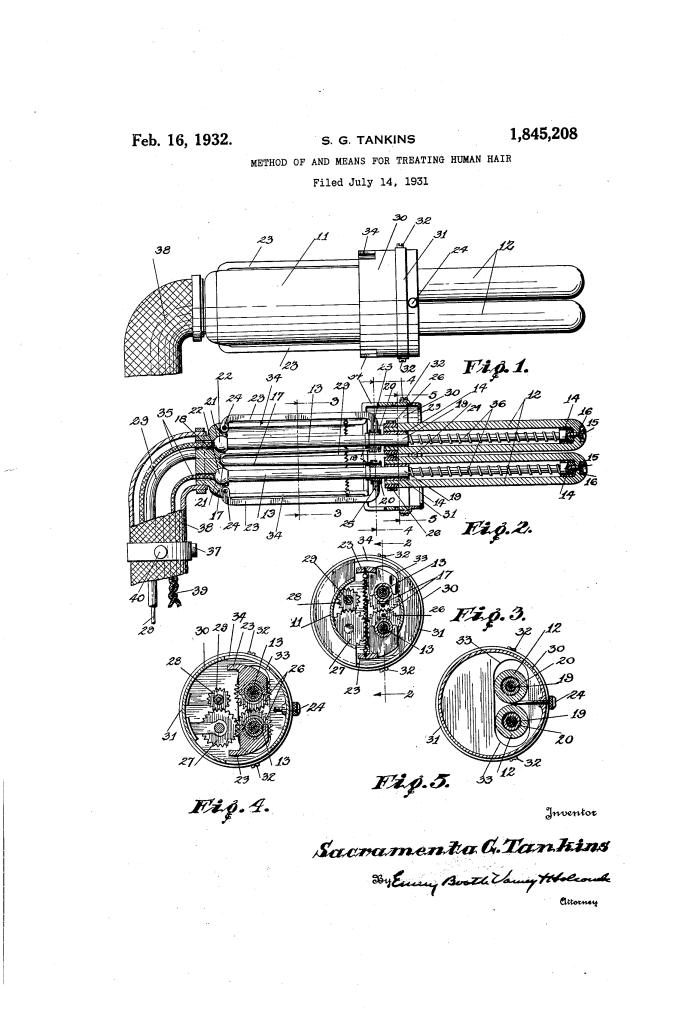
Method of and Means for Treating Human Hair (Sagramenta G. Tankins, No. 1,845,528)
Patented in 1932 by Sagramenta G. Tankins of Atlantic City, New Jersey, this invention describes an early motorized hair-straightening device. While manual pressing combs and curling irons were common at the time, Tankins’ invention sought to automate the process using heated rollers that applied uniform pressure and heat, reducing the physical labor required by the stylist and providing a more consistent result for the client.
1. The Motorized Roller Mechanism
The core of the device consists of two hollow, “thimble-shaped” rollers (12) that project from a hand-held casing. Unlike standard irons that remain static, these rollers are designed to move the hair through the device automatically.
- Constant Rotation: Power is supplied by a small electric motor via a flexible shaft (29). This shaft turns a series of gears (26, 27, 28) that cause the rollers to rotate in unison.
- Uniform Progression: By rotating at a constant speed, the rollers pull the hair strands from the scalp to the ends at a steady pace. This ensures that no single section of hair is over-heated or under-pressed.
- Controlled Tension: The method emphasizes applying “moderate tension” by rolling the hair rather than pulling it, which was intended to be gentler on the strands than traditional manual stretching.
2. Heating and Electrical Control
The device is “internally heated,” meaning the heat source is shielded inside the rollers to prevent direct contact with the skin or hair surface that might cause scorching.
- Heating Elements (13): Inside each hollow roller is a resistance coil. These coils are wired in series to ensure they maintain the same temperature.
- Insulation: To protect the operator and the internal gears, the heating elements are mounted using insulating bushings (14, 20) and ball-shape thimbles (22) made of heat-resistant materials.
- The Rheostat (40): A dial or rheostat is integrated into the circuit, allowing the operator to fine-tune the degree of heat based on the texture and thickness of the patient’s hair.
3. Pressure and Gap Adjustment
Tankins included several mechanical features to allow the stylist to customize the treatment for different hair types.
- Pivotal Mounting: The rollers are mounted on a pivot point inside the casing. A spring (17) normally keeps them apart, allowing the stylist to easily insert a section of hair near the scalp.
- The Grips (23): The operator squeezes the handle grips to bring the heated rollers together against the hair strands.
- Adjustable Screw (24): A tapered screw projects between the rollers. By turning this screw, the operator can set a “minimum gap” or a specific pressure limit. This prevents the stylist from accidentally applying too much pressure and crushing or damaging the hair.
4. Technical Component Summary
| Component | Function |
| Flexible Shaft (29) | Transfers rotational power from a remote motor to the hand-held unit. |
| Hollow Rollers (12) | Apply simultaneous heat and pressure while moving along the hair. |
| Insulating Ball Thimbles (22) | Allow the rollers to pivot freely while protecting the casing from heat. |
| Idler Gear (27) | Ensures both rollers rotate in the correct direction to feed hair through. |
| Rheostat (40) | Provides precise control over the temperature of the internal coils. |
Significance in Hair Care History
Sagramenta Tankins was a pioneer in the “pressing and curling” industry. This patent represents a shift toward the professionalization and mechanization of Black hair care in the early 20th century. By combining motorized movement with regulated electrical heat, Tankins’ device aimed to make hair straightening safer, faster, and more uniform than the traditional method of using stovetop-heated metal combs.
