
Preserving Perishable Foodstuffs in Transit (1957)
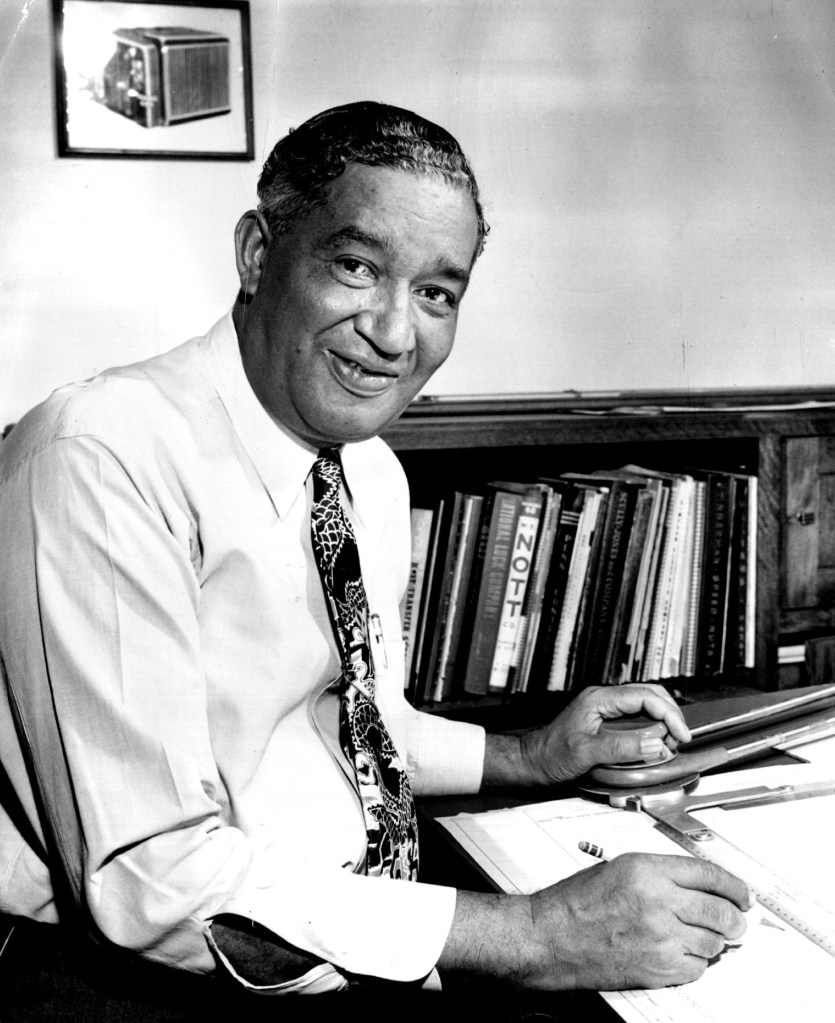
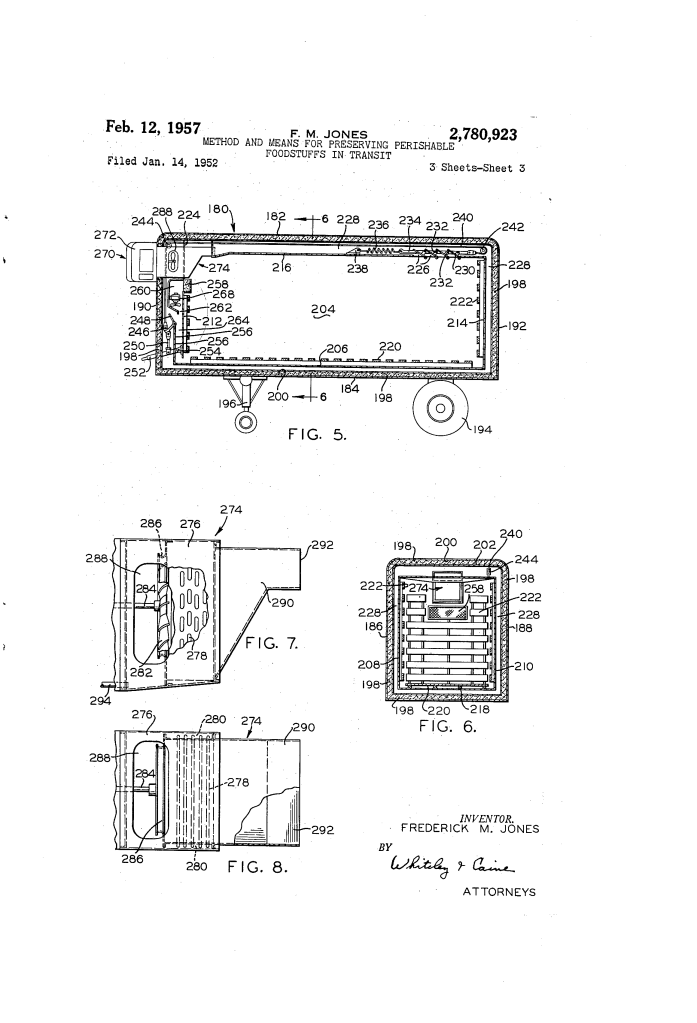
U.S. Patent No. 2,780,923, granted on February 12, 1957, to Frederick M. Jones, describes a sophisticated refrigeration method and apparatus designed to protect fresh produce during long-distance transportation. Frederick Jones, the co-founder of Thermo King and a prolific self-taught engineer, was the dominant figure in the development of mobile refrigeration.
This specific invention solved a dual threat in the shipping industry: “windburn” (dehydration from excessive air circulation) and “stratification” (uneven temperatures that cause pockets of spoilage). It introduced a two-stage cooling cycle that transitioned from active precooling to a “cold-wall” storage mode.
The Innovation: The “Jacketed Cooling” System
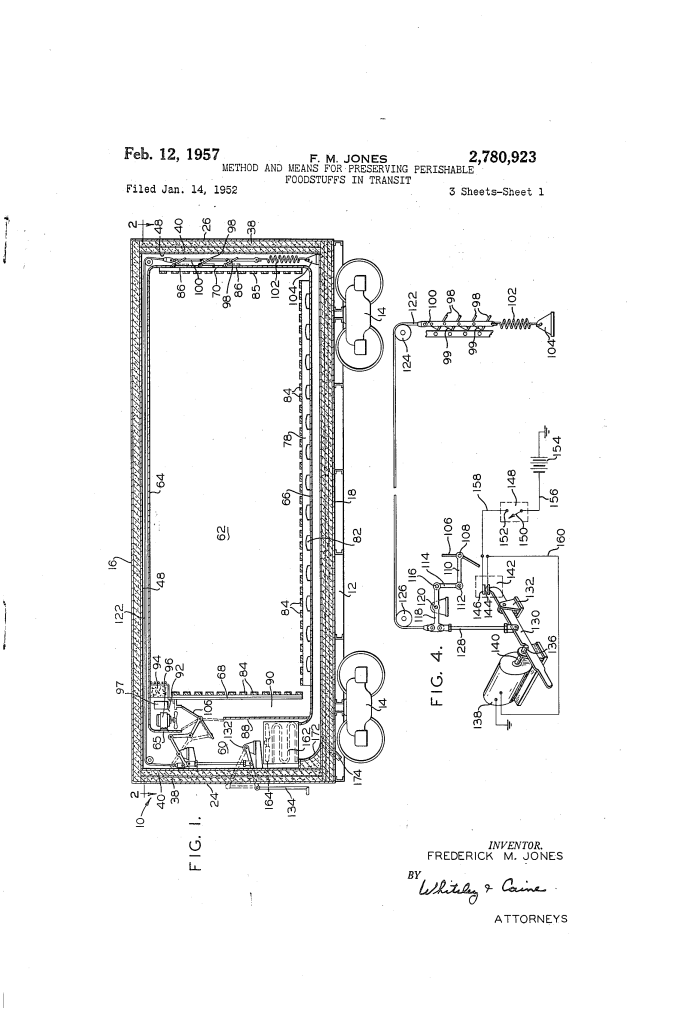
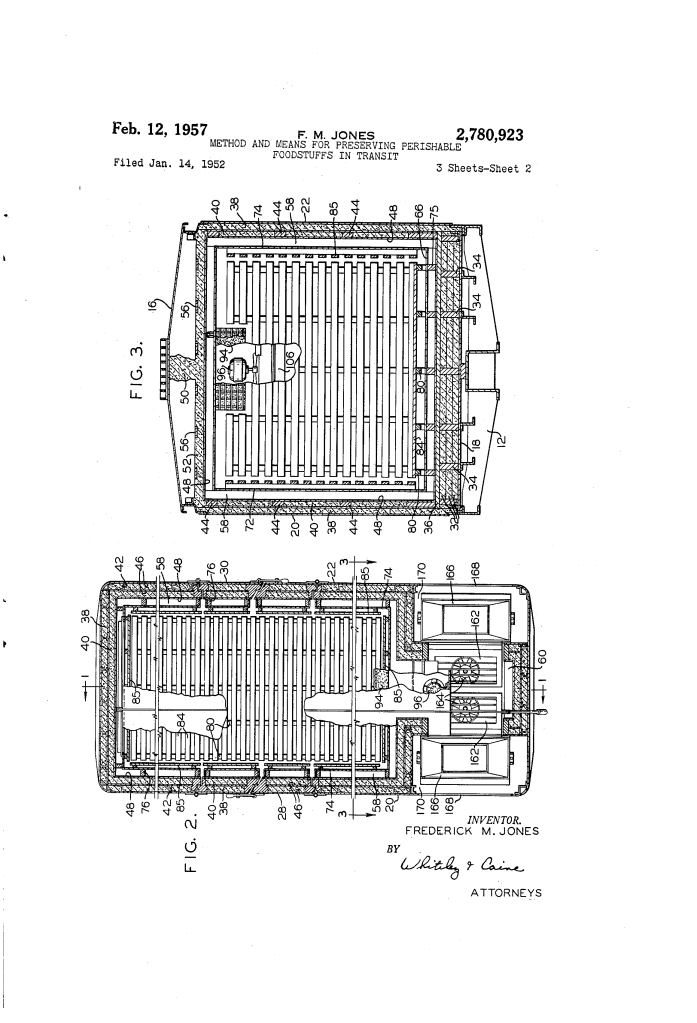
Produce like strawberries and leafy greens are highly delicate; if you move air over them too fast, they wither, but if the air is stagnant, they rot. Jones’s breakthrough was a system that used a cargo chamber (62) suspended within an outer insulated shell, creating a “jacket” of air around the food.
Instead of continuously blowing refrigerated air through the produce for the entire trip, Jones designed a system that isolates the food once it reaches the ideal temperature.
Why Jacketed Cooling?
- Initial Precooling: Initially, dampers open to blast refrigerated air directly through the produce to remove “field heat” as quickly as possible.
- Sealed Isolation: Once the target temperature is hit, the dampers snap shut. The produce is then kept cool by the “cold-wall effect”—refrigerated air continues to circulate around the outside of the chamber, absorbing heat through the walls without drying out the food.
- Atmospheric Control: It allows for the modification of the air inside the chamber, such as reducing oxygen or absorbing carbon dioxide to further slow the ripening process.
Key Chemical and Mechanical Components
The system is a complex marriage of thermodynamics and automated controls:
| Component | Function |
| Cargo Chamber (62) | A “box within a box” made of materials with low thermal resistance to allow easy heat transfer. |
| Automatic Dampers (98, 106) | Mechanical gates that open for initial cooling and permanently seal for the remainder of the trip once the load is cold. |
| Air Modifier (97) | A device that can act as an ozonator (to kill mold/fungi) or an oxygen consumer (to slow respiration). |
| Floor & Wall Racks (78, 85) | Spacing structures that ensure air can reach every surface of the cargo, even when the chamber is sealed. |
| Internal Fan (96) | A secondary, gentle fan that circulates air inside the sealed chamber to prevent hot spots without causing windburn. |
Performance: Controlling Respiration
Jones’s patent provides a blueprint for managing the “breathing” of harvested plants. By cooling the produce rapidly, the rate of respiration (the consumption of oxygen and release of CO_2) is drastically reduced.
The Two-Stage Cycle:
- Stage 1 (Precooling): Refrigerated air flows through the dampers, into the chamber, and through the floor racks. This removes heat and excess moisture immediately.
- Stage 2 (Storage): The thermostat (148) satisfaction triggers a solenoid (138) to release a latch. Springs (102) snap the dampers shut. For the rest of the journey, the produce sits in a “cooled isolated atmosphere.”
The Manufacturing and Control Process
The apparatus uses a “fail-safe” mechanical linkage to ensure the food isn’t ruined by human error or accidental temperature spikes:
- Manual Start: The operator manually pulls a lever (130) to open the dampers and begin precooling at the loading dock.
- Thermal Release: A thermostatic switch (148) monitors the internal temperature.
- Irreversible Sealing: Once the load is cold, the solenoid retracts, and the dampers close. A safety feature prevents the dampers from being accidentally re-latched in the open position during transit.
About the Inventor: Frederick M. Jones
Frederick McKinley Jones was one of the most brilliant mechanical minds of the 20th century and a pivotal African American inventor.
- Patents: He held over 60 patents, ranging from movie projectors and x-ray machines to the automatic refrigeration units that made modern supermarkets possible.
- Impact: Before Jones, long-distance transport of perishables relied on ice and salt, which was heavy, messy, and unreliable. His “Thermo King” units allowed trucks and trains to carry fresh food across continents and across oceans during WWII.
- Legacy: In 1991, he was posthumously awarded the National Medal of Technology, the first African American to receive the honor.
Summary of Claims
The patent explicitly claims:
- A method of precooling and then isolating perishable products within a jacketed enclosure.
- The use of diverse air paths—one path for active cooling and a second, gentler path for preventing stratification once sealed.
- A temperature-responsive latching mechanism that permanently terminates the interchange of air between the cooling unit and the cargo once the desired temperature is reached.
- The addition of air-treating means (like an ozonator or $CO_2$ absorber) within the isolated cargo space.
