
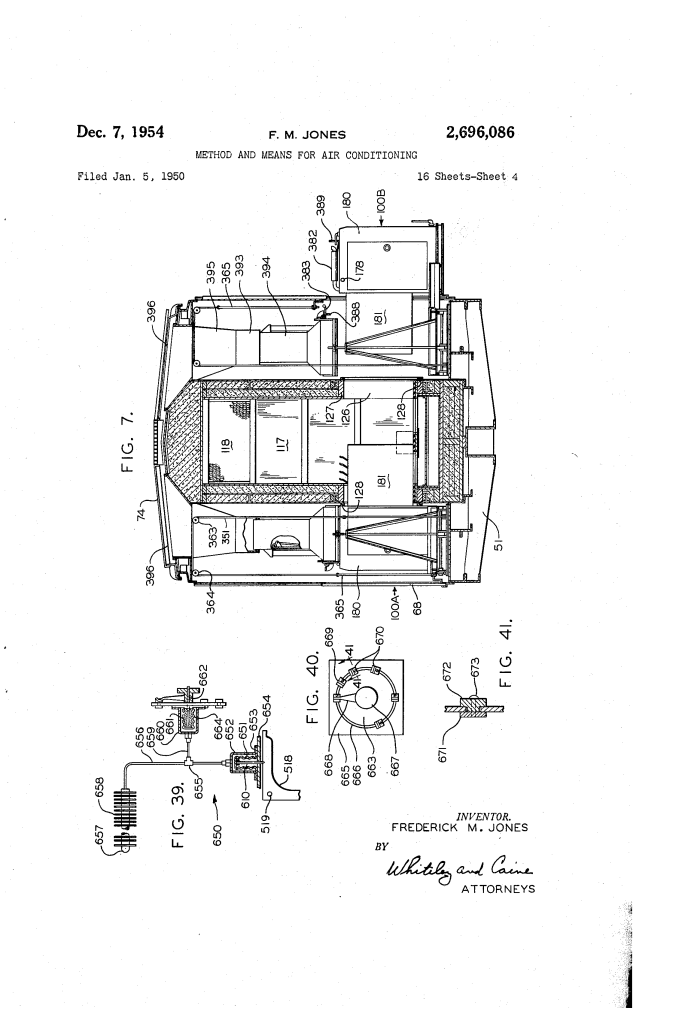
Method and Means for Air Conditioning (1954)
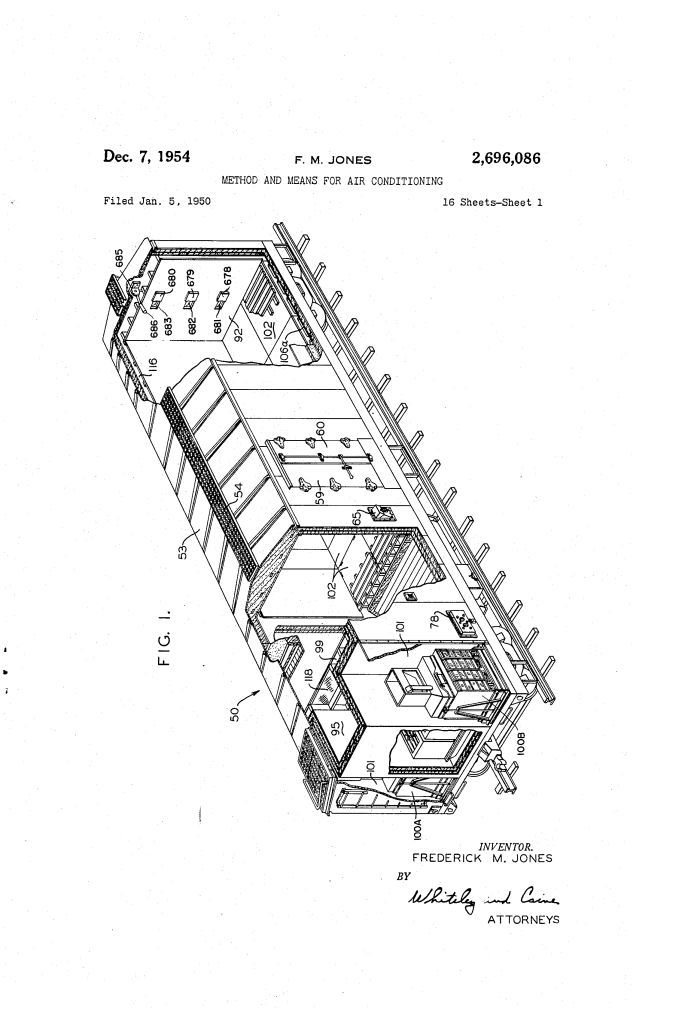
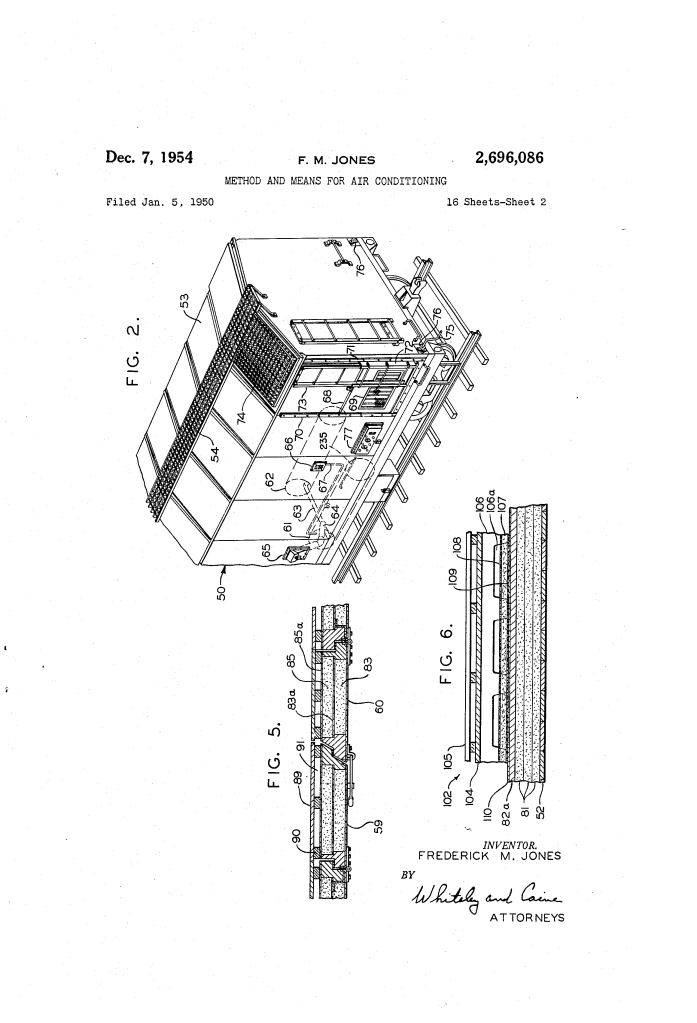
Patented on December 7, 1954 (U.S. Patent No. 2,696,086), this invention by Frederick McKinley Jones is widely considered one of the most significant advancements in the history of global logistics. While Jones had previously patented portable cooling units for trucks, this 16-sheet, 32-claim patent provided the blueprint for the modern mechanical refrigerator car (reefer) for railroads.
Before this invention, railroads relied on “ice bunkers” that had to be refilled every few hundred miles. Jones’s system replaced ice with a fully automated, self-powered mechanical unit capable of maintaining temperatures as low as -10°F or as high as 加热 (heating) for thousands of miles.
1. The “Envelope” Cooling System
Jones didn’t just put an air conditioner in a train car; he redesigned the car itself. He realized that blowing cold air directly onto produce could cause “freezer burn” or dehydration.
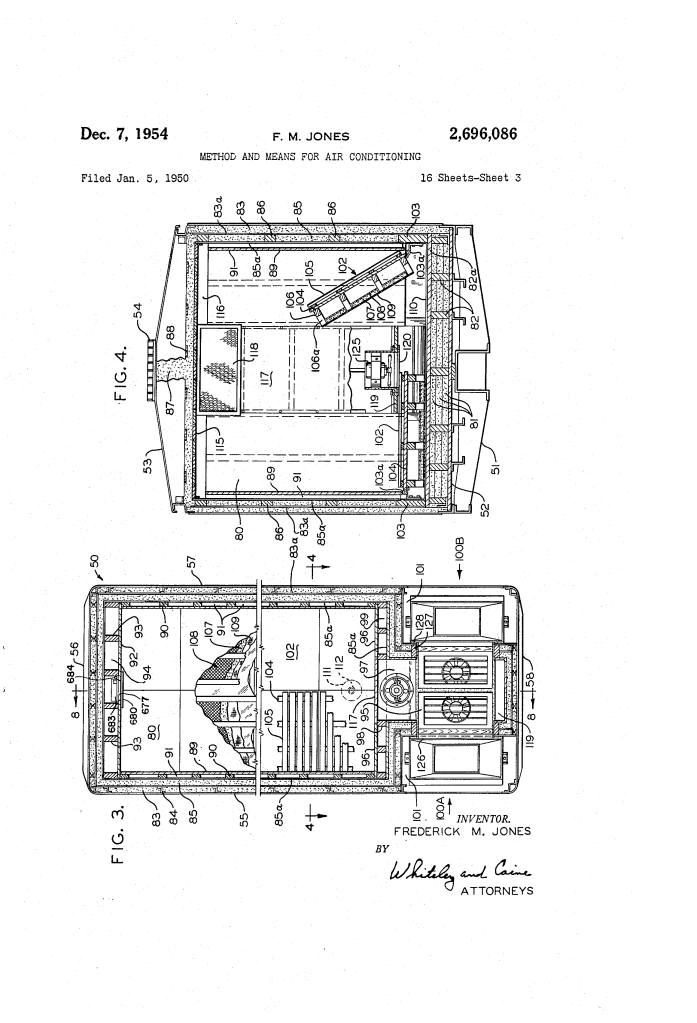
- The Air Duct (91): He created a “car-within-a-car.” The cargo is held in an inner chamber (80) separated from the insulated outer walls by air channels.
- The Protective Blanket: Conditioned air circulates through these channels, effectively “wrapping” the cargo in a blanket of cold air. This minimizes direct contact between the dry, refrigerated air and the delicate perishables.
2. The Dual-Unit “Standby” Design
Jones understood that if a cooling unit failed in the middle of a desert, the entire cargo would be lost.
- Redundancy: The patent describes two independent “package units” mounted at the end of the car.
- Automatic Backup: If the primary unit fails to maintain the pre-set temperature, the control system automatically starts the second unit.
- Control Panel (77, 78): External panels allow inspectors to check the internal temperature and the status of both engines without opening the sealed cargo doors.
3. The Reversible Cycle: Cooling and Heating
Transportation often involves moving cargo through different climates (e.g., from a warm southern state to a freezing northern one).
- The Reverse Valve: Jones included a specialized valve that reverses the flow of refrigerant.
- The Result: The unit can act as a refrigerator in the summer and a heater in the winter, ensuring that choice eating apples (which Jones noted must stay at exactly 31°F) never freeze or decompose.
4. Shock Protection and Maintenance
Railroad cars are subject to massive “shunting” forces when they slam into each other during coupling.
- Shock Mounting: The units are mounted on a specialized frame designed to absorb severe vibrations and impacts that would otherwise cause refrigerant leaks.
- The “Slide-Out” Feature: To solve the problem of complex repairs, Jones designed the units to be “package units.” By unlocking a sliding door (68), the entire engine and cooling assembly can be winched out for replacement in minutes, similar to a modern modular server.
Technical Specifications & Features
| Feature | Description |
| Prime Mover | Internal combustion engine (diesel or gasoline). |
| Humidity Control | Moisture-absorbent means to prevent cargo dehydration. |
| Defrost Cycle | Automatic dampers close to prevent hot air from entering the cargo space during defrosting. |
| Night/Day Visibility | Indicator lights allow crews to verify unit operation at a glance during the night. |
| Pre-cooling Mode | Dampers can be opened initially to blast the cargo with cold air for a quick “pull-down” of temperature. |
Impact on Society
Frederick McKinley Jones’s work for U.S. Thermo Control Co. (Thermo King) effectively ended the “Ice Age” of transportation.
- Global Food Trade: It allowed for the transcontinental shipment of frozen foods, such as orange juice concentrate and strawberries, which were previously impossible to ship by rail.
- Reduction in Spoilage: Jones noted that spoilage accounted for one-fourth of the value of products; his invention slashed this loss.
- The Cold Chain: This patent was the final piece in the “Cold Chain”—the uninterrupted temperature-controlled supply chain from farm to table.
