
Method and Composition for Autocatalytically Depositing Copper (1969)
U.S. Patent No. 3,436,233, granted on April 1, 1969, to Henry Jackson, details a groundbreaking chemical stabilizing composition and method for autocatalytic (electroless) copper plating baths. Jackson addressed a major roadblock in electronics manufacturing: the rapid degradation and short operating life of chemical plating solutions used to metallize non-conductive surfaces.
This invention solved a critical manufacturing problem in printed circuit board fabrication: conventional electroless copper baths had an operational life of only about 10 hours before chemical exhaustion occurred, requiring expensive bath dumping, disposal of reagent-grade chemicals, and constant downtime. Jackson engineered an additive mixture that extended bath longevity from hours to several weeks while simultaneously producing brighter, smoother, and more uniform copper deposits.
The Innovation: The Multi-Component Stabilizer System
Electroless copper plating relies on the chemical reduction of copper ions from an aqueous solution onto a catalyzed substrate without using external electrical current. While earlier systems worked in concept, uninhibited baths quickly suffered from spontaneous decomposition, copper dropout, and rough crystal formation.
Jackson discovered that combining an organic sulfur compound with alkali metal carbonates, thiosulfates, thiocyanates, and an anionic wetting agent produced an exceptionally stable, balanced alkaline bath. Instead of degrading within a single shift, working solutions could be continuously run for up to 26 days.
Why the Five-Component Synergistic Blend?
- Extended Solution Life: The organic sulfur compound and thiocyanates stop spontaneous bath breakdown and premature reduction of copper ions.
- Controlled Crystal Refining: Thiosulfates reduce copper grain size, eliminating dull or nodular coatings to yield a bright, lustrous surface finish.
- Deposition Rate & pH Buffer: The carbonate/bicarbonate component stabilizes the additive concentrate and accelerates overall plating velocity.
- Uniform Wetting: Anionic dispersing agents eliminate surface tension voids, ensuring full chemical penetration into narrow, high-aspect-ratio holes without foaming.
Key Chemical Components
The stabilizing composition functions through five core ingredients blended into an alkaline aqueous concentrate (pH 10.5 to 11.0):
| Component | Function |
| Active Organic Sulfur Compound (e.g., thiourea, 2,5-dimercapto-1,3,4-thiadiazole, 8-mercaptopurine, thiomalic acid) | The primary stabilizer; prevents spontaneous solution breakdown, increases operating bath life up to three weeks, and levels the copper layer. |
| Alkali Metal Thiosulfate (e.g., sodium thiosulfate pentahydrate, potassium thiosulfate) | Increases bath efficiency and enhances luster by refining the crystal structure and reducing copper particle size. |
| Alkali Metal Thiocyanate (e.g., sodium thiocyanate, potassium thiocyanate) | Enhances bath stability and overall plating efficiency under high throughput. |
| Alkali Metal Carbonate or Bicarbonate (e.g., sodium carbonate, potassium bicarbonate) | Buffers and stabilizes the additive formulation while promoting optimal deposition speed. |
| Wetting and Dispersing Agent (e.g., Tamol SN, Tamol 731, Daxad) | Anionic surfactant compatible with alkaline media; ensures uniform surface contact and leveling without generating foam. |
Performance: Bath Longevity and Throughput
Jackson’s patent provides concrete comparative data illustrating the dramatic operational gain over standard industrial baths:
- Unstabilized Control Bath: Completely depleted and exhausted after just 6 hours of continuous operation.
- Jackson Stabilized Bath (Example 34): Operated continuously for 7 days with bright, level, and adherent copper deposition.
- Extended Industrial Run (Example 35): Operated for 26 days (over 64.5 active plating hours), successfully coating more than 3,000 square feet of non-conductive substrate with zero bath breakdown.
The Through-Hole Plating Sequence
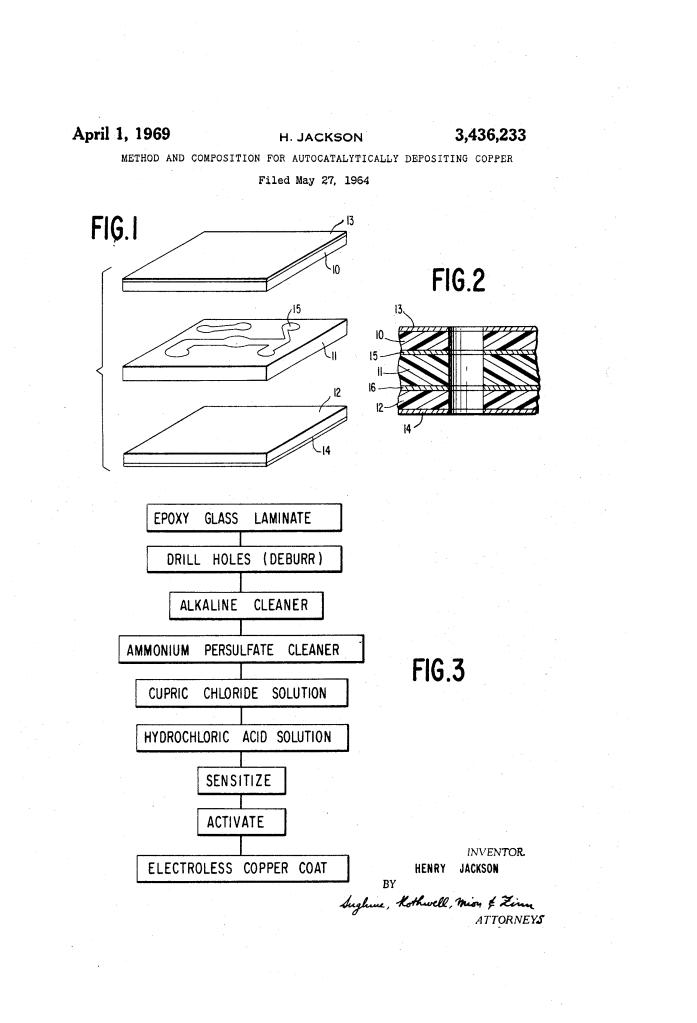
To manufacture multi-planar printed circuit boards with reliable through-hole electrical connections between internal circuit layers (FIG. 1 and FIG. 2), Jackson established a precise, multi-stage wet chemical sequence (FIG. 3):
- Drill and Deburr: Form through-holes across the stacked epoxy-glass laminates (10, 11, 12) exposing internal circuit traces (15, 16).
- Alkaline Clean: Immerse in alkaline cleaner (Pennsalt K-2) for 2 minutes to degrease; rinse with water.
- Persulfate Micro-Etch: Dip in ammonium persulfate solution (approx. 2 lbs/gal) for 30 seconds to clean and micro-roughen copper surfaces; rinse.
- Cupric Chloride & Acid Dip: Immerse in acidic cupric chloride for 30 seconds, rinse, followed by a 1-minute 25% hydrochloric acid dip to remove oxides; rinse.
- Sensitize: Immerse for 5 to 7 minutes in an aqueous stannous chloride (SnCl2) and hydrochloric acid bath at 70–80°F to deposit tin ions onto the non-conductive hole walls; rinse.
- Activate (Seed): Dip for 2 to 4 minutes in an acidic palladium chloride (PdCl2) bath to deposit a catalytic monolayer of metallic palladium seed particles.
- Electroless Copper Deposition: Immerse for approximately 20 minutes in the stabilized electroless copper bath (working pH 11.6 to 12.0 at 66–70°F) to autocatalytically build a smooth, bright, and uniform conductive copper underlayer.
- Electrolytic Reinforcement: Electroplate a heavy copper layer over the autocatalytic deposit, followed by final etching and optional tin-lead solder coating.
Historical and Industrial Impact
Henry Jackson’s patent arrived at a defining moment in the modern electronics revolution:
- Commercial Viability of Multi-Layer PCBs: Multi-planar circuit boards required reliable conductive pathways through microscopic drilled holes. Prior methods were cost-prohibitive due to constant bath failure. Jackson’s chemistry made continuous production lines commercially and economically feasible.
- Chemical Waste Reduction: By eliminating the mandatory 10-hour bath dump cycle, manufacturers saved massive quantities of reagent-grade copper salts, formaldehyde, Rochelle salts, and chelating agents.
- Foundation for Modern Electronics Packaging: The ability to plate dense, reliable through-holes without blisters or nodular bridging enabled the miniaturization of circuit boards that underpinned aerospace hardware, industrial computers, and telecommunications equipment.
About the Inventor: Henry Jackson
Henry Jackson was an industrial research chemist whose work directly tackled foundational challenges in metal finishing and printed circuit engineering. Working during the rapid expansion of Cold War aerospace and computer technologies, Jackson’s formulations helped bridge the gap between delicate laboratory demonstrations and high-volume, reliable industrial electronics production.
Summary of Claims
The patent explicitly claims:
- A stabilizing composition for electroless copper plating solutions comprising an alkali metal carbonate or bicarbonate, an alkali metal thiosulfate, an alkali metal thiocyanate, a sulfur-containing compound (thiourea, water-soluble mercaptans, or base-soluble mercaptans), and a wetting agent.
- Specific organic sulfur compounds including 2,5-dimercapto-1,3,4-thiadiazole, thiourea, and synergistic mixtures of 8-mercaptopurine and thiomalic acid.
- An aqueous electroless plating bath containing cupric sulfate, formaldehyde, nickel chloride, a copper complexing agent, sodium hydroxide, and a minor but effective amount of the stabilizing composition.
- Formulations where bath operating life is sustained across multiple weeks with improved crystal leveling and brightness in the autocatalytically deposited film.
