
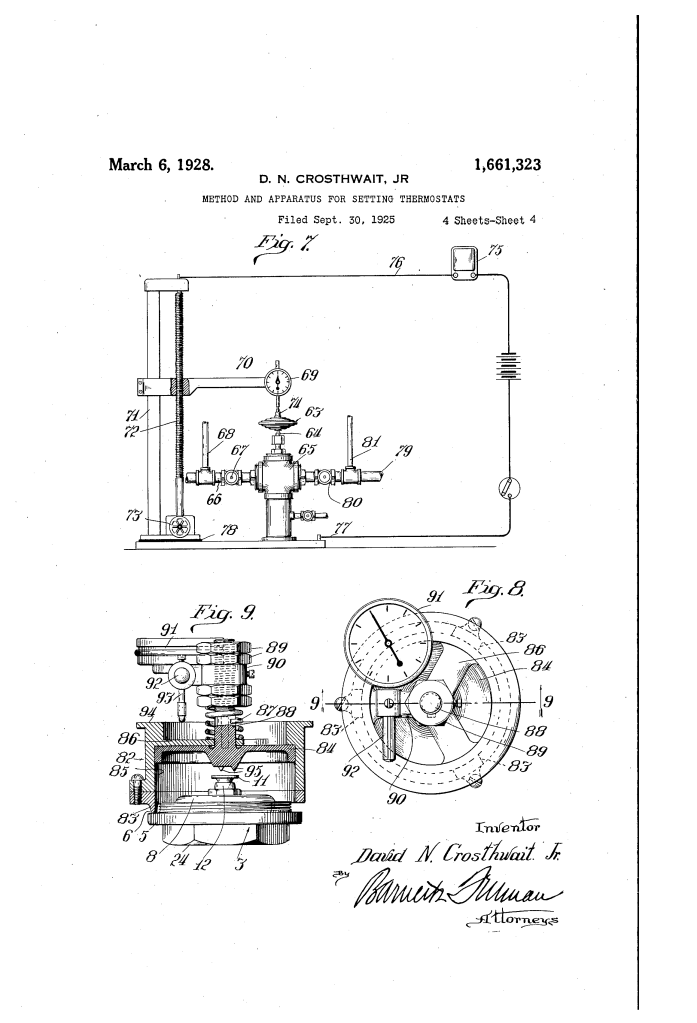
🌡️ Method and Apparatus for Setting Thermostats (David N. Crosthwait, Jr., No. 1,661,323)
The patent by David N. Crosthwait, Jr. of Marshalltown, Iowa, describes a specialized Method and Apparatus for Setting Thermostats (Patent No. 1,661,323, 1928). This invention is a high-precision industrial testing system designed to calibrate thermostatic steam traps. Crosthwait’s primary objective was to ensure that every thermostat—despite minor manufacturing variations in its metal diaphragm—would expand at exactly the right moment to close a valve and prevent steam waste. His innovation involves simulating actual working conditions (pressure and temperature) within a test chamber to measure a thermostat’s unique expansion profile before it is permanently installed.
Inventor Background: David N. Crosthwait, Jr.
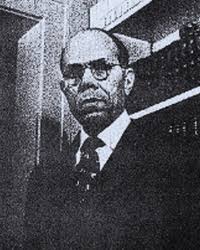
David Nelson Crosthwait, Jr. (1898–1976) was a brilliant African American mechanical engineer and a giant in the field of HVAC (Heating, Ventilation, and Air Conditioning). Holding nearly 40 U.S. patents, Crosthwait was an expert in heat transfer and steam systems, notably designing the heating system for Radio City Music Hall. At the time of this 1928 patent, he was a research engineer for the C. A. Dunham Company. His work was foundational in making large-scale central heating systems efficient, reliable, and “smart” long before the digital age.
Key Mechanical & Testing Systems
Crosthwait’s apparatus is essentially a “proving ground” for the volatile internal components of a steam trap.
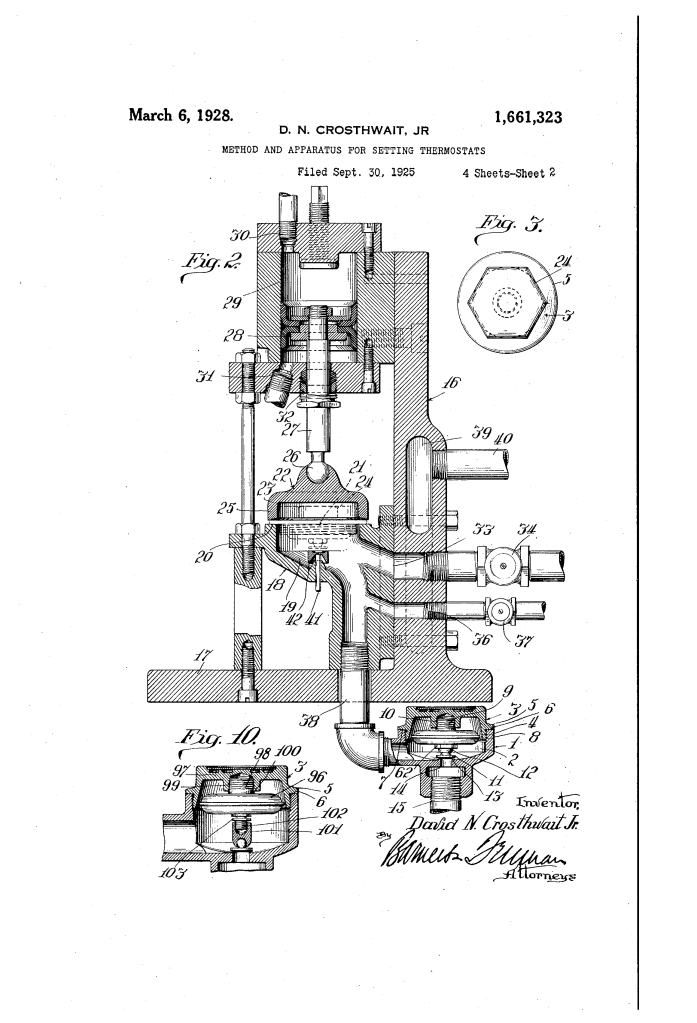
1. The Simulated Operating Chamber (18, 19)
- The Housing: A casing (18) encloses a steam space (19).
- The Seat (20): An assembled trap top (3) and thermostat (8) are clamped onto this seat using a fluid-pressure cylinder (29).
- Function: This mimics the environment inside a radiator or steam line. By admitting steam into the chamber, the technician can see exactly how a specific thermostat will behave when it’s “on the job.”
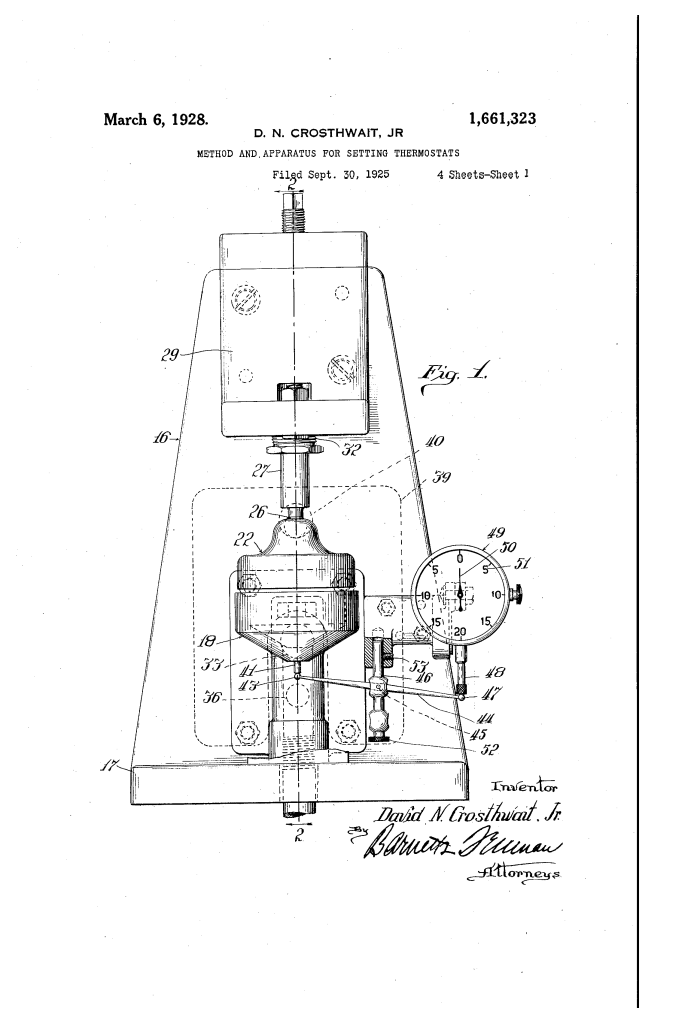
2. The Indicator and Lever Linkage (41, 44, 49)
- The Plunger (41): As the thermostat expands, it pushes down on a central plunger (41).
- The Lever (44): This plunger rests on a lever that transmits the motion to an indicator (49).
- Dial (51): The indicator features a pointer (50) and a graduated dial.
- Action: This system translates the microscopic expansion of the metal disk into a visible reading on a dial, measuring variations in thousandths of an inch.
3. The Steam Jacket (39) (Key Innovation)
- Thermal Hysteresis: Metal parts often behave differently depending on whether they are heating up or cooling down.
- The Solution: Crosthwait added a steam jacket (39) around the testing standard to keep the entire machine at a constant, elevated temperature.
- Function: This eliminates “thermal hysteresis,” ensuring that the measurements are accurate and consistent regardless of how many tests are performed in a row.
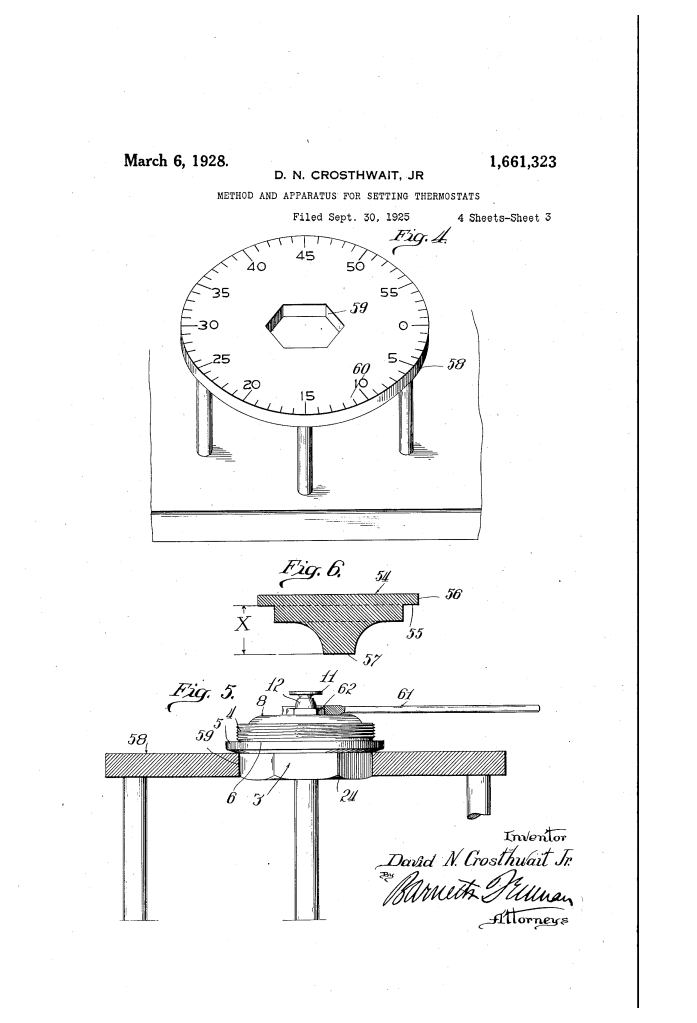
4. The Adjusting Plate and Wrench (58, 61)
- Calibration: Once the error is measured on the dial, the assembly is moved to an adjusting plate (58).
- The Wrench (61): A specialized wrench turns the thermostat nut (62).
- Action: The technician screws the thermostat in or out of its mounting to compensate for the measured error, perfectly “setting” the valve distance.
Improvements Over Standard Thermostat Assembly
| Feature | Standard “Static” Assembly | Crosthwait’s Testing Method |
| Accuracy | Relied on a “one size fits all” factory setting. | Individual calibration based on actual expansion. |
| Reliability | Traps often leaked steam or failed to drain water. | Ensures perfect seating of the valve every time. |
| Efficiency | Significant energy loss due to imprecise traps. | Maximizes steam retention, lowering heating costs. |
| Speed | Slow, trial-and-error installation. | Rapid and easy testing for mass production. |
Significance to HVAC and Building Engineering
David N. Crosthwait, Jr.’s testing method influenced the development of precision thermal controls and automated building management.
- Standardization of Performance: By creating a way to make imperfectly manufactured parts act “perfectly” through calibration, Crosthwait pioneered a standard of quality control that is now universal in the manufacturing of sensors and valves.
- Energy Conservation: His work on steam traps was a critical early contribution to green building technology, focusing on minimizing the fuel required to heat large urban structures.
- HVAC Systems Design: The principles of “simulated conditions” in this patent are still used today in the commissioning of HVAC systems, where equipment is tested under load before a building is occupied.
- Scientific Excellence: Crosthwait was a fellow of the American Society of Heating, Refrigerating and Air-Conditioning Engineers (ASHRAE), and this patent is a prime example of the mathematical and physical rigor he brought to the industry.
