
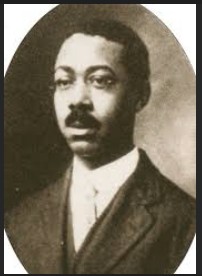
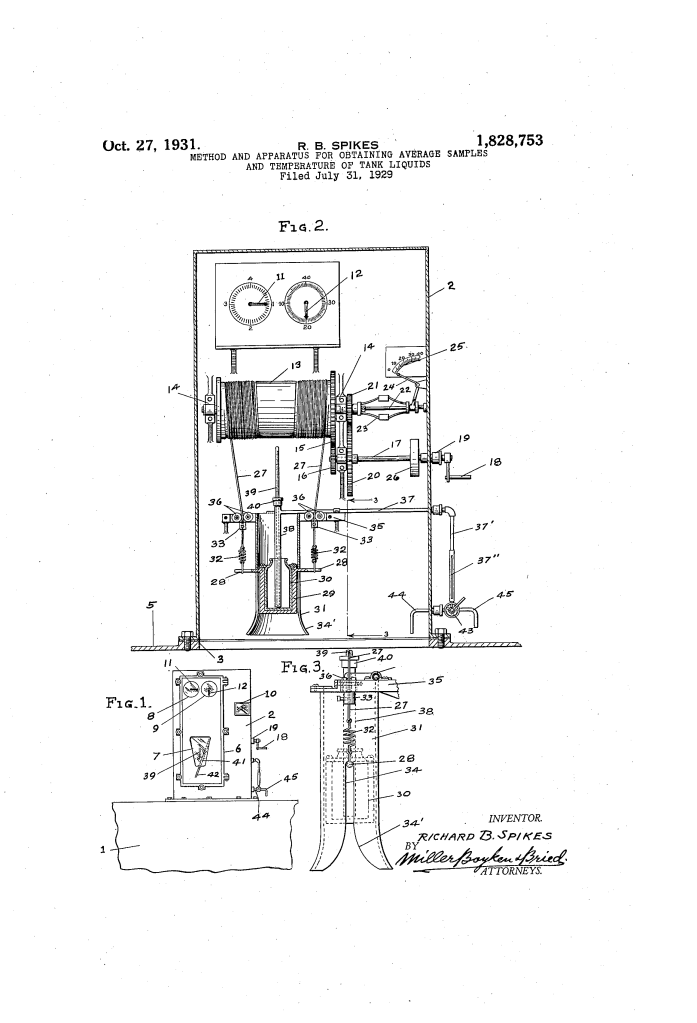
Method and Apparatus for Obtaining Average Samples and Temperature of Tank Liquids, Richard B. Spikes, Patent No. 1,828,753
The patent by Richard B. Spikes of San Francisco, California describes a Method and Apparatus for Obtaining Average Samples and Temperature of Tank Liquids (Patent No. 1,828,753). This invention is a sophisticated pneumatic and mechanical sampling system integrated directly into the headspace of industrial storage tanks, designed to extract a vertically integrated “average” sample of volatile liquids (like petroleum) and record their temperature without exposing the operator or the environment to hazardous fumes.
The “Why”
In the early 20th-century oil industry, measuring the quality and temperature of crude oil in 40-foot tall tanks was a dangerous and imprecise task. Liquid at the bottom of a tank is often cooler and denser than at the top. To get an accurate reading, workers often had to open “thief” hatches, exposing themselves to explosive gases and the atmosphere to volatile organic compounds (VOCs). Spikes sought to eliminate the “guesswork” of manual dipping and the physical danger of tank-top explosions by creating a closed-loop, speed-regulated system.
Inventor Section: Richard B. Spikes
Richard Spikes was a prolific Black inventor whose engineering philosophy centered on safety through automation. Living and working during the Jim Crow era, Spikes faced immense systemic barriers, yet he became a vital figure in automotive and industrial history (also credited with early versions of the directional signal and improved gear shifts). His approach to the sampling apparatus showcases a “systems thinking” mindset—he didn’t just build a bucket; he built a calibrated, hermetically sealed laboratory interface.+1
Key Systems Section
1. The Variable-Speed Hoist & Centrifugal Governor
To obtain an “average” sample, the bottle must travel through the liquid column at a constant rate so it fills evenly from bottom to top.
- Modern Engineering Term: Closed-loop velocity control. * Spikes utilized a centrifugal governor (23) linked to a weighted balance wheel (26). This acted as a mechanical speedometer, allowing the operator to maintain a precise “feet-per-second” descent based on the current oil depth.
“
2. Hermetic Housing & Observation Ports
The entire mechanism is encased in a gas-tight sheet metal housing (2).
- Modern Engineering Term: Intrinsically safe enclosure. * It features reinforced glass portholes (7, 8, 9) and an internal windshield wiper (41). This allowed technicians to read gauges and thermometers while maintaining the pressure seal, preventing the escape of “volatile constituents.”
3. Automatic Thermal Coupling
A unique “docking” system for the sampling receptacle.
- Modern Engineering Term: Automated probe immersion.
- When the bottle holder (29) is raised via the right-and-left scored drum (13), it is guided by a funnel-like chute (31). As it seats, a stationary thermometer (39) and suction pipe (38) are automatically submerged into the fresh sample.
4. Pneumatic Discharge System
- Modern Engineering Term: Differential pressure siphoning.
- Using a three-way valve (43), the system leverages the tank’s internal gas pressure to force the sample out of the bottle and through a sight tube (3) for external collection, or siphons it back into the tank.
Comparison: Manual Dipping vs. The Spikes Method
| Feature | Standard Methods (Circa 1920s) | The Spikes Innovation |
| Safety | High risk of gas inhalation/explosion. | Sealed environment; zero atmospheric exposure. |
| Accuracy | “Spot” samples (only one depth). | Integrated average via speed-regulated descent. |
| Visibility | Obscured by vapors/weather. | Internal wipers and portholes for clear reading. |
| Labor | Heavy physical hauling and manual pouring. | Geared-down hand crank with automatic docking. |
Significance
- Precursor to Modern SCADA Sampling: The use of a centralized “reading station” for multiple data points (depth, temp, density) mirrors modern automated tank gauging.
- Vapor Recovery Systems: His focus on “sealed relation to outer atmosphere” is a direct ancestor to modern environmental Vapor Recovery Units (VRUs).
- Safety Engineering: Set an early standard for “intrinsically safe” industrial operations, reducing flash fires in the petroleum sector.
