
Thermostatic Control for Gas Engines, Frederick M. Jones (1949)
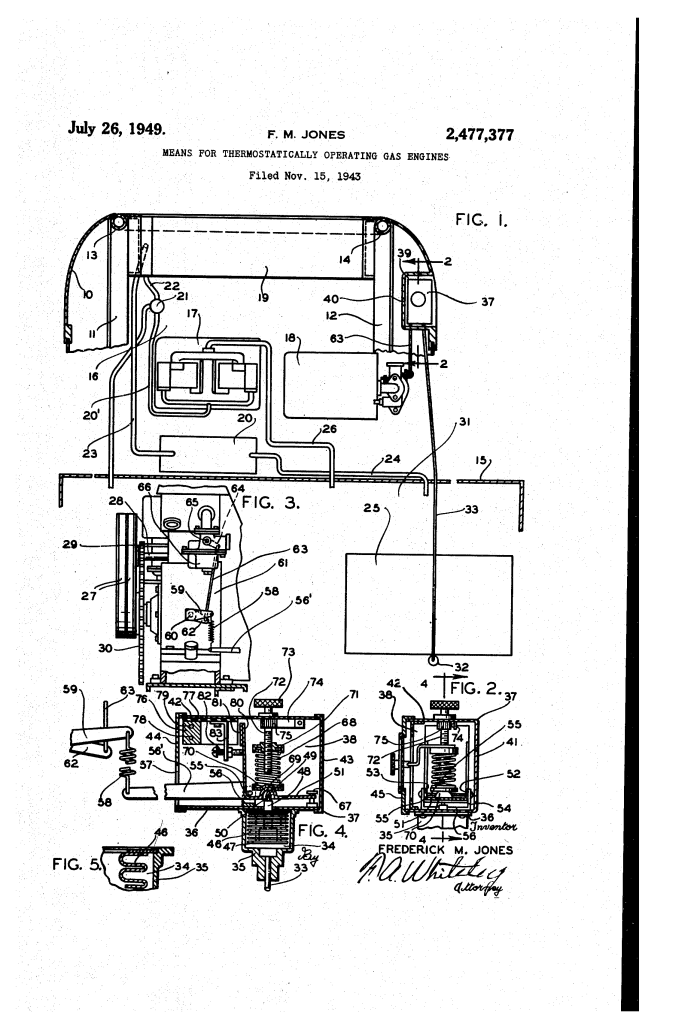
Patented in July 1949, this invention (U.S. Patent No. 2,477,377) solved a critical reliability problem in early mobile refrigeration.
In the 1940s, automated cooling systems typically worked by turning a gas engine completely off when the compartment reached the desired temperature and restarting it when it got warm. However, gas engines were notoriously difficult to start—especially in extreme weather. If the engine failed to restart, the entire cargo would spoil.
Jones’s breakthrough was the “Constant-Run” throttle control. Instead of stopping the engine, his system used a specialized thermostat to shift the engine between high speed (active cooling) and low speed/idling (resting). This kept the engine warm, lubricated, and ready to respond instantly.
The “Why”
Frederick M. Jones understood that a running engine is a reliable engine.
- The Problem: Frequent starting and stopping causes massive mechanical wear and “no-start” failures. Furthermore, simple on/off cycles created “temperature swings” that could damage sensitive produce.
- The Solution: A system that keeps the engine idling at all times. The thermostat simply “tells” the carburetor to speed up when the cargo gets too warm, providing a much smoother temperature curve.
Inventor Section: Engineering Philosophy
Jones’s philosophy was Fluid-Mechanical Automation. He preferred rugged physical mechanisms over the delicate electrical sensors of the era, which often failed due to truck vibrations. He used the physical expansion of gas to drive a “snap-action” mechanism, ensuring the engine shifted decisively between speeds without stalling.
Key Systems Section
1. The Gas-Filled Thermostat
The “brain” of the system is a closed loop of temperature-sensitive gas.
- The Bulb (32): A metal bulb filled with gas is placed inside the cargo compartment.
- The Bellows (46): As the cargo warms, the gas expands, traveling through a tiny tube to an “accordion” bellows.
- The Action: The expanding gas collapses the bellows’ exterior, pushing a plunger (48) to trigger the engine’s throttle.
2. The Lever & Linkage System
Jones used a series of mechanical levers to translate the tiny movement of the bellows into a powerful shift of the engine throttle.
- Rocking Lever (51): This acts as the primary pivot point moved by the plunger.
- Throttle Linkage (63, 64): These rods connect the thermostat directly to the carburetor (66).
- Spring Link (58): This adds “give” to the system, protecting the carburetor from being jerked too hard by the mechanical force of the bellows.
3. The Magnetic “Snap-Action”
To prevent the engine from “hunting” (wavering indecisively between speeds), Jones added a clever magnetic lock.
- The Magnet (76): An electromagnet holds the throttle lever firmly in the “High Speed” position.
- The Snap: The lever won’t move until the bellows generates just enough force to overcome the magnet’s pull (or vice versa).
- The Benefit: This creates an instantaneous shift. The engine stays at full power until the cargo is perfectly chilled, then “snaps” down to an idle immediately, preventing fuel waste.
How the Cycle Works
| Condition | Cargo Temperature | Gas in Bulb | Engine State |
| Warm | Above set point | Expands | High Speed: Compressor runs at max capacity to cool the truck. |
| Cooling | Dropping | Contracts slightly | Maintained: Magnetic lock holds engine at high speed despite slight pressure drop. |
| Cold | Reaches set point | Contracts fully | Snap-to-Idle: Bellows force drops enough for spring to overcome magnet; engine idles. |
Technical Components
| Part Number | Component | Function |
| 32 | Thermostatic Bulb | Senses the air temperature in the cargo space. |
| 46 | Bellows | Converts gas pressure into mechanical movement. |
| 66 | Carburetor | Controls the fuel/air mix to set engine speed. |
| 76 | Electromagnet | Provides the “Snap-Action” for decisive speed changes. |
| 81 | Armature | The metal piece the magnet “grabs” to hold the speed. |
Significance
This 1949 patent changed the “Cold Chain” forever:
- Precision Cooling: Habitable spaces and transport vehicles could maintain a constant temperature without the shocks of engine restarts.
- Reliability: This system is why Thermo King units earned a reputation for running thousands of hours without intervention.
- Fuel Efficiency: Idling avoided the “rich” fuel mixture needed for cold starts, saving significant operational costs over long hauls.
