
Aerial Mail Transfer System, Henry F. Stilwell, Patent No. 1,911,248
The patent by Henry F. Stilwell of San Antonio, Texas, describes a Means for Receiving Mail and Other Matter on Aeroplanes while in Motion (Patent No. 1,911,248). This invention is a dynamic mid-air recovery system consisting of a ground-based funneling station and a specialized aircraft-mounted winch. It allows a pilot to “snag” mail pouches from the ground without landing, utilizing a weighted cable and a self-locking mechanical trap.
The “Why”
During the “Golden Age of Flight” in the late 1920s and early 30s, the primary bottleneck in airmail speed was the time lost during takeoff and landing. Small towns often lacked full runways but required mail service. Stilwell aimed to eliminate these delays by solving the precision problem of mid-air retrieval. He recognized that a pilot could not hit a small target at high speeds, so he designed a ground station that acted as a “funnel” to guide a trailing cable into a mechanical “trap” that would lock onto the load automatically.
Inventor Section: Henry F. Stilwell
Henry F. Stilwell was an inventor operating out of San Antonio, a major hub for military and civil aviation in the 1930s. His engineering philosophy was rooted in fail-safe automation. In an era of high-risk flight, Stilwell focused on reducing the pilot’s cognitive load; his system used the physical “jerk” of the mail bag being caught to automatically trigger the winch. This clever use of kinetic feedback meant the pilot didn’t have to push a button at the exact millisecond of contact—the physics of the impact did the work.
Key Systems Section
1. The Ground-Based Converging Guideway
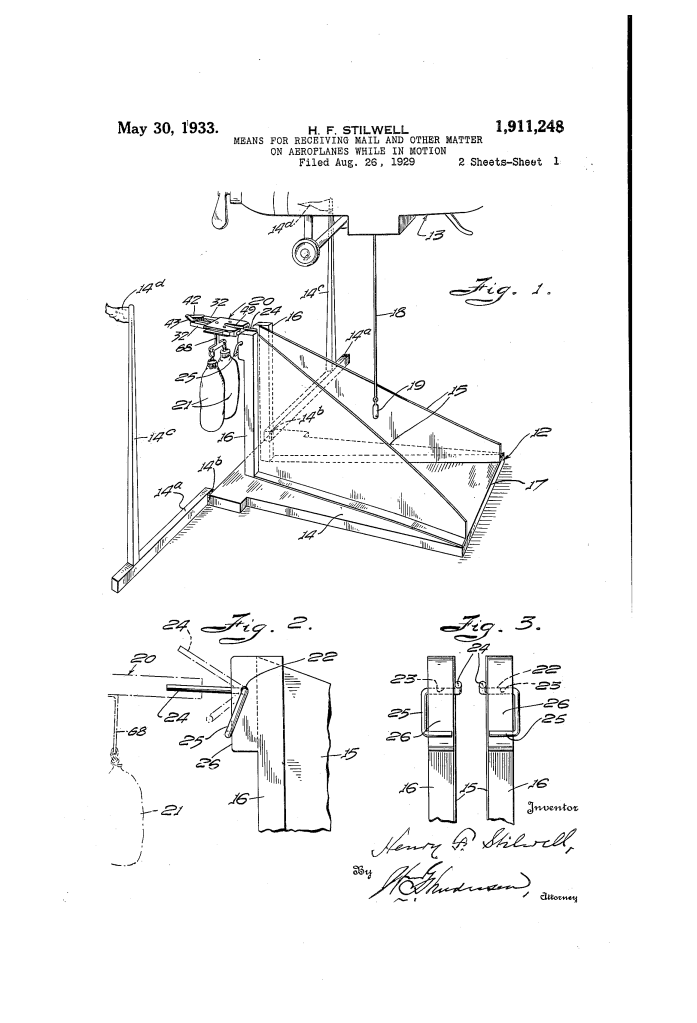
The system starts with a base (14) featuring converging vertical walls (15).
- Modern Translation: A mechanical “funnel” or alignment duct.
- The walls are wide at the entry and narrow at the “exit” where the mail trap sits. This compensates for pilot steering errors, guiding the aircraft’s trailing weight (19) into the center of the trap.
2. The Self-Locking Cable Trap (Capture Mechanism)
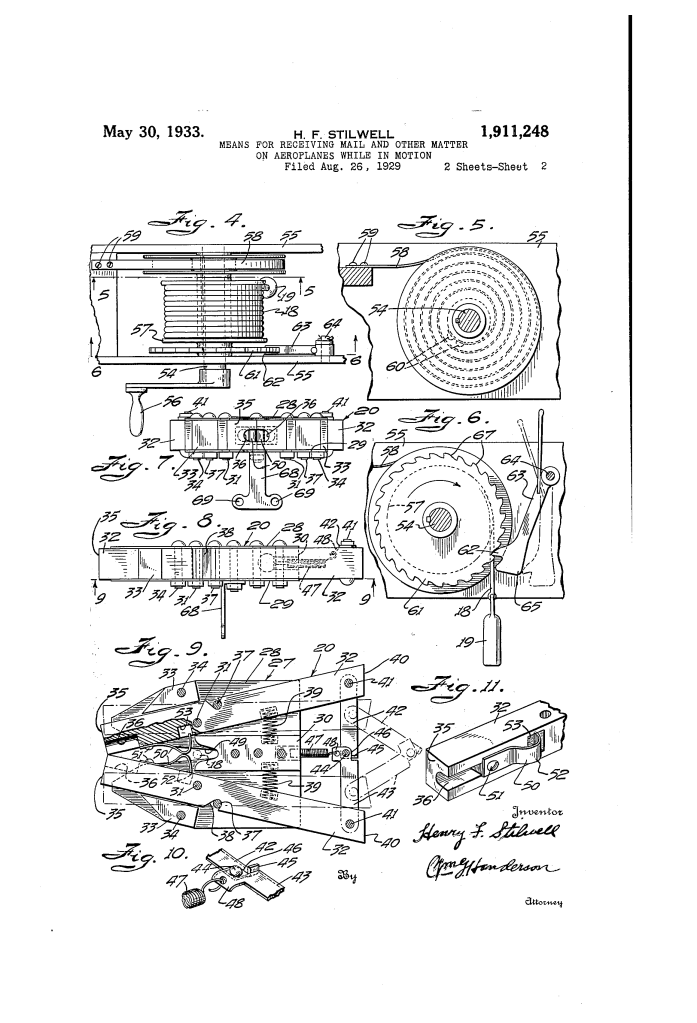
The trap (20) uses a pair of spring-loaded jaws (32) that stay open while resting on the ground station’s arms (24).
- Modern Translation: A spring-return toggle clamp.
- As the aircraft’s cable enters the trap, the weighted end (19) strikes the bottom. This force pulls the trap off its supports, causing the toggle links (42, 43) to snap shut and lock. This ensures the mail bag cannot slip off the cable during the high-speed ascent.
3. The Automatic “Jerk-Triggered” Winch
Inside the cockpit, Stilwell designed a winding drum (57) equipped with a unique ratchet wheel (61).
- Modern Translation: A kinetic-energy recovery winch with a centrifugal or impact release.
- The winch is pre-tensioned with a heavy coil spring. When the weight hits the trap on the ground, the resulting “jerk” on the line knocks the locking pawl (63) out of the ratchet. The spring then instantly rewinds the cable, “reeling in” the mail like a fishing line.
Comparison Table
| Feature | Standard Mail Pickup (Pre-1930s) | Stilwell’s Innovation |
| Ground Accuracy | Required precise “hooking” by pilot. | Guideway funnel compensates for 10-20ft of error. |
| Locking Safety | Friction-based hooks (prone to dropping). | Toggle-link jaws that lock tighter under load. |
| Winch Operation | Manual hand-cranking by the pilot. | Automatic spring-loaded “snap” retrieval. |
| Pilot Visibility | Guesswork based on ground features. | Integrated foldable flag markers for alignment. |
Significance Section
- Precursor to “Skyhook”: This system is a direct mechanical ancestor to the Fulton Surface-to-Air Recovery System used by the CIA and Special Forces in the Cold War.
- Haptic Feedback Design: Stilwell’s use of the mechanical shock of impact to trigger a secondary action is a classic example of event-driven automation.
- Regional Logistics: It enabled “Non-Stop Airmail,” which revolutionized delivery speeds for rural communities before the advent of the modern hub-and-spoke helicopter systems.
