
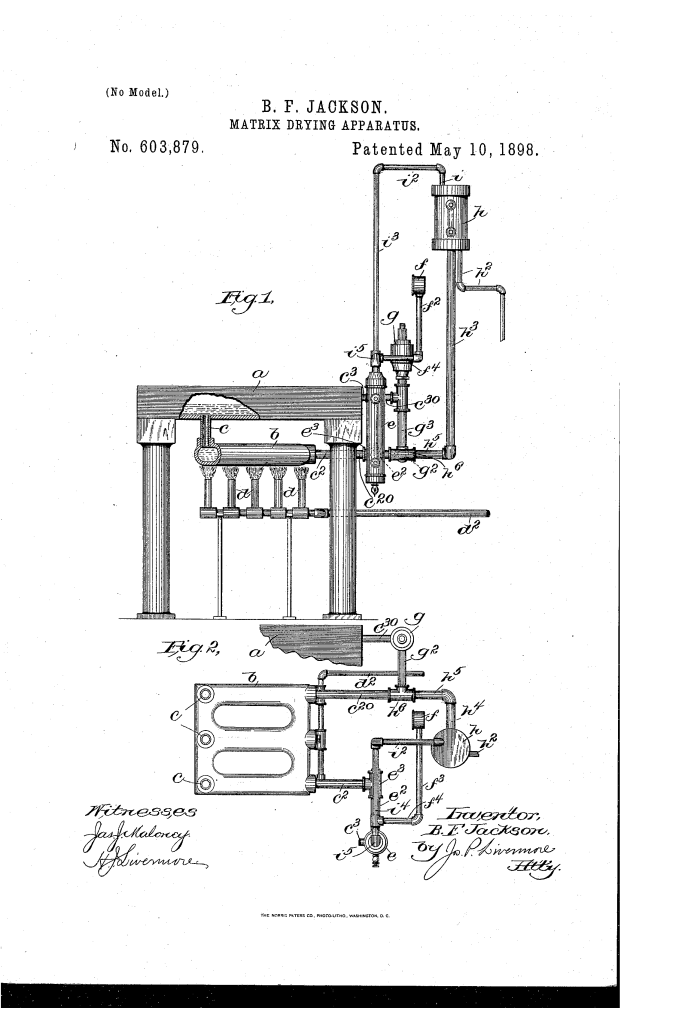
Matrix-Drying Apparatus (1898)
U.S. Patent No. 603,879, granted on May 10, 1898, to Benjamin F. Jackson (assignor of three-fourths to Ada M. Child), describes a self-contained, steam-heated drying table designed for newspaper and commercial printing operations. Jackson, an inventor based in Cambridge, Massachusetts, engineered a system to rapidly cure wet paper-pulp matrices before they were cast into metal stereotype plates for printing presses.
This invention solved a critical production bottleneck in the high-speed printing industry: traditional drying tables took too long to heat, heated unevenly, and risked scorching the fragile papier-mache matrices under direct flame. Jackson delivered a compact, self-contained unit that achieved intense, uniform, non-scorching heat while accelerating the drying cycle by several minutes per page.
The Innovation: Low-Capacity Steam Generation & Pressure Equalization
In stereotyping, a wet papier-mache matrix (flong) was pressed over a form of handset movable type to capture the impression, then dried rigid so molten metal could be cast into a curved printing plate. Drying this matrix quickly without burning it required steam heat, but boiling an entire steam table from cold water was terribly slow.
Jackson separated the water-heating reservoir from the drying surface:
- Low-Capacity Generator (b)Instead of heating the large drying table directly, Jackson mounted a compact generator below it, consisting of a single casting with three longitudinal channels joined across the ends. Because the generator had a substantially smaller volume than the table chamber (a), gas burners focused intense heat on a small body of water, converting it rapidly into steam that rose directly into the table.
- Gravity-Feed Pressure EqualizationFilling a pressurized boiler usually required complex pumps or shutting the system down. Jackson integrated an overhead supply tank (h) connected to ordinary city water mains and linked to the steam table via an equalizing pipe system (i, i1). By equalizing the steam pressure between the tank and table, water flowed into the generator purely by gravity during operation without dropping boiler pressure.
Why This Design?
Speed: Concentrating burner heat on a small generator saved 4 to 5 minutes per drying cycle—an immense operational gain in fast-paced newspaper offices racing against printing deadlines.
Uniform Heat: Steam rising into the flat-topped rectangular chamber heated the entire working surface evenly from end to end.
Scorch Prevention: The matrix never contacted metal heated directly by open flame; the buffered steam provided an upper thermal limit that prevented burning the pulp.
Self-Contained Utility: It eliminated reliance on bulky external steam boilers, allowing any print shop with a gas line and city water connection to run a dedicated stereotyping station.
Key Apparatus Components
| Component | Identifier | Function |
| Drying Table Chamber | a | Steam-tight rectangular chamber with a flat top that receives and dries wet matrices. |
| Steam Generator | b | Low-capacity single casting with three connected channels mounted directly below the table. |
| Steam & Water Ducts | c, c1, c2 | Connecting pipes entering the bottom and sides of the table to circulate steam and water. |
| Burner Assembly | d, d1 | Gas burners arranged in longitudinal lines beneath the generator channels, fed by gas pipe d1. |
| Water Gauge | e, e1, e2 | Visual sight glass indicating internal water levels in the system. |
| Pressure Gauge | f, f1, f2, f3 | Dial instrument displaying working steam pressure inside the drying chamber. |
| Safety Valve | g, g1, g2 | Pressure-relief mechanism guarding against over-pressurization. |
| Supply Tank | h, h1, h2, h3, h4 | Water-feed reservoir connected to municipal supply that uses gravity to charge the generator. |
| Pressure-Equalizing Duct | i, i1 | Steam pipe linking the table head-space to the supply tank to balance internal pressures. |
How the Apparatus Functions
- ChargingCity water enters supply tank h via feed pipe h1. Equalizing line i balances steam pressure between chamber a and tank h, allowing water to drop via gravity through pipe h2 directly into generator b and table a until verified on water gauge e.
- Concentrated FiringIlluminating gas feeds through pipe d1 into burner series d aligned underneath the casting channels of generator b. Heat concentrates on the small water volume within the generator channels.
- Rapid Evaporation & DistributionThe water boils rapidly; steam rises through upright pipe c into the hollow table chamber a, sweeping across the internal ceiling and evenly heating the flat drying plate above.
- Matrix DryingThe wet pulp matrix is laid on the flat surface of chamber a. The steady steam temperature dries the paper form thoroughly without scorching, shaving 4 to 5 minutes off standard stereotype preparation.
About the Inventor: Benjamin F. Jackson
Benjamin F. Jackson was an inventor active in the late 19th and early 20th centuries in Cambridge and Boston, Massachusetts. Operating during the peak of the Second Industrial Revolution, Jackson focused his mechanical innovations on thermal efficiency, steam systems, and heating apparatuses. His matrix-drying table represented a key incremental step in mechanizing and accelerating American newspaper production during an era defined by mass circulation and rapid daily editions.
Summary of Claims
The patent explicitly claims:
- A matrix-drying apparatus comprising a steam-tight table, a steam generator of substantially less capacity mounted beneath the table and connected by ducts, burners focused against the generator walls, an elevated closed water supply reservoir, and pressure-equalizing means allowing gravity feeding to form a complete, self-contained system.
- The combination of drying table a, single-casting generator b with connecting bottom pipes c, supply reservoir h with top equalizing and bottom feed passages, and an integrated water gauge, pressure gauge, and safety valve system.
