
Sublimation Timing Switch (1966)
U.S. Patent No. 3,286,064, granted on November 15, 1966, to Louis Wilson, Wilson E. Hull, Jacob D. Steinberg, and Robert E. Fischell, describes an ultra-reliable mechanical timing switch engineered for the extreme environment of outer space. Assigned to the United States of America as represented by the Secretary of the Navy, this invention solved a mission-critical dilemma during the dawn of satellite and missile development: how to sequentially fire pyrotechnic squibs, deploy payloads, and activate sensitive electronic experiments in orbit without relying on complex, failure-prone motor timers or battery-draining clockwork circuits.
The inventors, based in Maryland and Washington, D.C., turned to a basic principle of physical chemistry: solid-state sublimation in a hard vacuum. By using a solid chemical cylinder that gradually vaporizes into space, they created an exceptionally simple, fault-tolerant countdown timer and sequential multi-pole switch.
The Core Design: The “Spring-Loaded Sublimation” Plunger
In the zero-pressure environment of space, certain solid volatile compounds transition directly from a solid to a vapor without melting into a liquid. Wilson, Hull, Steinberg, and Fischell harnessed this natural physical loss mechanism to meter the movement of a spring-driven electrical contact assembly.
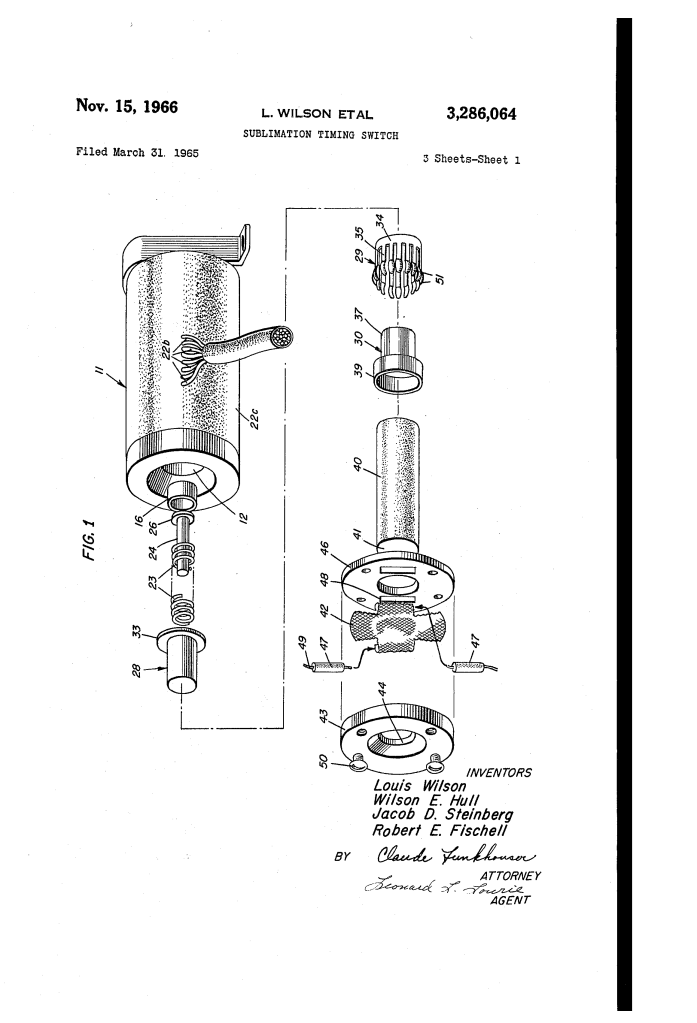
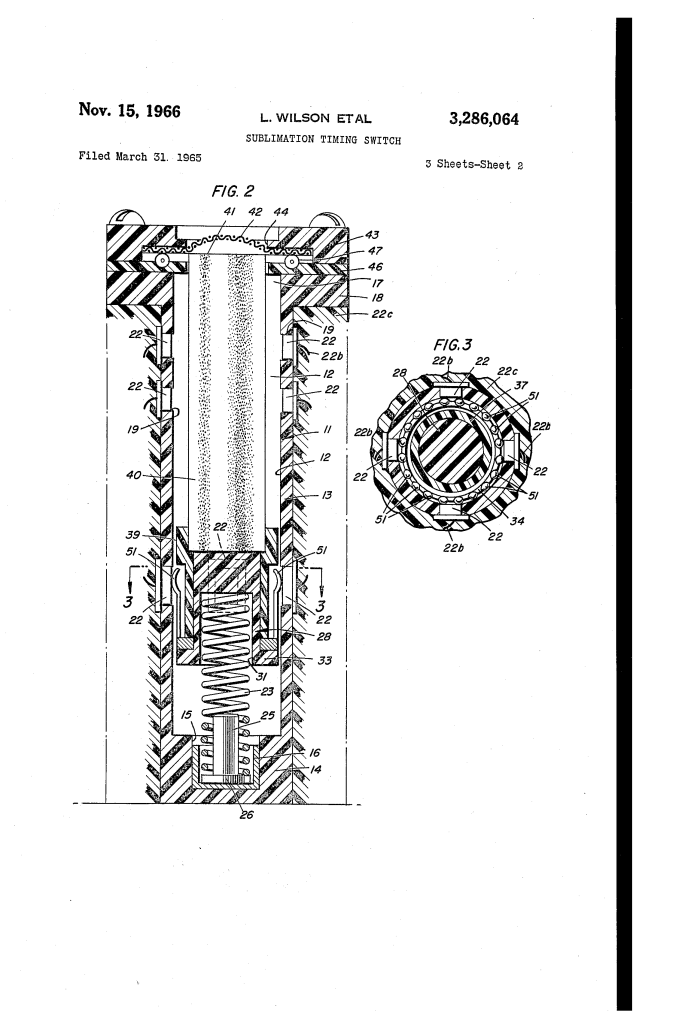
- The Compressed Chemical Cartridge (40)The heart of the switch is a precision-milled cylinder of solid sublimable material.
- It is held firmly under continuous tension by a strong internal coil spring (23).
- The top face (41) of the solid pellet presses flush against an open wire screen or perforated mesh (42) at the top of the housing.
- As the chemical solid sublimes directly into gas molecules that escape through the mesh into the vacuum of space, the cartridge slowly decreases in height, allowing the spring-driven plunger to advance along the chamber at a predictable, controlled velocity.
- Segmented Multi-Finger Sliding Plunger (27, 28, 29, 30)To eliminate circuit chatter and ensure high electrical contact reliability in high-vibration aerospace flight:
- The plunger carries a circular metallic shorting ring (34) equipped with a series of longitudinal, segmented curved finger contacts (35, 51).
- The contact fingers are sized and spaced so that at least two adjacent fingers press simultaneously against each stationary terminal plug (22), building built-in electrical redundancy into every connection.
How the Apparatus Functions
The switch operates along a sequential progression tied directly to orbital flight milestones:
| Step | Action | Operational Purpose |
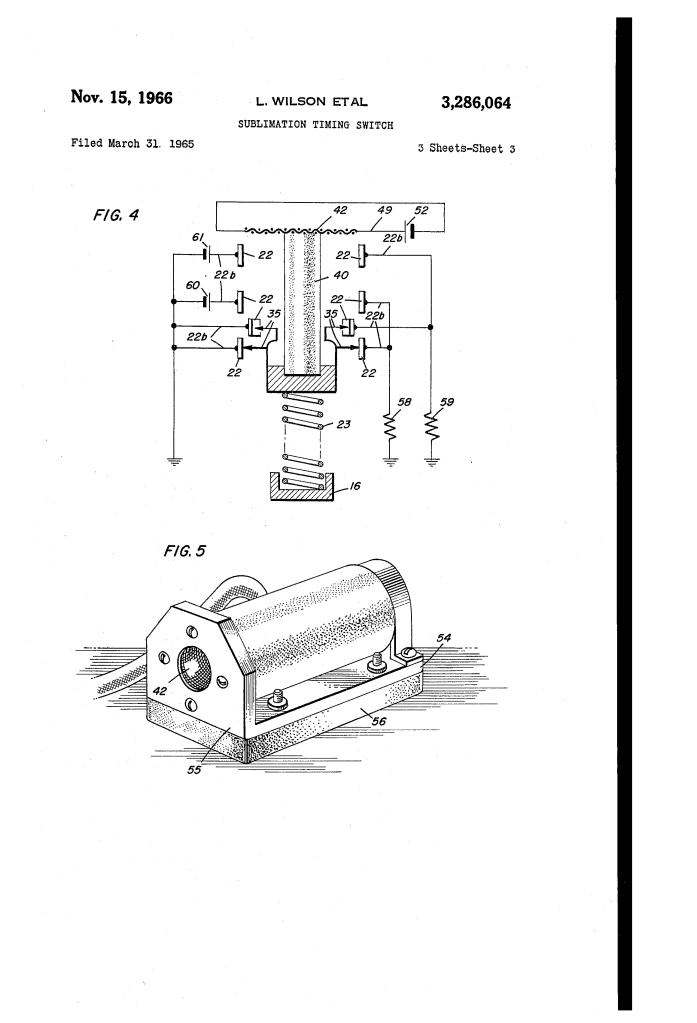
| 1. Launch & Ascent | Plunger rests at Position 1, holding finger contacts against the bottom set of terminals. | Grounds explosive squibs (58, 59) through the shorting ring band to prevent accidental firing from static or launch pad interference. |
| 2. Orbital Insertion | Satellite enters the hard vacuum of space; sublimable pellet begins vaporizing through mesh (42). | Initiates the passive or electrically heated countdown sequence automatically without motors or gearboxes. |
| 3. First Stage Actuation | Spring advances plunger to Position 2 as the pellet recedes. | Connects battery (60) to first squib (58), detonating payload fairing release pins or separation clamps. |
| 4. Secondary Stage Actuation | Continued sublimation advances plunger to Position 3. | Connects battery (61) to squib (59) or powers up high-voltage satellite science instruments. |
Active vs. Passive Modes: Tuning the Delay
The timing interval of the switch is determined by the length of the solid cartridge, the specific compound chosen, and whether thermal energy is applied:
- Active Heating Mode: The wire mesh (42) is connected to a small silver-zinc battery or wrapped around heating resistors (47). Supplying electrical current warms the face of the charge, accelerating vaporization for rapid, short-duration staging delays (seconds to minutes).
- Passive Mode: No electrical heating is applied. The material vaporizes purely in response to the vacuum of space. By placing the pellet behind sequential expansion chambers with tiny escape orifices, the timing delay can be extended from hours up to multiple years.
- Kinetic Skin-Heat Mode: In an alternative ballistic configuration (FIG. 5), the switch housing is bolted to an angle-shaped bracket (54) mounted directly to the rocket skin. Heat generated by atmospheric friction during launch conducts straight into the charge, with an insulated fiberglass-epoxy buffer sheet (56) calibrated to delay operation to a specific flight altitude.
Sublimable Chemical Charges
The inventors identified a family of volatile organic solids that compress cleanly under high pressure into solid blocks capable of being machined, lathed, or milled to tight mechanical tolerances:
- Camphor: Provides rapid baseline sublimation rates under moderate heat.
- Naphthalene: Delivers stable, uniform solid-to-gas transition rates in vacuum.
- Biphenyl: Offers intermediate volatility for mid-range orbital timing requirements.
- Benzoic Acid: Provides slower sublimation rates for longer delays, often blended in combination with other organic compounds to tailor specific vaporization curves.
Technical Components
Insulating Switch Housing (11): A cylindrical body molded from high-dielectric plastic, nylon, or high-temperature ceramic that defines an axial interior chamber (12).
Terminal Plugs & Bores (19, 22, 22b, 22c): Solid metal terminal pins seated in peripheral rows through the housing wall, sealed in place and insulated from one another with moldable epoxy resin.
Spring Guide Assembly (16, 23, 24, 25, 26): A compression spring stabilized by a center guide pin (25) resting in a cup seat (16) at the closed bottom wall, ensuring smooth axial thrust without tilting, binding, or scraping the inner chamber wall.
Retaining Holder & Spacer (43, 46, 50): A bolted annular collar that clamps the heated mesh (42) and heat-distributing resistors across the open exhaust throat (17).
Historical and Scientific Impact
Engineered at the height of the Space Race, this patent addressed one of the most perilous aspects of early space exploration: payload release failure.
- Failsafe Satellite Staging: The device served as an independent mechanical backup timer. If a launch vehicle’s primary electronic programmer malfunctioned, the passive sublimation switch would automatically fire the separation squibs once the rocket reached orbital vacuum, saving expensive satellite missions from remaining trapped on booster upper stages.
- Immunity to Electrical Transients: Mechanical isolation meant the timing trigger could not be jammed, short-circuited, or triggered prematurely by severe electromagnetic pulses (EMP), launch vibration, or telemetry radio static.
- Spacecraft Design Foundations: Co-inventor Robert E. Fischell and his colleagues at the Johns Hopkins Applied Physics Laboratory went on to pioneer foundational spacecraft systems—including satellite navigation (Transit), magnetic attitude control, and later, miniaturized implantable biomedical devices.
About the Inventors
Louis Wilson, Wilson E. Hull, Jacob D. Steinberg, and Robert E. Fischell were prominent aerospace engineers and physicists working for the U.S. Navy and the Johns Hopkins University Applied Physics Laboratory (APL).
Robert E. Fischell is widely celebrated as one of the most prolific aerospace and biomedical inventors in American history, holding over 200 patents. After pioneering early spacecraft guidance and satellite power systems at APL, Fischell translated aerospace-grade telemetry and materials science into breakthrough life-saving medical devices, including the rechargeable implantable cardiac pacemaker, implantable insulin pumps, and brain neurostimulators for treating epilepsy.
Summary of Claims
The patent explicitly claims:
- A satellite timing switch comprising an insulating housing with closed and open ends and multiple longitudinally separated sets of peripheral electrical terminals.
- A spring-loaded sliding carrier fitted with electrical shorting fingers that sequentially advance across the terminal sets as an abutting charge of sublimable material vaporizes into space.
- The incorporation of an electrically energized wire heating mesh positioned across the open exhaust port to actively accelerate and regulate the rate of chemical sublimation.
- An axial internal guide pin arrangement that maintains pure longitudinal spring alignment and prevents mechanical binding during plunger travel.
- A multi-finger contact structure wherein two or more parallel fingers bridge each terminal plug to guarantee redundant electrical contact.
