
Curing Furfuryl-Alcohol-Modified Urea Formaldehyde Condensates (1967)
U.S. Patent No. 3,297,611, granted on January 10, 1967, to Henry A. Hill, addresses a major processing defect in industrial foundry manufacturing: the premature hardening of acid-catalyzed thermosetting resin binders used to shape sand molds and cores. Henry A. Hill, an accomplished research chemist based in Watertown, Massachusetts, assigned the patent to The Borden Company of New York, N.Y.
This invention solved a critical dilemma in high-temperature metal foundry work: furfuryl-alcohol-modified urea formaldehyde resins offered outstanding bonding strength and rapid heat curing, but had an exceptionally short “pot life” at room temperature. The resin-catalyst mix often gelled and set up within an hour, gumming up machinery, ruining sand batches, and causing substantial material waste.
The Innovation: The Hexa-Nitrite Retarder System
In the foundry “hot box” process, sand coated with resin and an acidic catalyst is blown into metal core boxes heated to 350–500°F. The ambient problem arose because the acidic catalyst (such as ammonium chloride) instantly began cross-linking the resin at room temperature.
Hill discovered that pairing a water-soluble nitrite (such as sodium nitrite) with an auxiliary amine base—specifically hexamethylenetetramine (“hexa”)—acts as a latent chemical switch. At storage temperatures, this dual-component retarder suppresses the acid-driven cross-linking reaction. Yet, once blown into the heated mold, the thermal threshold destroys the retarding balance, permitting the natural exothermic cure to proceed instantly.
Why the Hexa-Nitrite Combination?
- Extended Pot Life: It dramatically delays ambient gelling, multiplying working holding time from roughly 1 hour to several days—or over 30 days at maximum concentrations.
- Latent Action: It neutralizes early acid activity in storage without preventing high-speed thermosetting once exposed to hot-box mold temperatures.
- Flow Preservation: When admixed with foundry sand, it ensures the coated grains remain free-flowing for 24 hours or more before being packed into the molding machine.
Key Chemical Components
The composition relies on a balanced formulation where each element regulates curing speed and structural binding:
| Component | Function |
| Furfuryl-Alcohol-Modified Urea Formaldehyde Condensate | The base curable binder resin that polymerizes to bind sand grains into a rigid, self-supporting core structure. |
| Acidic Catalyst (e.g., Ammonium Chloride) | Establishes a working pH below 7 to initiate and drive the cross-linking polymerization reaction. |
| Sodium Nitrite | The primary low-temperature inhibitor; reacts in the presence of acidic salts to release trace nitrous acid, checking premature resin propagation. |
| Hexamethylenetetramine (Hexa) | The synergistic auxiliary stabilizer; moderates system acidity and reinforces ambient latency alongside the nitrite. |
| Free/Added Urea | Secondary scavenger added post-condensation (5 to 15 parts per 100 parts resin) to bind free formaldehyde and optimize reaction kinetics. |
| Foundry Sand | The primary aggregate refractory material (typically mixed at 2 parts binder solution per 100 parts sand). |
Performance: Extending Resin Working Life
Hill’s patent demonstrates the retarder’s capability by tracking the time required for the uncontrolled exothermic curing reaction to elevate the mix temperature to 50°C at ambient room conditions.
Pot Life and Exotherm Measurements (Per 100 parts dry resin):
- Unretarded Control (0 parts Hexa / 0 parts Nitrite): Reached exothermic cure in 0.95 to 1.0 hour.
- Light Retardation (0.085 parts Hexa / 0.26 parts Nitrite): Held stable for 2.05 hours.
- Moderate Retardation (0.34 parts Hexa / 1.12 parts Nitrite): Extended stability to 19.75 hours.
- Recommended Formulation (0.51 parts Hexa / 1.71 parts Nitrite): Remained stable for over 4 days.
- High-Concentration Retardation (1.27 parts Hexa / 4.24 parts Nitrite): Suppressed premature exotherm for more than 30 days.
The Foundry Application Process
Hill established a clear, industrial-scale mixing and casting sequence:
- Premix the Nitrite into the liquid modified resin solution.
- Dissolve the Hexa into the aqueous catalyst solution alongside ammonium chloride and urea.
- Blend the two stable liquids together immediately prior to or during application to the aggregate sand.
- Coat dry foundry sand with approximately 2% by weight of the combined binder mix; the coated sand remains flowable and usable for a full 24-hour work shift.
- Blow the cold sand mix into a hot metal core box heated to 350–500°F (approx. 425°C wall surface).
- Hold for 10 to 30 seconds until the surface bonds into a rigid, self-supporting shape.
- Eject the core into ambient air; the internal exothermic chemical reaction completes the full cure without further furnace heating.
About the Inventor: Henry A. Hill
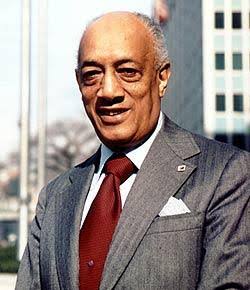
Henry Aaron Hill was a trailblazing American chemist and corporate leader whose technical contributions shaped mid-century industrial polymer and resin chemistry.
- Academic and Professional Background: After earning his Ph.D. in organic chemistry from the Massachusetts Institute of Technology (MIT) in 1942, Hill served in top research and managerial roles across New England chemical firms, later founding the National Polychemicals company and the Riverside Research Laboratories.
- Industrial Impact: Hill developed critical advances in synthetic resins, blowing agents, and rubber-curing technologies. His ability to manipulate reaction kinetics, as demonstrated in this patent for The Borden Company, directly improved mass-production casting methods across the automotive and metal-casting sectors.
- Historical Legacy: In 1977, Dr. Henry A. Hill became the first African American president of the American Chemical Society (ACS), championing professional standards, economic equity, and safety protocols for working research chemists nationwide.
Summary of Claims
The patent explicitly claims:
- An aqueous resin binder combining a furfuryl-alcohol-modified urea formaldehyde condensate, an acidic curing catalyst providing a pH below 7, and a low-temperature curing retarder.
- A retarder formulation comprising 0.2 to 4.5 parts by weight of a water-soluble nitrite (specifically alkali metal nitrites, such as sodium nitrite) and 0.08 to 1.3 parts of hexamethylenetetramine per 100 parts dry resin.
- The method of producing shaped, bonded foundry articles by coating sand with the retarded resin mixture, blowing it into heated molds, and allowing post-ejection exothermic curing to finish the set.
