
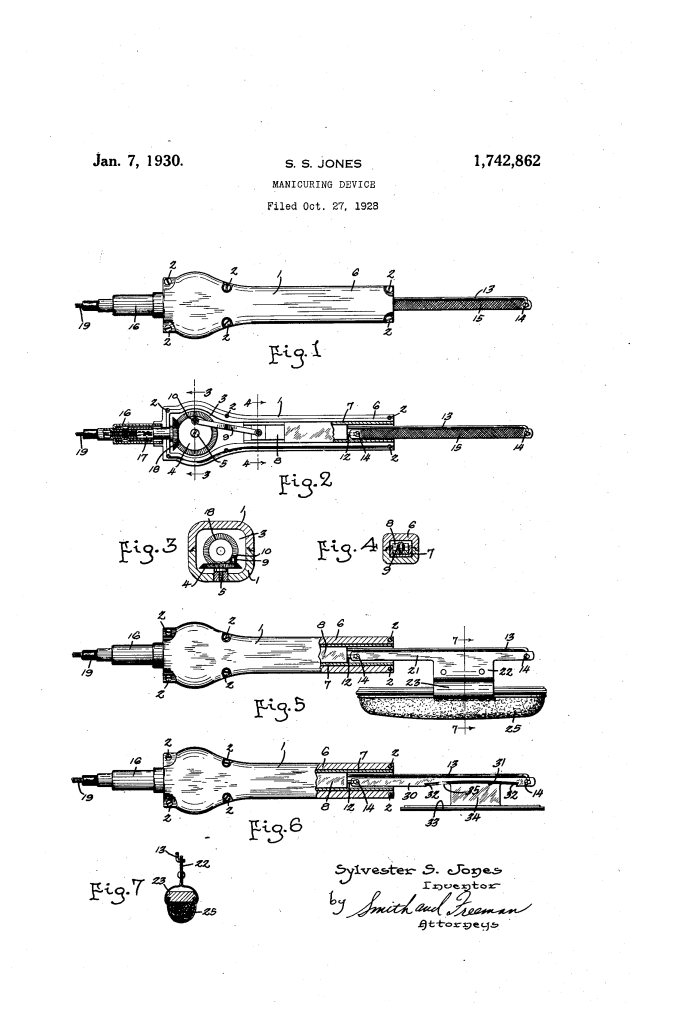
Power-Driven Manicuring Device (Sylvester S. Jones, No. 1,734,518)
The patent by Sylvester S. Jones of Cleveland, Ohio, describes a specialized Manicuring Device (Patent No. 1,734,518, 1930). This invention is a power-operated tool designed to automate common manicuring tasks such as filing, buffing, and the use of emery boards. Jones’s primary objective was to expedite the manicurist’s labor and reduce bodily fatigue caused by repetitive manual motions. His innovation features a reciprocating mechanical linkage that allows standard, hand-sized tools to be used interchangeably with a power-driven handle, making the transition to mechanized manicuring seamless for both the operator and the patron.
Inventor Background: Sylvester S. Jones
Sylvester S. Jones was an African American inventor and engineer active in Cleveland during the late 1920s. His 1930 patent represents a sophisticated entry into the burgeoning “beauty technology” market. At a time when salon services were becoming increasingly standardized and professionalized, Jones applied industrial principles—specifically rotary-to-linear motion translation—to the delicate work of nail care. His design was unique because it didn’t require “uncongenial” or specialized tools; instead, it adapted the familiar wooden and metal strips already used by professionals, proving his keen sense of ergonomics and user adoption.
Key Mechanical & Power Systems
The device transforms the rotation of a motor into a steady, back-and-forth motion through a handle-mounted gearbox.
1. The Power Train and Gearbox (4, 5, 18, 19)
- Flexible Shaft (19): Power is delivered from an external motor (not shown) via a flexible shaft.
- Bevel Gear Drive: A small pinion (18) at the end of the shaft meshes with a larger bevel gear (4) journaled on a stud (5) within the handle.
- Function: This 90-degree gear arrangement allows the motor’s high-speed rotation to be converted into torque within the compact space of a handheld device.
2. The Reciprocating Linkage (8, 9, 10) (Key Innovation)
- Eccentric Pin (10): The large bevel gear carries an off-center or eccentric pin.
- The Pitman (9): A connecting rod, or pitman, is articulated between the eccentric pin and a sliding rod (8).
- Metal Lining (7): The rod (8) is mounted within a rectangular metal lining in the narrow part of the handle.
- Action: As the gear turns, the pitman pushes and pulls the rod back and forth. This translates the motor’s circular motion into a precise reciprocating linear motion, mimicking the natural hand-filing action of a manicurist.
3. Interchangeable Tool Attachment (12, 13, 14, 15)
- The Hooks: The end of the reciprocating rod is equipped with a short hook (12) and a long, spring-tensioned hook (13).
- The Tools: Standard tools like a file (15) or a buffer have apertures (14) at their ends.
- Function: The manicurist can “snap” different tools onto the hooks without needing screws or buttons. The spring tension of the hook holds the tool securely during high-speed operation but allows for quick changes between filing, shaping, and polishing.
4. The Adapter Handle and Bracket (30, 32, 34, 35)
- The Adapter (30): For tools like emery boards, Jones designed a specialized metal strip adapter.
- Spring-Steel Strip (35): This strip fits into under-cut shoulders (32) on the adapter.
- Lateral Brackets (34): These project the tool away from the handle.
- Function: The brackets ensure the tool clears the body of the machine, allowing the manicurist to work at various angles without the handle obstructing the patron’s hand.
Improvements Over Manual Manicuring
| Feature | Manual Filing and Buffing | Jones’s Power Manicuring Device |
| Fatigue | High; causes wrist and hand strain. | Drastically reduced via motor-driven motion. |
| Speed | Limited by human physical speed. | Rapid and consistent stroke rate. |
| Uniformity | Varies based on pressure and tiredness. | Steady reciprocating action for a smoother finish. |
| Versatility | Required switching hand positions. | Interchangeable hooks for various salon tools. |
Significance to Engineering and the Beauty Industry
Sylvester S. Jones’s manicuring device influenced the development of handheld power tools and automated personal care hardware.
- Rotary-to-Linear Conversion: The pitman and eccentric pin system used by Jones is a foundational principle in reciprocating saws and electric toothbrushes, showcasing an early application in the beauty sector.
- Ergonomic Adaptation: By designing the machine to use existing professional tools, Jones practiced a form of user-centered design, acknowledging that professionals are more likely to adopt technology that respects their traditional workflows.
- Modular Accessory Design: The “snap-on” hook system and specialized brackets anticipated the quick-change chucks and attachments found in modern rotary tools (like Dremels) used in salons today.
- Professionalization of Services: This device was a critical early contribution to the industrialization of the beauty shop, allowing for faster client turnover and more standardized results.
