

Mail-Canceling Machine (1897)
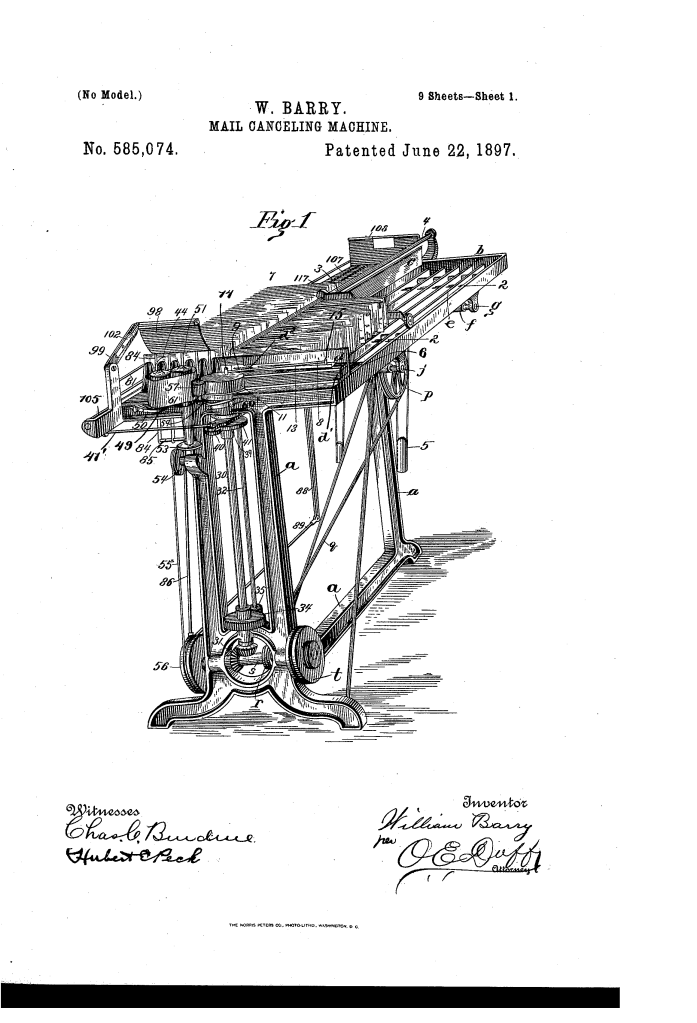
U.S. Patent No. 585,074, granted on June 22, 1897, to William Barry, describes a high-speed, continuous-feed mail-canceling and postmarking machine. William Barry, an inventor from Syracuse, New York, developed this specialized apparatus to automate the rapid cancellation of postage stamps and application of date postmarks on letters.
This specific invention solved a persistent bottleneck in late 19th-century post offices: handling high volumes of mixed mail varying widely in thickness without jamming, double-feeding, smearing ink, or damaging envelopes.
The Innovation: The “Segmented Needle-Feed and Cam-Timed Printing” System
Early mail-marking machinery often jammed when processing thick packets alongside thin envelopes, or caused ink smears by dragging letters across wet rollers. Barry solved these challenges by engineering a synchronized mechanical flow involving a segmented biting feeder, dynamic separating fingers, and an eccentric-controlled type segment.
Key Functional Subsystems
- The Multi-Plate Needle Feeder (9, 9′, 9″)
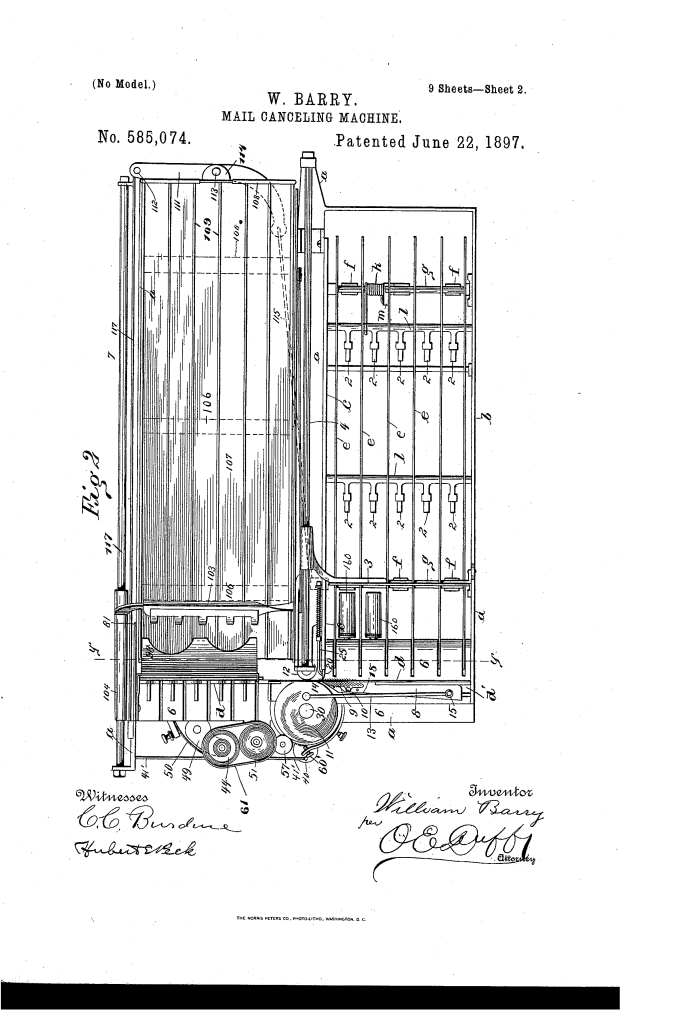
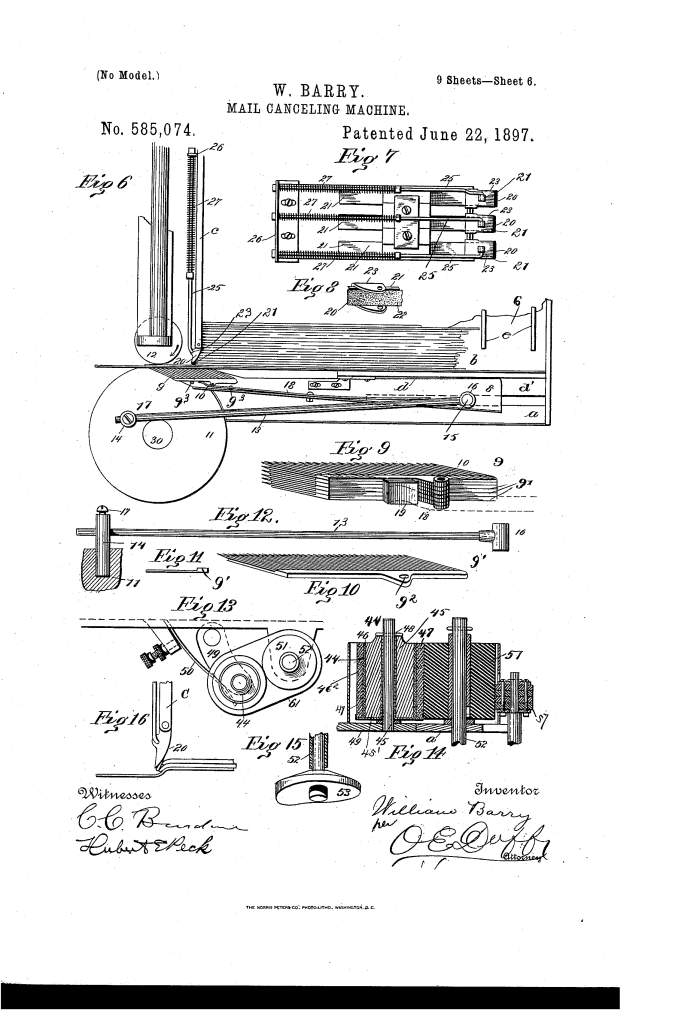
- The heart of the lateral feeding mechanism is a feed-block built from a stack of independent, parallel metal plates (9′) mounted on a pivot (10) or slotted guides (147).
- Each individual plate holds a series of fine, closely arranged needle points projecting from its biting edge.
- Because the individual plates can yield or rock independently under spring pressure (18, 19), the feeder conforms directly to uneven or lumpy letter surfaces, gripping each piece securely without tearing.
- Spring-Actuated Friction Separators (20, 21, 22)
- Positioned directly across the throat opening from the feed bed to the printing couple.
- Flexible strips (21) faced with friction material such as emery-cloth (22) are held under adjustable spring tension (27).
- These fingers press firmly against the rear face of incoming mail, holding back any trailing pieces and guaranteeing that only a single envelope enters the printing rollers at a time.
- Eccentric-Actuated Type Carrier (77)
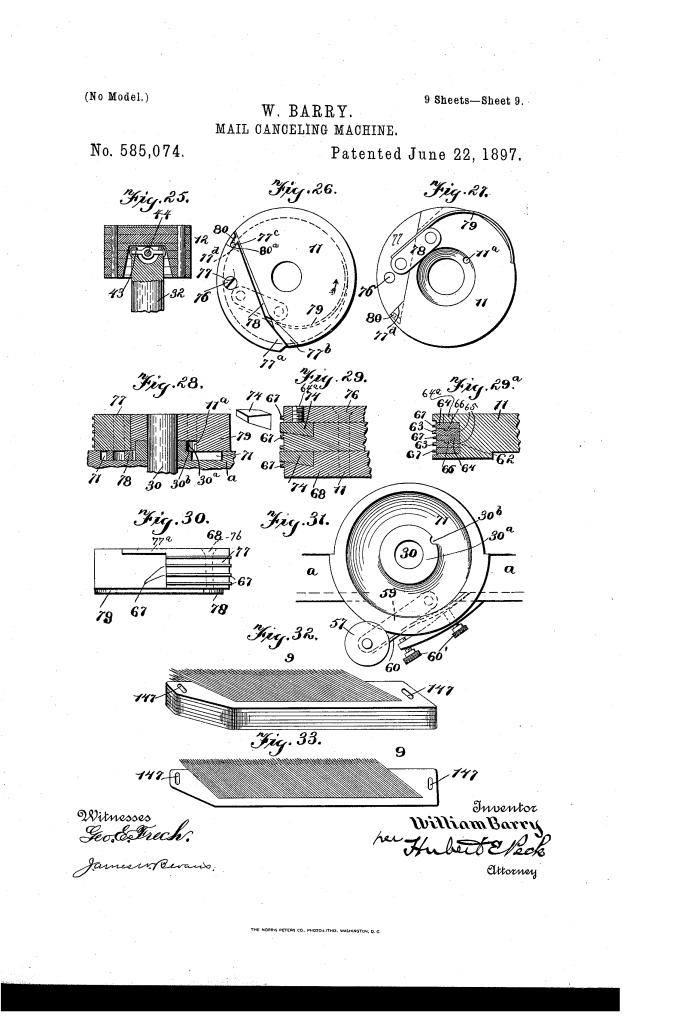
- The printing-roll (11) incorporates a movable sector-shaped type block (77) linked to a base cam groove (71) on the table.
- The type block extends radially outward only when passing the inking roller (57) to receive ink, retracting back to a solid mechanical seat just before striking the envelope against the platen roller (12).
- This eliminates stray ink contact and prevents envelope faces from being daubed or smeared.
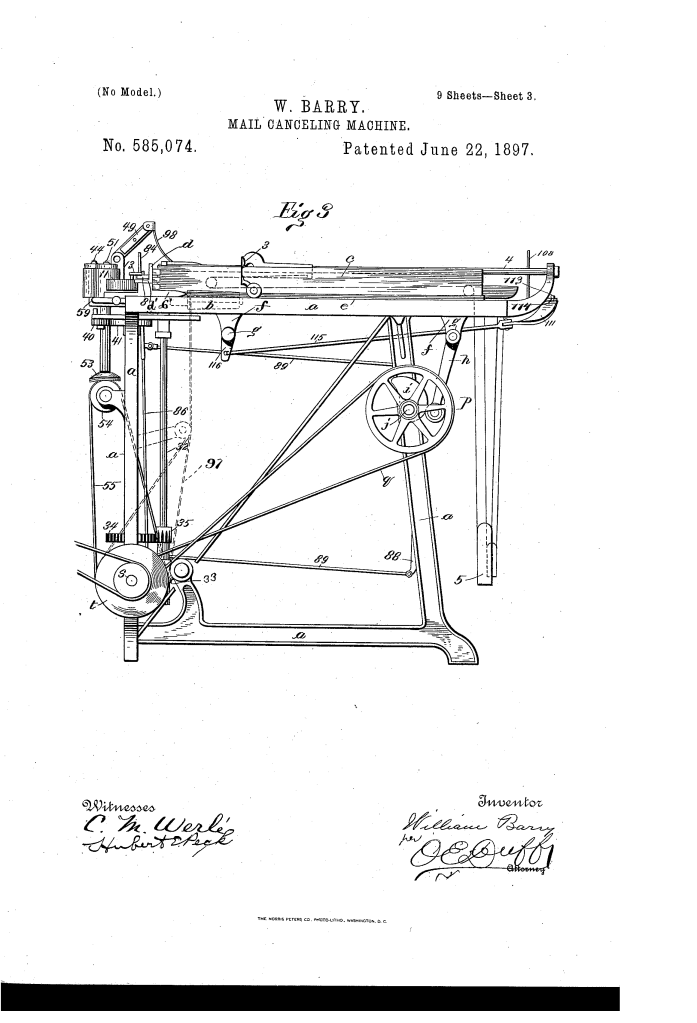
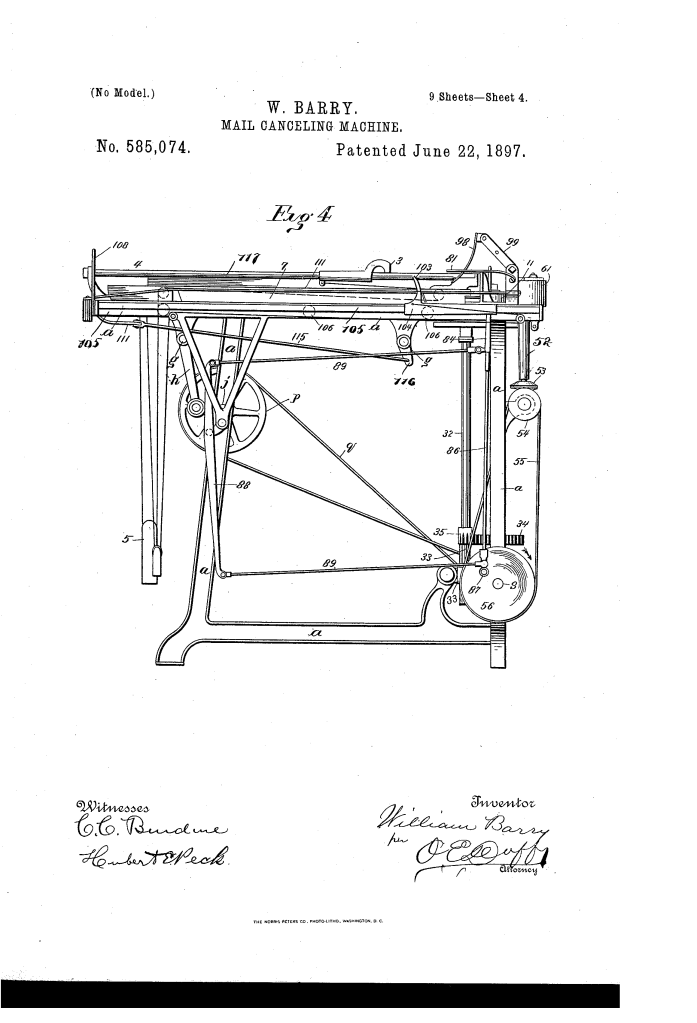
| Component | Patent Callout | Function |
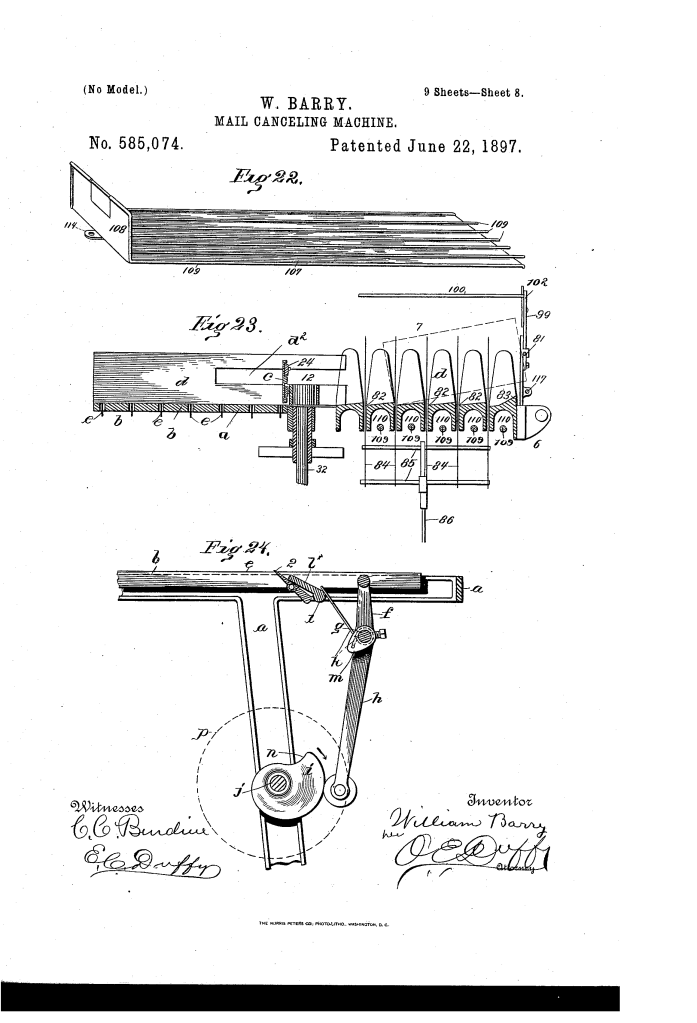
| Reciprocating Feed Floor | e, f, g, i, k | Parallel longitudinal bars that shift forward slowly to advance letters on edge, then snap back rapidly via drop shoulder n to loosen the stack without dragging it in reverse. |
| Non-Return Pawls | 2, l’ | Weighted, upward-inclined fingers that prevent retrograde movement of envelopes during the quick return stroke of the feed floor. |
| Segmented Feed Block | 9, 9′, 10, 18 | Needle-pointed composite gripper that reaches through slot d1 to advance the frontmost envelope laterally into the printing throat. |
| Adjustable Pitman | 13, 14, 15, 16 | Connects the feed plate to an eccentric crank-pin on the printing roll, allowing the operator to adjust the stroke length and timing. |
| Impression Platen Roll | 12, 32, 43, 44 | Rawhide-layered roller mounted on a universal joint that swings away momentarily via cam 41 to receive letters of any thickness before applying solid backing pressure. |
| Inking Mechanism | 44, 51, 57, 59 | Saturated core reservoir roll, vertically reciprocating distributor roll (51), and felt inker (57) ensuring a uniform, non-spattering ink film. |
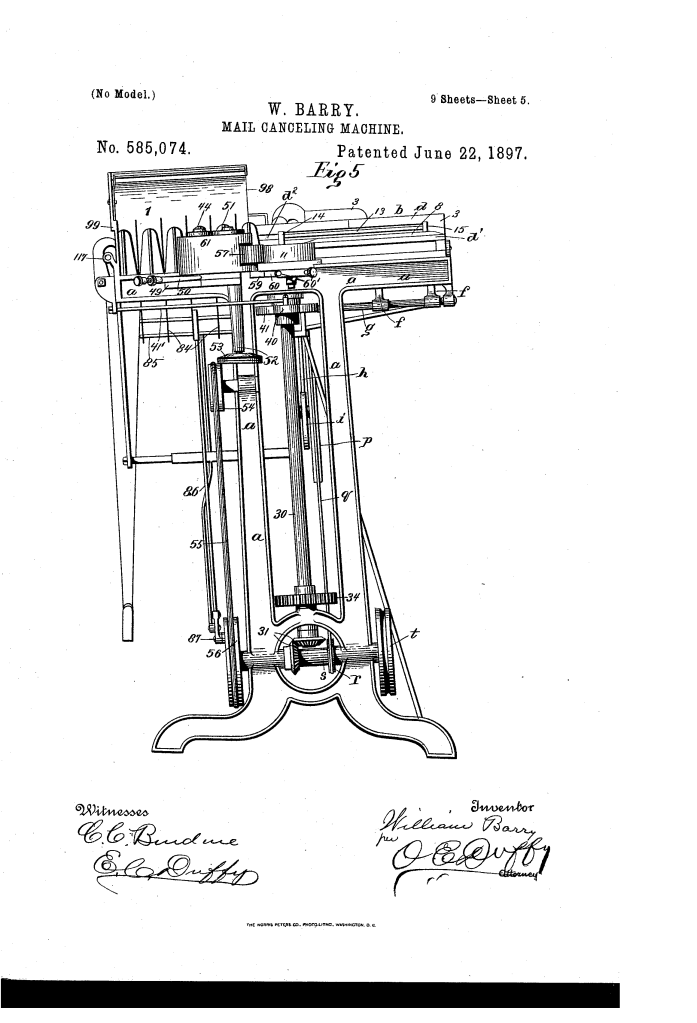
| Stacking Fingers & Shield | 84, 86, 88, 98 | Oscillating vertical fingers that push stamped letters onto inclined receiving steps (82) beneath a flexible leather retaining shield (98). |
| Removable Output Tray | 107, 108, 109, 111 | Ribbed floor tray reciprocated in reverse by arm 116 to stack sorted letters for immediate collection. |
How the Machine Functions
- Loading and Floor Advance: Mail is loaded on edge into feedway b. Rock-shafts g oscillate the longitudinal bars e forward against front wall d, snapping back abruptly so letters advance steadily without jamming under follower 3.
- Singulation and Throat Feed: Reciprocating carrier 8 thrusts needle-block 9 through slot d1. The needles bite into the lead envelope and push it laterally past emery-faced friction fingers 20, which hold back all secondary letters.
- Pressure Relief and Infeed: Cam 41 momentarily relaxes tension spring 37, allowing counter-shaft 32 and rawhide impression roller 12 to swing open and receive the incoming envelope without impact or crushing.
- Postmarking and Inking: Type segment 77 is projected outward by eccentric groove 71 to contact inking roll 57, then pulls back to its solid seat as cam 41 restores full spring pressure, cleanly stamping the postmark and canceling the stamp.
- Stacking and Discharge: The canceled letter shoots across the inner end of receiving-way 7 against curved guide 81 and drops behind stop shoulder 82. Oscillating stacker fingers 84 sweep up and forward to seat the envelope under flexible shield 98 onto reciprocating collection tray 107.
Industrial and Operational Impact
- High-Volume Continuous Throughput: Replaced manual hand-stamping with continuous mechanical feeding, processing letters as fast as clerks could empty the removable receiving trays.
- Variable Thickness Handling: The floating rawhide platen roller and independent segmented feeder eliminated manual presorting for envelope thickness.
- Clean Postal Impressions: Moving type sectors eliminated ink buildup on non-printing surfaces, keeping postal records and correspondence cleanly legible.
Summary of Claims
The patent explicitly claims:
- The combination of parallel letter-ways having oppositely reciprocating feeding floors actuated together from a shared rock-shaft drive.
- A letter-feeding block constructed of a series of independently movable parallel plates carrying needle points to engage uneven surfaces.
- Friction-faced separating fingers yieldingly held by adjustable springs across the feedway discharge opening to prevent double-feeding.
- A printing roll featuring an eccentric-actuated movable type sector that extends outward to receive ink and retracts to a solid backing seat for printing.
- An impression roll mounted on a universal joint and counterbalanced by a cam-and-yoke mechanism to dynamically vary roll clearance and printing pressure.
- An oscillating stacking mechanism operating in tandem with a flexible overhead guard shield and stepped receiving floor.
