
Magnetic Car-Balancing Device (1895)
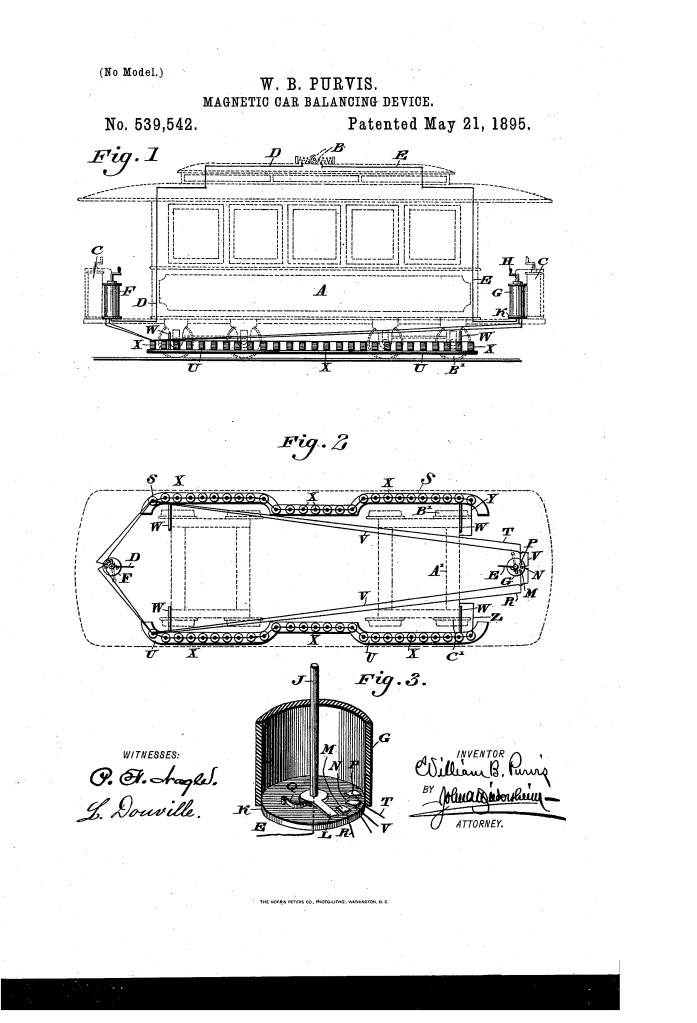
U.S. Patent No. 539,542, granted on May 21, 1895, to William B. Purvis, describes an electromagnetic traction-enhancement system designed to prevent electric trolley cars from slipping or derailing. Purvis, a remarkably prolific Philadelphia-based inventor, developed this device to address a major safety and operational hazard of early urban mass transit: the loss of wheel-to-rail adhesion during inclement weather.
This specific invention solved a critical problem for the rapidly expanding electric railway systems of the late 19th century—namely, how to keep lightweight streetcars firmly planted on the tracks when navigating sharp curves, climbing inclines, or traversing wet, muddy, and icy rails, all without relying on mechanical weights or manual sanding.
The Innovation: Controlled Electromagnetic Adhesion
The brilliance of Purvis’s design lies in its selectively energized, truck-mounted magnetic bars. Instead of adding permanent physical weight to the car (which would increase power consumption and wear on the tracks), Purvis utilized the streetcar’s existing electrical supply to turn the car itself into a powerful electromagnet on demand.
By running a shunt wire from the overhead trolley pole down to a custom switching mechanism, the motorman could instantly project a powerful magnetic field downward into the iron rails. This magnetic attraction effectively “pulled” the car closer to the track, artificially increasing the weight and grip of the wheels precisely when needed.
How the Apparatus Functions
The system was designed for dual-ended streetcars, allowing the motorman to operate the balancing mechanism from either platform depending on the direction of travel.
| Step | Action | Operational Purpose |
| 1. Assessment | The motorman encounters a hazard (e.g., an icy patch, a steep incline, or a sharp curve). | Identifies the immediate need for localized traction control. |
| 2. Selection | The motorman rotates the switch handle to engage specific contact plates (M, N, or P). | Directs power to either side independently or to both sides simultaneously. |
| 3. Energization | Current flows from the trolley pole through the shunt wires to the iron bars (S and U). | Instantly magnetizes the continuous coils of insulated wire wrapped around the cores. |
| 4. Adhesion | The magnetized bars attract the iron rails, forcing the wheels tightly against the track. | Eliminates wheel slippage and prevents the car from jumping the track. |
| 5. Grounding | The current passes through the car axle (A’) and dissipates safely into the earth. | Completes the electrical circuit using the existing rail-return system. |
Key Mechanical and Electrical Components
The system is a highly adaptable configuration where the electrical layout directly serves mechanical stability:
- Magnet Supporting Bars (S & U): Heavy iron bars mounted longitudinally beneath each side of the car truck. They are curved outward near the wheels to clear the running gear while remaining close to the rails.
- Electromagnetic Coils (X): A series of interconnected electromagnets wrapped with insulated wire around insulating cores, creating a continuous, powerful magnetic field along the entire length of the bar.
- Insulating Supports (W): Heavy-duty mounts that isolate the magnetized iron bars from the main car truck, preventing the entire frame of the passenger car from becoming magnetized.
- Three-Position Switch (F & G): A directional control switch located at both ends of the car. It features a brass arm and insulated copper contact plates that allow the motorman to selectively power the left side, right side, or both sides at once.
Performance: Independent and Simultaneous Control
Purvis’s design offered unmatched flexibility compared to crude, uniform traction systems of the era by introducing asymmetric stabilization:
- Straight, Icy Tracks: The motorman sets the switch to the center plate (N). Both bars (S and U) magnetize uniformly, giving maximum bilateral grip to climb slick hills or stop safely on wet pavement.
- Navigating Curves: When rounding a sharp curve, centrifugal force threatens to tip the car or cause the outer wheels to climb the rail. The motorman shifts the switch to plate M or P, energizing only the side facing the inside or outside of the curve to counteract the tilt and balance the vehicle perfectly.
About the Inventor: William B. Purvis
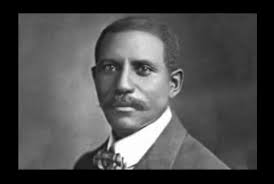
William B. Purvis was an exceptionally talented African American inventor from Philadelphia, Pennsylvania, whose career spanned the late 19th and early 20th centuries.
- Patents: Purvis held a diverse and highly successful portfolio of over a dozen patents. While best known for his foundational improvements to the fountain pen (1890), his work spanned heavy industrial utility patents, including paper-bag manufacturing machinery, edge-folders, and multiple electric railway technologies.
- Impact: During the 1890s, cities were rapidly replacing horse-drawn cars with electric trolleys, but early lightweight streetcars frequently derailed or slipped, causing severe transit delays and accidents. Purvis’s magnetic traction concepts helped lay the groundwork for modern light-rail safety systems.
- Legacy: By successfully assigning shares of his patents to prominent investors, Purvis navigated the challenging post-Reconstruction industrial landscape as a recognized professional inventor, contributing heavily to the golden age of American urban innovation.
Summary of Claims
The patent explicitly claims:
- A dual-series system of connected magnets properly insulated and supported beneath opposite sides of a rail car.
- A specialized control switch capable of receiving electrical power from an overhead line and distributing it to the furthest ends of the magnetic bars.
- The ability to independently or simultaneously magnetize either side of the car, allowing the operator to compensate for uneven track hazards or lateral forces on curves.
- A dedicated grounding pathway that safely routes the working current from the electromagnets through the car axle and directly into the earth via the track.
