
Magnetic Car-Balancing Device (William B. Purvis, No. 539,542)
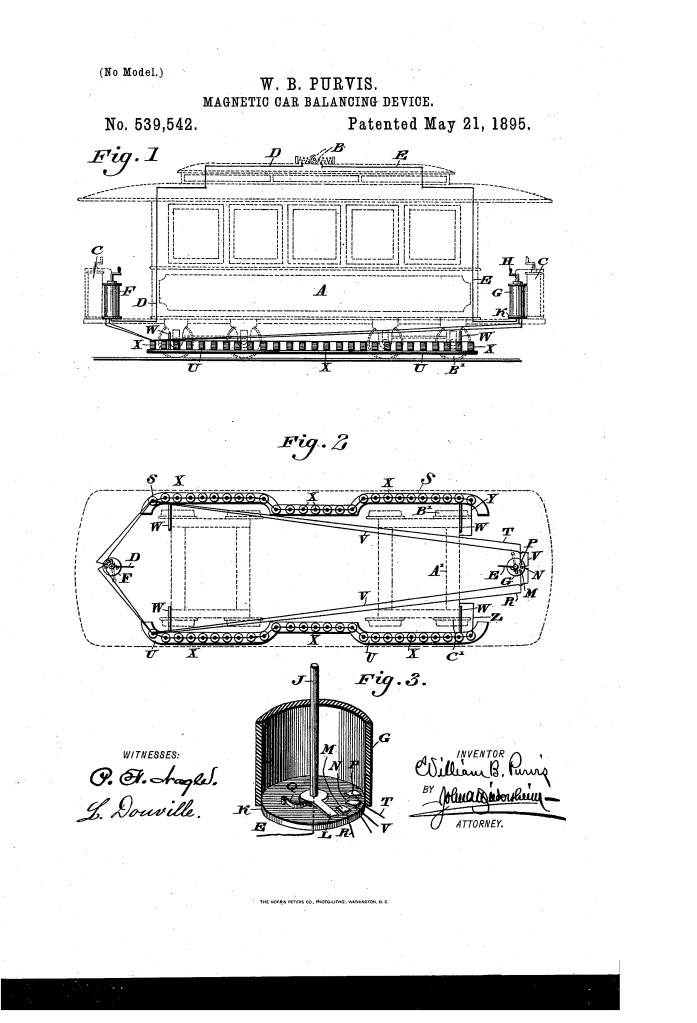
The patent by William B. Purvis of Philadelphia, Pennsylvania, describes a Magnetic Car-Balancing Device for trolley or other cars. The invention consists of a system of electromagnets placed beneath the car and controllable by the motorman, designed to adhere the car wheels closely to the tracks when necessary.
Invention and Mechanism
The device is an electromagnet-based traction and safety system controlled by the motorman from either end of the car.
- Magnet System:
- Supporting Bars (S and U): Iron bars placed beneath the car, one under each side (S for the right, U for the left). They are attached to the truck using insulating supports (W).
- Electromagnets (X): A series of connected magnets supported by the bars S and U. Each magnet has a core formed of wood or other insulating material wound with insulated wire.
- Circuit: The magnets along each side are connected in series. Wires (Y and Z) lead from the far end of the magnet series to the car axle (), which serves as the return path to the ground/earth.
- Control and Operation:
- Power Source: Electric power is drawn from the trolley line via shunt wires (D and E) near the trolley pole (B).
- Switches (F and G): Identical switches are located at both ends of the car, allowing the motorman to operate the device from either end.
- Selective Magnetization: Each switch contains an arm (L) that can be moved into contact with three plates (M, N, and P), allowing the motorman to choose which magnets to activate:
- Plate M (or P): Activates only the magnets on the left (U) or right (S) side of the car.
- Plate N: Activates the magnets on both sides (S and U) simultaneously.
- Function: When activated, the energized iron bars (S and U) become powerful electromagnets that attract the steel rails beneath them, thereby significantly increasing the adhesion of the car wheels to the tracks.
- Purpose:
- Preventing Derailment: Reducing the “liability of jumping the track” when going around curves.
- Increasing Traction: Preventing the wheels from slipping in icy or wet weather.
Historical Significance and the Inventor
William B. Purvis’s 1895 patent is a key technological response to the challenges of early electric streetcars.
- Traction and Derailment: Early electric streetcars suffered from poor traction on wet or icy tracks and were prone to derailing on sharp, high-speed curves common in urban environments. Adding weight was not always a viable solution. Purvis’s device offered a way to mechanically increase effective weight (adhesion) on demand using the abundant electrical power available from the trolley wire.
- Selective Control: The ability to magnetize the sides independently (using plates M or P) is significant. If one side of the car was slipping or if one rail was wet while the other was dry, the motorman could selectively increase adhesion only where needed, demonstrating an early approach to traction control.
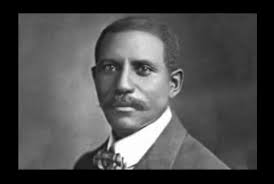
- The Inventor (William B. Purvis): William B. Purvis was an African-American inventor from Philadelphia who held numerous patents. This invention, along with his Electric Railway patent (No. 519,291), highlights his expertise in using innovative electromagnetic applications to solve major engineering problems in the burgeoning field of electric public transit.
Relation to Current Products
Purvis’s magnetic balancing device is a foundational concept for several modern railway and vehicle technologies:
- Magnetic Brakes: The strongest modern parallel is the Electromagnetic Track Brake , widely used on trams and high-speed rail. These brakes use powerful magnets attached beneath the car to clamp directly onto the rails, creating friction and providing rapid, emergency stopping power, utilizing the same principle of magnetic attraction to the rail.
- Active Suspension/Traction Control: The idea of actively and selectively increasing the load (or adhesion) on the wheels in response to dynamic conditions (slipping or cornering) is a conceptual ancestor to modern active suspension systems in cars and electronic traction control systems in trains, which use sensors and motors/brakes to manage wheel slip and optimize cornering stability.
- Magnetic Levitation (Maglev): While Maglev uses magnetic forces for lift, Purvis’s work is part of the historical exploration into using electromagnetism to interact with the track to enhance vehicle performance, whether through adhesion, braking, or propulsion.
