
Multi-Barrel Machine Gun (Clarence Gregg, No. 1,277,152)
The patent by Clarence Gregg of Pitt Bridge, Texas, describes a Machine Gun (Patent No. 1,277,152, 1918). This invention is a heavy-duty, multi-barrel firearm designed to provide a “sweeping” field of fire by simultaneously discharging a plurality of cartridges. Unlike the single-barrel machine guns of World War I (such as the Maxim or Vickers), Gregg’s design utilized a radial array of barrels and an innovative electrical firing mechanism to achieve a massive, coordinated output of fire.
Inventor Background: Clarence Gregg
Clarence Gregg was an African American inventor based in Texas. His patent, filed in early 1918, reflects the urgent technological demands of the Great War. While the standard machine guns of the era were prone to overheating and jamming, Gregg’s multi-barrel approach distributed the heat load across several barrels (4). His integration of electromagnetic actuation for the firing pins was a sophisticated leap forward, moving away from the purely mechanical triggers of the time and anticipating the remote-firing systems used in modern aircraft and vehicle mounts.
Key Mechanical Components & Functions
The gun consists of a pivotable frame, a vertical step-by-step magazine, and an electrical firing system.
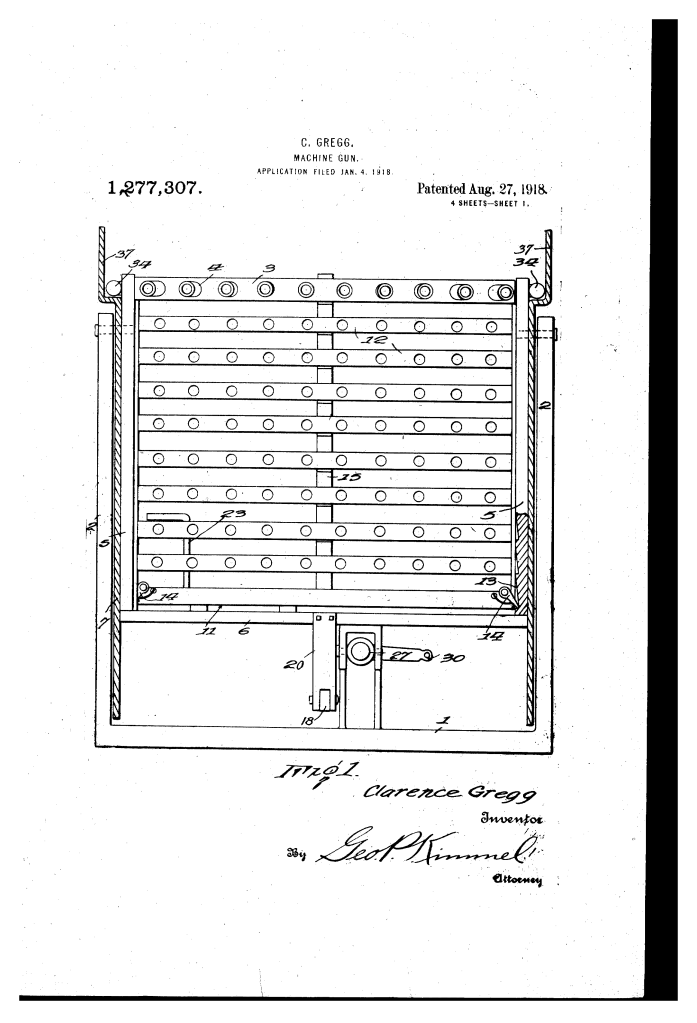
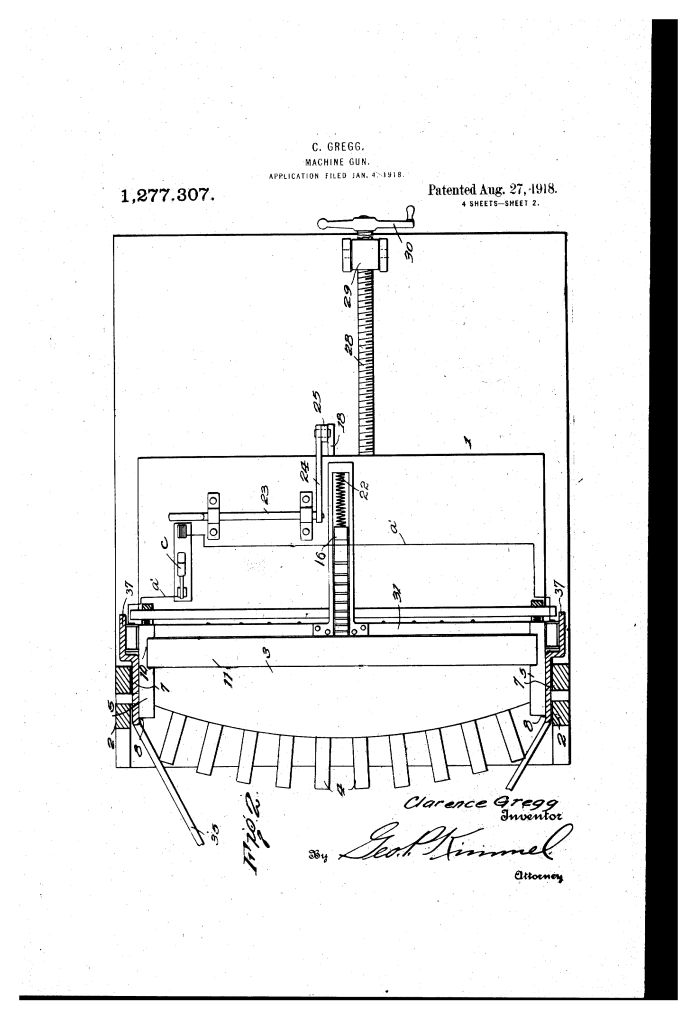
1. The Radial Barrel Array (3, 4)
- Barrel Support (3): The gun features a convex, radially disposed support that holds a plurality of gun barrels (4).
- Sweeping Fire: Because the barrels are arranged in a fan-like or radial shape, a single discharge sends bullets out in a wide arc, effectively “sweeping” the path of travel and covering a larger area than a single-point weapon.
2. The Step-by-Step Magazine (11, 12)
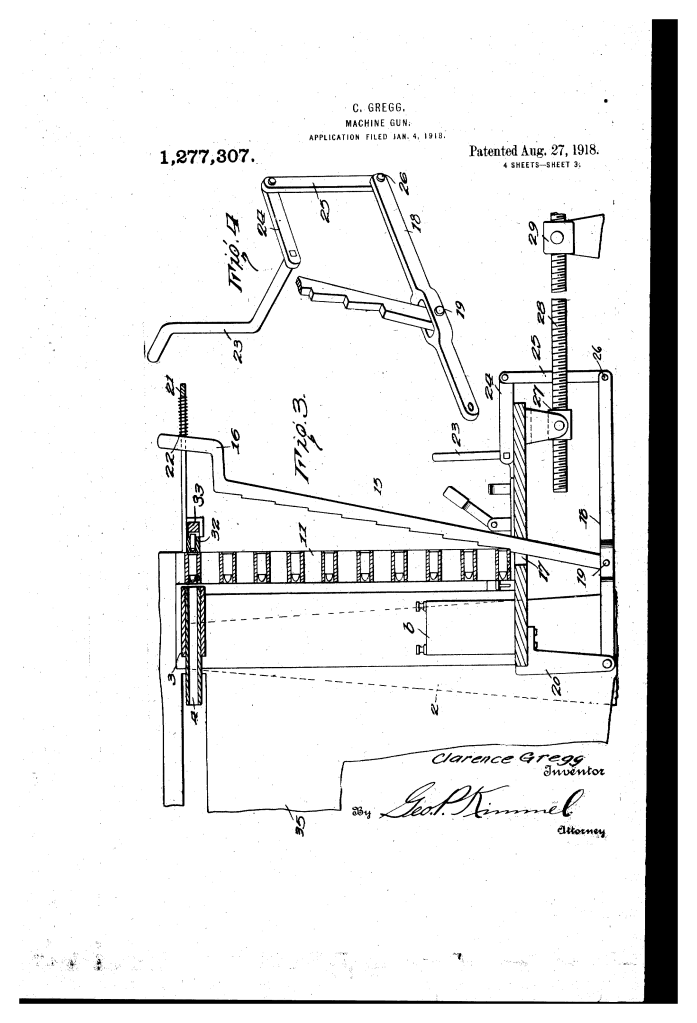
- Magazine Structure: The magazine (11) is a rectangular frame containing multiple cartridge racks (12) arranged horizontally.
- Ratchet Elevation (15, 18): To load the gun, the operator rocks a crank shaft (23). This moves a lever (18) and a ratchet bar (15).
- Function: This mechanism raises the entire magazine vertically in a “step-by-step” fashion. Each “step” aligns a new row of cartridges perfectly with the breech ends of the radial barrels. Pawls (14) lock the magazine in place at each level to ensure precise alignment.
3. The Electromagnetic Firing System (33, 34) (Key Innovation)
Instead of a manual trigger for each barrel, Gregg used electricity to fire all barrels at once.
- Firing Pins (32): A bank of firing pins (32) is aligned with the row of cartridges.
- The Striker Bar (33): Positioned behind the pins is a heavy striker bar (33).
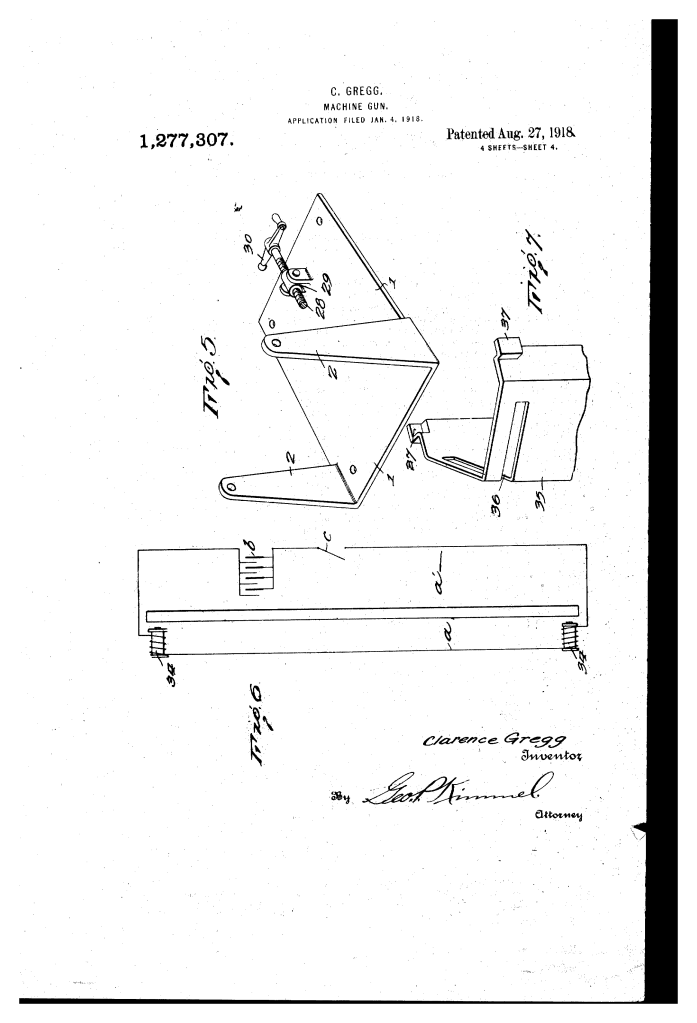
- Electromagnets (34): The ends of the striker bar are positioned over powerful electromagnets (34).
- Action: When the operator closes the electrical circuit (using a remote switch or button), the magnets instantly pull the striker bar (33) forward with great force. The bar slams into all the firing pins simultaneously, exploding the cartridges in unison.
4. Range and Shielding (28, 30)
- Range Adjustment: A screw-threaded shaft (28) and crank handle (30) allow the operator to tilt the entire gun frame on its standards (2).
- Protective Shield: A heavy metal shield is mounted forward of the mechanism to protect the operator from return fire.
Improvements Over Standard Machine Guns
| Feature | Standard 1918 Machine Guns | Gregg’s Machine Gun |
| Firing Pattern | Single point; requires “slewing” the gun. | Radial barrels create a natural “sweep” in one shot. |
| Trigger Mechanism | Mechanical linkage; susceptible to wear. | Electromagnetic bar for perfectly synchronized firing. |
| Cooling | Rapid overheating of the single barrel. | Heat is distributed across multiple radial barrels. |
| Loading | Belt-fed or drum-fed. | Vertical rack-magazine allows for rapid row-by-row firing. |
Significance to Military Engineering
Clarence Gregg’s machine gun influenced the concepts of simultaneous area denial and remote weapon actuation.
- Synchronized Discharge: The use of a single bar to strike multiple pins at once is a principle seen in modern volley-fire weapons and multiple-launch rocket systems (MLRS).
- Electrical Firing: By using electromagnets to move the striker, Gregg anticipated the electronic triggers and “solenoid fire” mechanisms found in modern high-speed Gatling guns (like the M61 Vulcan).
- Modular Ammunition Racks: The “step-up” magazine allowed for a very high density of fire from a stationary position, a logic used in early anti-aircraft batteries and coastal defense.
- Adjustable Geometry: The use of threaded shafts for precision elevation is a classic engineering solution for ballistics and range finding, ensuring that the gun could be tuned for specific distances with high accuracy.
