
Machine for Embossing Photographs (1895)
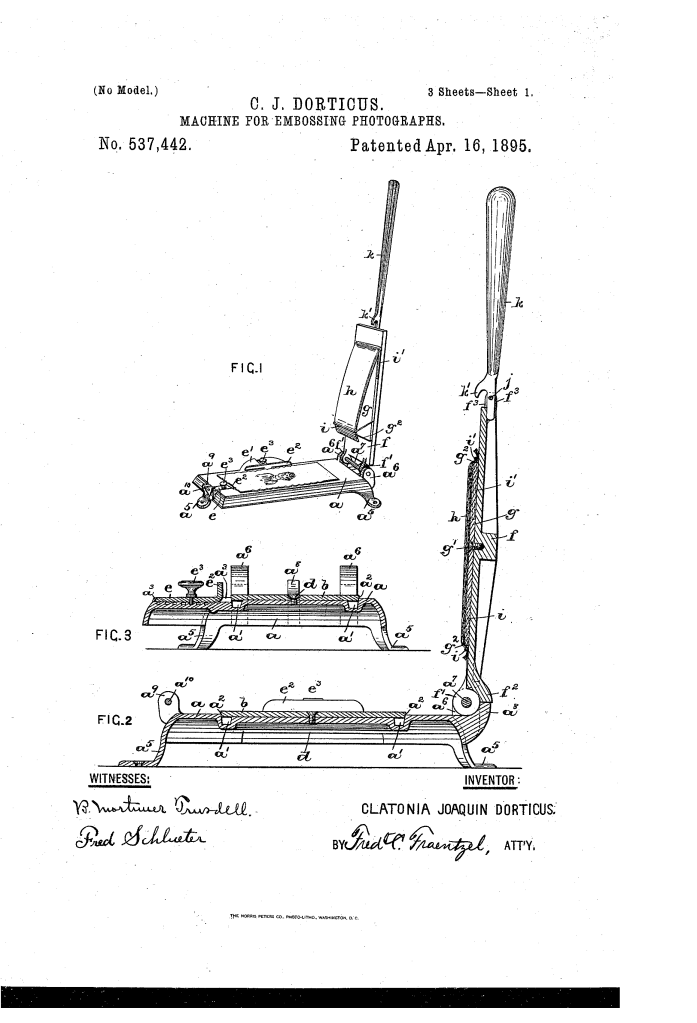
U.S. Patent No. 537,442, granted on April 16, 1895, to Clatonia Joaquin Dorticus, introduces a highly adaptable, dual-purpose machine engineered for the photographic industry. Developed during the height of the late-19th-century photography boom, this invention provided photographers with a reliable, mechanical solution for both mounting prints onto card stock and stamping them with elegant, raised embossed designs.
Dorticus’s design solved a persistent operational problem for photographic studios: uneven pressure during processing, which frequently caused ruined prints, trapped air pockets, structural creasing, or misaligned, crooked borders.
The Innovation: The Dual-Function Oscillating Press
The core breakthrough of the Dorticus apparatus lies in its mechanical adaptability and its self-aligning pressure mechanism. By featuring easily swappable components, a single machine could transition seamlessly from a flat finishing press to a precision embossing station.
1. The Multi-Use Bed Plate & Adjustable Guides
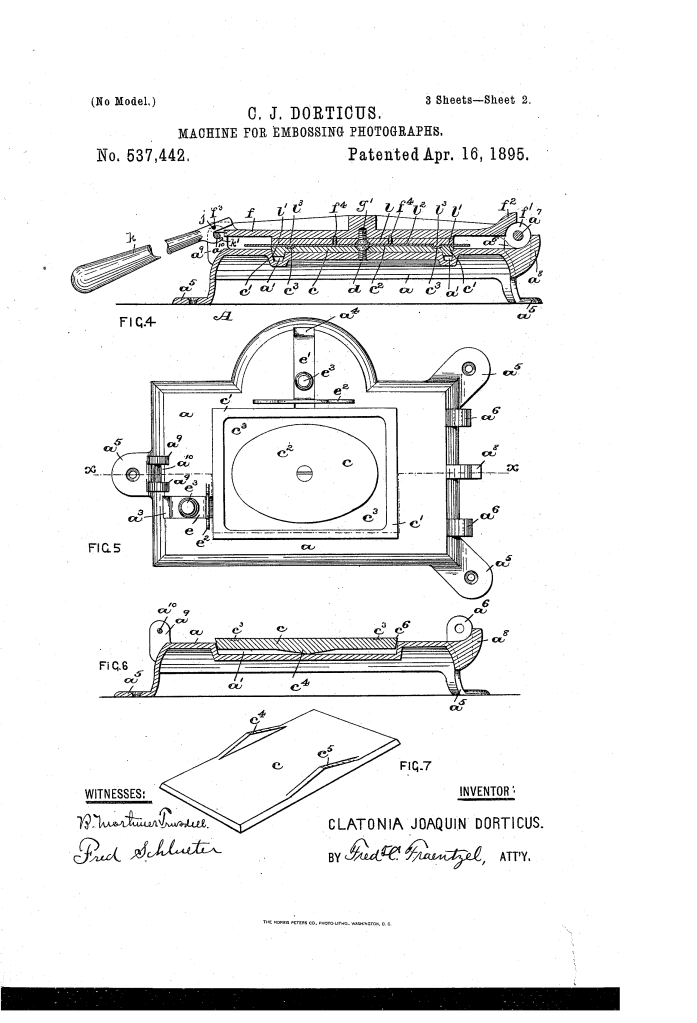
The machine features a specialized base or bed plate (a) containing a recessed portion (a’).
- Universal Fit: The recess holds either a flat mounting plate (b) for adhering prints or a recessed female embossing die (c), secured firmly by a specialized clamping screw (d).
- Perfect Alignment: Built-in slots contain adjustable guide plates (e, e’) governed by centering screws. This allowed operators to instantly center and secure any size photographic card stock without manual guesswork.
2. The Self-Aligning Rocker Base
To ensure an absolutely uniform impression across a delicate photographic film, Dorticus engineered an oscillating die system.
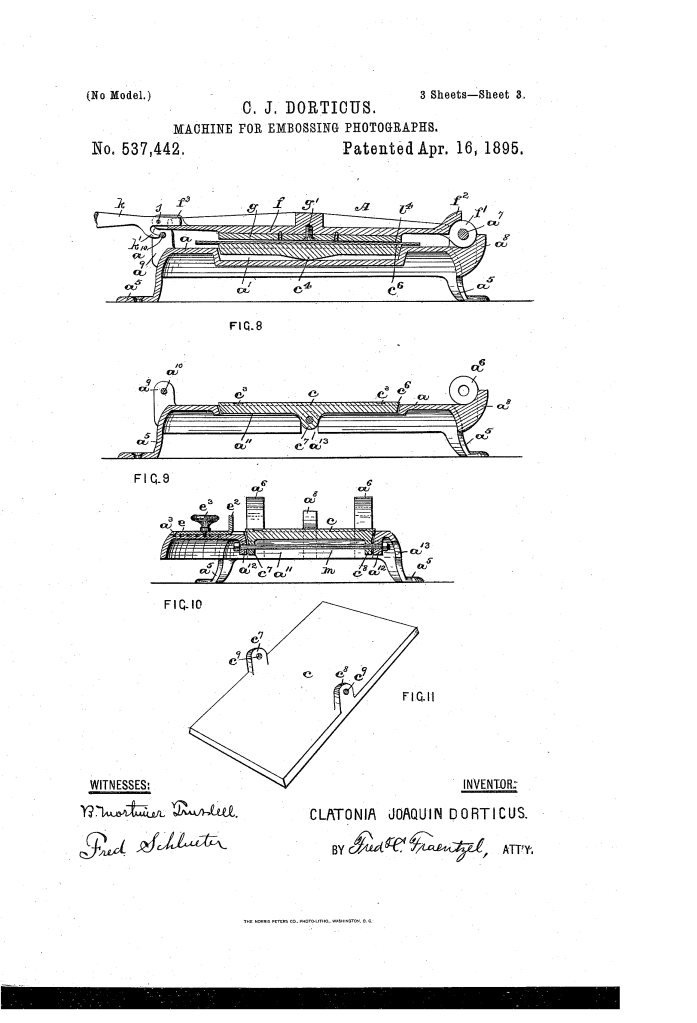
- Rather than pressing straight down rigidly—which could pinch or tear the paper—the lower die (c) features rounded, centrally located rockers or bearings (c³, c⁴).
- As the upper arm descends, the lower die dynamically pivots and self-corrects its angle, bringing the two faces into flawless parallel contact before the final pressure is applied.
How the Apparatus Functions
The machine operates through a straightforward sequence, whether finishes are being applied to a wet print or an intricate border is being stamped:
| Step | Action | Practical Purpose |
| 1. Preparation | The photograph is aligned on the lower die using the adjustable guide plates (e). | Eliminates human error and ensures perfectly centered images. |
| 2. Lowering | The hinged pressure bar (f) is swung downward via its pivot pin (a⁴). | A rear stop (a⁵) prevents the heavy arm from over-rotating when opened. |
| 3. Self-Alignment | The upper male die (l) makes initial contact with the rocking lower die (c). | The die oscillates to evenly distribute initial touch across the entire film. |
| 4. Mechanical Lock | The operator pulls the hand lever (k), forcing its curved jaw (k’) under a fixed locking pin (j). | Compresses the system securely to lock in the embossed texture or squeeze out trapped air. |
Key Mechanical Components
The design relies on a rugged, interconnected assembly built to withstand heavy daily use in a commercial studio:
- Hinged Pressure Bar (f): The heavy-duty upper arm of the machine that holds the corresponding male die (l). It is kept from shifting laterally by dual alignment pins (f⁴).
- Absorbent Fabric Assembly (h): For mounting wet prints, a soft, flexible cloth or blotter is secured to the upper plate by two tensioned wire yokes (i). This material absorbs excess water while compressing air bubbles out of the print.
- Locking Lever (k): A leveraged handle attached directly to the pressure bar that uses mechanical advantage to clamp the press shut with minimal operator effort.
Historical and Scientific Impact
Clatonia Joaquin Dorticus’s machine arrived at a time when photography was transitioning from a highly specialized chemical hobby into a massive commercial enterprise.
- Enhanced Structural Integrity: By safely squeezing out air and moisture under precise, uniform pressure, the machine stopped photographic films from peeling, bubbling, or degrading over time.
- Aesthetic Standardization: The crisp, raised geometric borders produced by the interchangeable dies allowed independent studios to mimic expensive, high-end industrial framing techniques economically.
- Operational Efficiency: Combining two distinct studio tasks—mounting and embossing—into a single footprint saved valuable workspace and reduced equipment costs for small-scale photographers.
About the Inventor: Clatonia Joaquin Dorticus
Operating out of Newton, New Jersey, Clatonia Joaquin Dorticus was an inventive mind who made notable contributions to photographic manufacturing and practical engineering during the 1890s.
- Patents: Beyond this embossing press, Dorticus secured several other patents during the same era, including improvements in photographic print washers and specialized slide holders.
- Commercial Mindset: His inventions focused on refining existing chemical and mechanical processes, making delicate photographic workflows faster, more reliable, and commercially viable for the everyday tradesperson.
Summary of Claims
The patent explicitly protects:
- A mounting and embossing machine featuring a bed plate, a female die, a hinged pressure bar with a male die, and a pivotable locking lever utilizing a holding jaw and pin.
- The integration of mechanical stops on the bed plate to limit the swing of the pressure bar.
- A self-aligning die assembly featuring centrally arranged rocker bearings that allow the die to oscillate, ensuring uniform, edge-to-edge facial contact upon closure.
