


Machine for Cleaning Seed Cotton (1897)
U.S. Patent No. 577,153, granted on February 16, 1897, to Peter Walker, describes an automated pneumatic system for cleaning raw seed-cotton and conveying it directly to ginning tables. Peter Walker, an inventor based in Friars Point, Mississippi, designed this apparatus to streamline agricultural processing by removing dirt, trash, and heavy debris from harvested cotton before it reaches the gin.
This invention solved a critical operational bottleneck in the cotton processing industry: how to efficiently extract unwanted foreign matter—such as dirt, nails, and leaf trash—from bulk seed-cotton while continuously delivering the cleaned material to multiple gin stands without manual handling or clogging the air suction machinery.
The Innovation: The Internal Trash-Retaining Beater Drum
While traditional cotton cleaners utilized external beaters to agitate cotton against stationary screens, Walker introduced a self-contained, rotating hollow drum engineered with internal directional valves. The drum acts simultaneously as a mechanical agitator and an internal trap for fine debris.
The outer shell of the drum features rows of projecting beater arms interspersed with circumferential rows of elongated apertures. As the cotton is drawn over the drum, foreign matter is knocked loose and forced into these slots by mechanical impact and air currents.
Why the Internal Retainer System Works:
- Trapping Efficiency: Stationary curved wings (retainers K) are mounted inside the drum, positioned just beneath the outer shell with overlapping ends to form narrow entry channels.
- Anti-Ejection via Centrifugal Force: Once trash enters the slots, the rapid rotation of the drum uses centrifugal force to sling the particles against the broad, flat sides of the interior wings rather than allowing them to bounce back out into the cotton stream.
- Easy Cleanout Maintenance: Accumulated trash remains safely stored inside the hollow core until operators empty the drum through a hinged access door located on its perforated end face.
Key Technical Components
The system operates as an integrated assembly of cleaning, air-handling, and material-conveying elements:
| Component | Function |
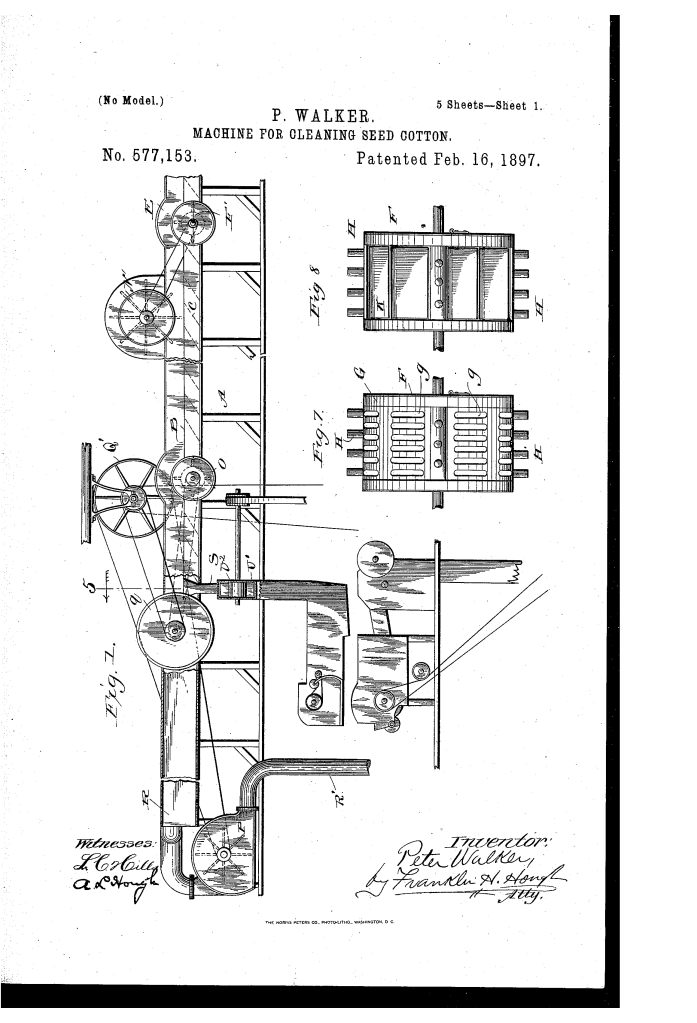
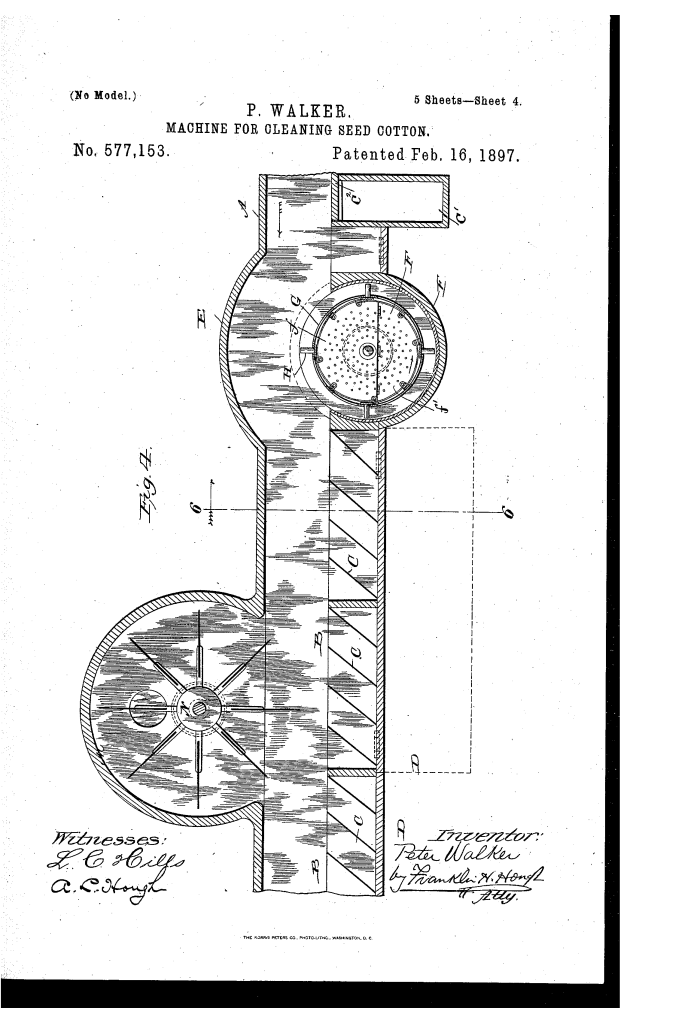
| Primary Trough (A) | The main intake conduit housing a horizontal plane of longitudinal wires (B) that allows heavy debris to fall through while supporting the traveling cotton. |
| Trash Compartments (C, D) | Partitioned, inclined collection bins located beneath the wire floor, fitted with hinged bottom doors (D) for clearing accumulated waste. |
| Debris Pocket (c) | A specialized trap with an adjustable slide gate (c’) located upstream of the beater drum to catch heavy objects like iron nails before they strike rotating parts. |
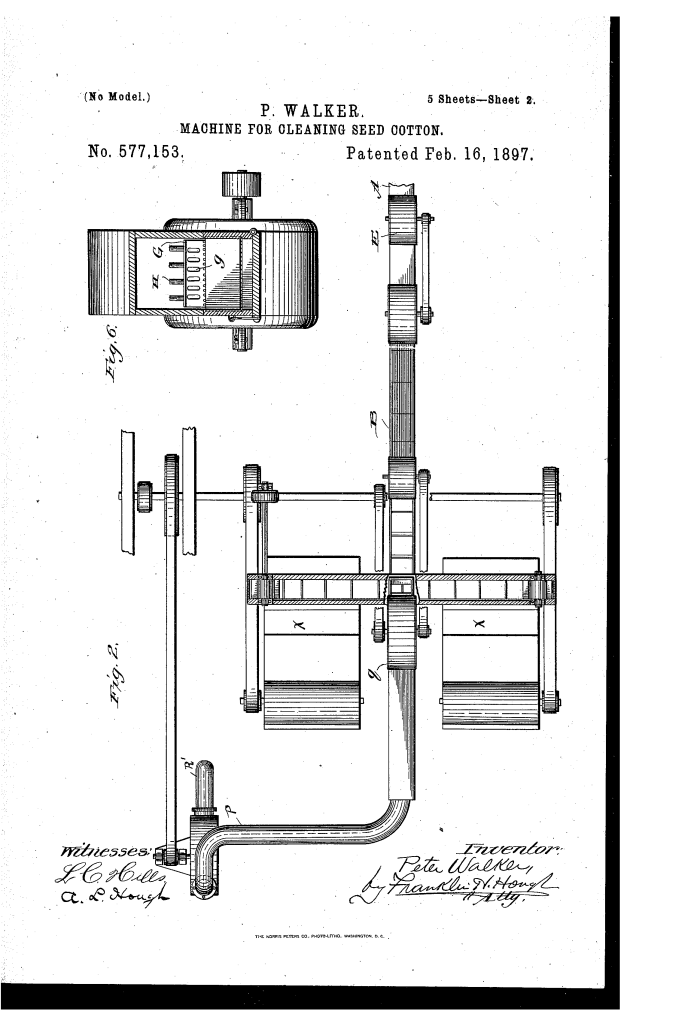
| Beater Drums (F, O) | Hollow cylindrical beaters with beater arms (H), circumferential apertures (g), and internal curved retainers (K) that agitate the cotton and capture fine trash. |
| Pneumatic Air-Wheel (N) | A paddle wheel driven directly by the incoming air stream, linked via a belt (n) to drive the primary beater drum in a counter-rotational direction against the cotton flow. |
| Perforated Screen-Wheel (Q) | A continuously revolving drum with a perforated circumference mounted near the exhaust duct, capturing flying cotton while allowing dust and air to pass through. |
| Suction Fan (P) | An external blower connected via duct (R) that creates the negative air pressure draft required to draw raw cotton through the entire system. |
| Conveyer Box (U) | An endless belt mechanism with fitted flight wings (U’) that forms an airtight seal, creating a partial vacuum in discharge duct (S) so clean cotton falls onto gin tables (X) by gravity without loss of suction. |
System Workflow & Air-Sealing Mechanism
The apparatus uses a coordinated process to clean and transport the cotton while maintaining internal vacuum pressure:
- Intake & Gravity Separation: Seed-cotton is pulled into trough A by suction. Heavy objects fall into pocket c, while loose dirt drops between wires B into the lower compartments.
- Agitation & Primary Cleaning: The cotton strikes the counter-rotating beater drum F. Beater arms H loosen foreign matter, forcing it through apertures g into internal retainers K.
- Secondary Dust Extraction: The cotton travels to screen-wheel Q. Air and airborne dust are pulled through the revolving perforated screen by fan P and exhausted outside via pipe R’, while the cotton clings to the outer surface of the drum.
- Vacuum Delivery: Cleaned cotton drops off the screen wheel into duct S and enters conveyer U. Tight-fitting flight wings U’ isolate the conveyer box from external air, maintaining suction in the main trough while delivering cleaned seed-cotton smoothly to the gin tables.
Historical and Scientific Impact
Peter Walker’s integrated pneumatic cleaner represented a significant step forward in post-harvest agricultural automation during the late 19th century:
- Fire and Damage Reduction: By installing a dedicated trap (c) to capture stray nails and metal fragments prior to agitation, the machine prevented sparks that frequently caused catastrophic gin house fires.
- Automated Material Handling: The combination of suction transport and airtight flight conveyers eliminated manual labor between the unloading bay and the ginning machinery.
- Enhanced Fiber Quality: Removing dirt, dampness, and leaf fragments prior to ginning protected the gin saws from binding and preserved the grade and market value of the cotton lint.
About the Inventor: Peter Walker
Peter Walker was an inventor residing in Friars Point, Coahoma County, Mississippi—a prominent center of agricultural production along the Mississippi Delta during the late 19th century. Operating within one of the most intensive cotton-growing regions in the United States, Walker designed practical machinery engineered to solve real-world processing bottlenecks facing local gin operations. His work on pneumatic conveyance and rotational screening contributed directly to the mechanization of Southern agricultural infrastructure.
Summary of Claims
The patent explicitly claims:
- An apparatus for cleaning and conveying seed-cotton combining a main trough, an air-driven paddle wheel, a beater drum driven by the paddle wheel, and a horizontal floor of longitudinal wires.
- A trough floor structure featuring inclined partitions beneath a wire grid and hinged cleanout doors along the bottom.
- A hollow beater drum featuring perforated end caps, outer circumferential slots, and internal overlapping curved retainer wings designed to trap and hold waste via centrifugal force.
- A revolving perforated screen-wheel paired with an air fan to draw off dust and exhaust it externally while diverting clean cotton to a sealed discharge duct.
