
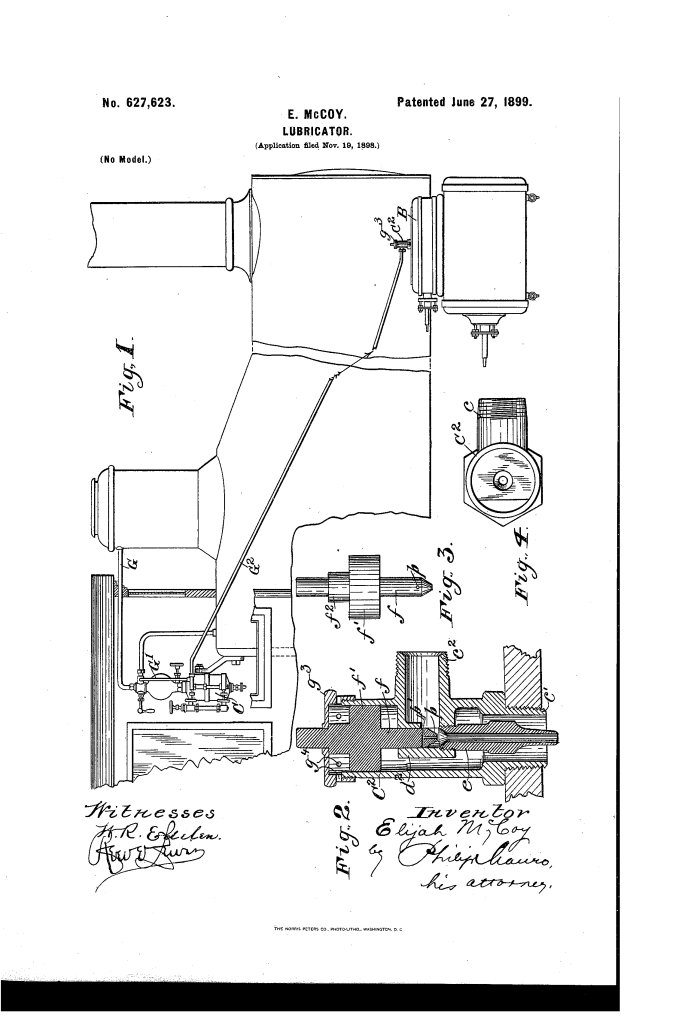
Steam-Cylinder Lubricators (Elijah McCoy, No. 173,032)
The patent by Elijah McCoy describes an Improved Steam-Cylinder Lubricator (Patented 1876). The main goal was to ensure that the engine received a constant supply of pure oil, and not water, a common problem that caused friction and inefficiency in steam engines.
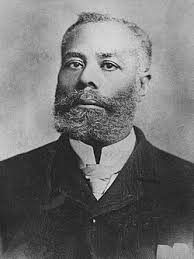
Inventor Background: Elijah McCoy
Elijah McCoy was an exceptionally important African-American inventor whose work on automatic oiling devices was so reliable that it is the likely origin of the phrase, “the real McCoy.” His inventions revolutionized industrial efficiency by allowing steam engines to be lubricated continuously while running.
Invention and Mechanism
This device is a sight-feed oiler built around a central pipe, designed with a clever oil-feed system to prevent contamination by condensed steam.
- The Oil Contamination Problem: Steam is used to push oil into the cylinder, but this steam cools and turns into water inside the oil reservoir. Since oil floats on water, the water would often block the oil’s path, or the engine would end up being fed water instead of oil.
- The New Oil Feed: McCoy fixed this by inventing a specialized regulating tube that sits inside the main pipe. Oil is poured directly into the top of this tube.
- The Clean Delivery: Because the oil is fed from the top and flows directly down onto the main valve, it completely bypasses the lower section where the water tends to collect.
- The Result: This ensures that the only substance reaching the valve, and subsequently the steam cylinder, is the pure, unmixed oil, keeping the engine running reliably without having to stop for manual oiling.
Core Concepts Influenced by This Invention
McCoy’s principles of controlled, automatic lubrication are essential to modern industrial machinery.
- Sight-Feed Lubrication: The foundational idea of using a regulated valve and gravity-feed system to introduce oil into a high-pressure environment is the basis for all modern sight-feed oilers and constant-level lubricators , common on industrial pumps and gearboxes.
- Contamination Prevention: The design that deliberately segregates the oil supply from the water condensation by feeding the oil from the top influenced the design of modern oil reservoir systems that use internal channels and baffles to ensure only clean lubricant reaches the moving parts.
- Reliable Automatic Oiling: This invention advanced the concept of continuous, hands-free lubrication, which was his signature contribution to industrial efficiency.
