
Improvement in Lubricators (1898)
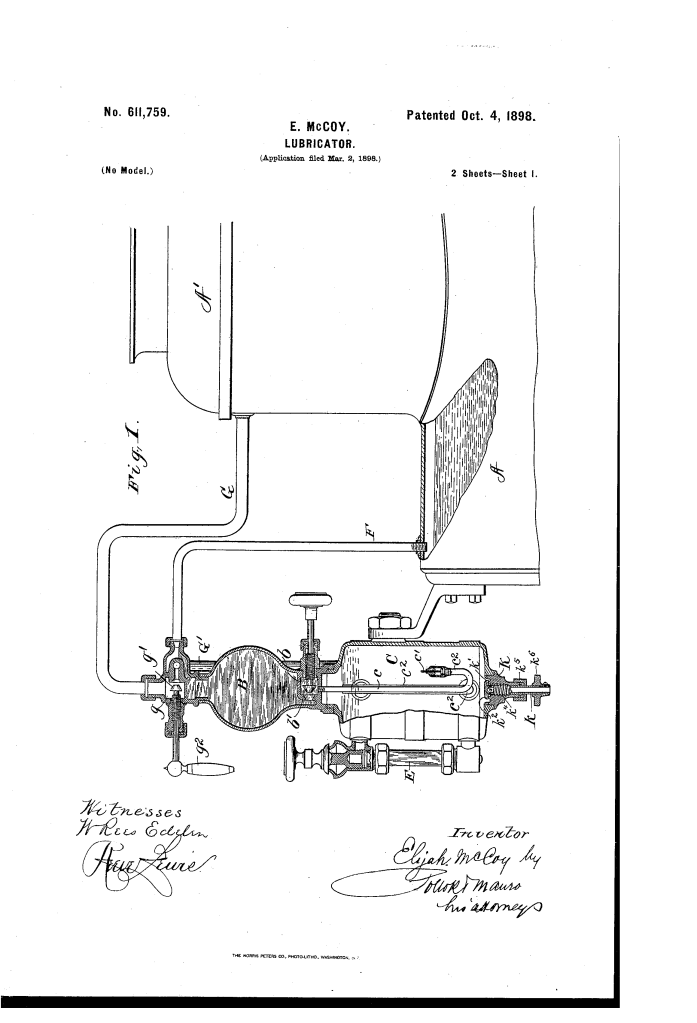
U.S. Patent No. 611,759, granted on October 4, 1898, to Elijah McCoy (assigned to the Detroit Sheet Metal and Brass Works), details an advanced sight-feed lubricator engineered specifically for locomotive engines. Elijah McCoy, one of the most prolific inventors of the late 19th and early 20th centuries, dedicated much of his career to perfecting continuous, automated lubrication systems for heavy industrial machinery and railroads.
This invention directly solved a persistent and dangerous operational flaw in conventional locomotive lubricators: erratic oil delivery caused by fluctuating back-pressure from the engine’s steam-chest. McCoy redesigned the internal mechanics to guarantee an uninterrupted, finely atomized oil supply regardless of throttle position, while simultaneously eliminating oil loss through boiler backflow.
The Innovation: Independent Overpressure and Continuous Propulsion
Standard sight-feed lubricators of the late 1800s relied on equalizing pipes that routed steam directly from the condenser to carry oil into the tallow-pipe. Whenever an engineer opened the throttle, back-pressure from the steam-chest spiked, often overcoming the carrier steam and completely halting lubrication. Additionally, conventional systems forced the steam and oil through a contracted atomizing orifice behind the nozzle, creating a bottleneck that regularly clogged.
McCoy solved this with two major mechanical departures:
- Independent Overpressure Supply: He severed the connection between the condenser supply and the oil-propelling steam. Condenser steam is drawn via pipe F, while a separate pipe G runs directly from the steam-dome A’ straight to an independent valve chamber g atop the condenser. This ensures an uninterrupted supply of high-pressure live steam unaffected by water-level swings or condensing rates.
- Direct-Current Oil Induction: Instead of choking the line with a narrow atomizing chamber behind the nozzle, McCoy eliminated the restrictive orifice entirely. The live steam pipe G’ meets the oil directly at the elbow of the upper sight-feed arm h2, front-loading the carrier current right as the oil emerges from orifice h1 into the tallow-pipe G2. The natural kinetic energy of the sweeping steam atomizes the lubricant instantly without mechanical throttling.
Preventing Backflow and Reservoir Loss
Another critical vulnerability in older designs was the siphoning or floating off of costly cylinder oil back into the boiler whenever water filled the lines or a vacuum developed. McCoy introduced a failsafe dual protection system:
- Weighted Puppet-Valve (c1): Installed at the upturned lower end of condenser pipe c, this valve lifts under hydrostatic pressure to displace oil, but slams shut automatically the moment counter-pressure or vacuum draws backward.
- Integral Water Trap (c2): The elbow bend in pipe c forms a permanent liquid barrier that prevents buoyant oil from floating upward into the condensing apparatus.
The Vibration-Proof Drain Valve
Locomotive operation subject components to violent vibration, which routinely loosened traditional threaded drain plugs and dumped oil reservoirs onto the roadbed. McCoy completely inverted the mechanics of the drain valve:
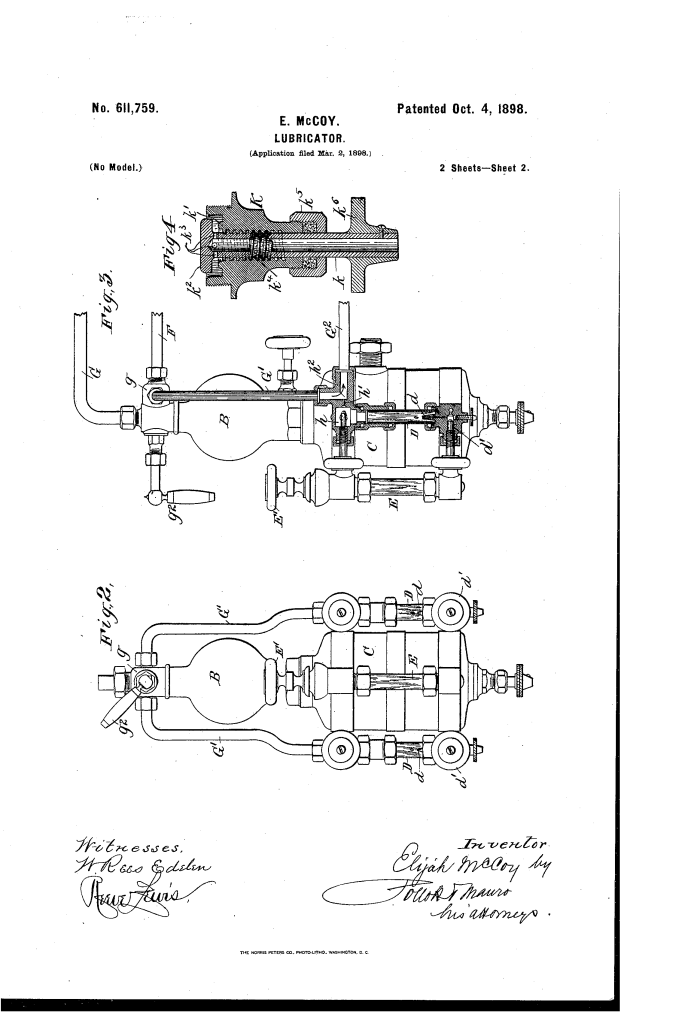
- Downward-Seating Disk (k2): The valve disk closes downward onto an elevated annular seat k1, meaning internal reservoir pressure tightens the seal rather than forcing it open.
- Left-Hand Threading (k4): The internal stem utilizes left-handed threads. Under vibration, internal fluid pressure naturally applies torque in the closing direction. Crucially, the valve still operates normally for the engineer: turning the handwheel k6 to the right closes it, preserving standard operating habits without relying on friction alone.
- Captive Stem: Assembled from the inside through body K with packing-box k5, the stem cannot vibrate loose or fall out and become lost on the tracks.
Key Mechanical Components
The lubricator functions as an integrated assembly of distinct fluid circuits:
| Component | Function |
| Steam Pipe F | Delivers live boiler steam to condenser B and doubles as an overflow return pipe. |
| Overpressure Pipe G / G’ | Dedicated steam conduit from dome A’ that propels oil through tallow-pipe G2 to the steam-chest. |
| Condenser Water Pipe c | Routes condensed water to bottom of reservoir C to displace lubricant upward. |
| Puppet-Valve c1 & Trap c2 | Weighted one-way valve and water seal preventing siphoning or backward oil loss into the boiler. |
| Sight-Feed Arm Elbow h2 | Direct junction point where high-velocity live steam shears and atomizes oil exiting orifice h1. |
| Inverted Drain Valve K | Bottom drain featuring left-hand threads and a downward-closing seat resistant to engine jar. |
Historical and Industrial Impact
McCoy’s 1898 design marked a critical advancement in heavy transport reliability during the expansion of the American railway network:
- Elimination of Throttle Stalls: Locomotives could transition from coasting to full throttle under maximum load without the cylinders running dry or burning out valves.
- Prevention of Oil Overheating: By routing high-temperature equalizer pipes away from the reservoir housing, McCoy stopped oil breakdown and carbonization before it reached the cylinders.
- Universal Retrofitting: McCoy designed the drain valve body K to standard external dimensions, enabling railway repair yards to upgrade existing stock without replacing entire reservoir casings.
About the Inventor: Elijah McCoy
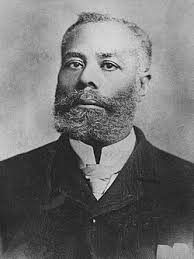
Elijah McCoy was a pioneering African American inventor and mechanical engineer who held 57 United States patents, primarily focusing on lubrication systems for steam engines and factory equipment. Trained in Scotland as a mechanical engineer, McCoy was famously barred from working as an engineer on American railroads due to racial prejudice and initially worked as a locomotive fireman.
Recognizing firsthand the inefficiency and hazards of stopping trains for manual oiling, he developed automatic displacement and sight-feed lubricators that transformed industrial productivity across the globe, cementing his legacy as a titan of industrial engineering.
Summary of Claims
The patent explicitly claims:
- An overpressure steam pipe drawing from a source independent of the condenser supply, routed directly into the tallow-pipe junction with the sight-feed chamber.
- An elbow arrangement in the sight-feed casing where oil is drawn into the carrier steam current through an orifice via suction rather than forced atomization orifices.
- A condenser-to-reservoir feed pipe equipped with a backflow-prevention valve and a siphon-stopping water trap.
- A reservoir drain valve combining an internal downward-closing disk with left-handed threads to resist loosening from operational vibration.
