
Lubricator (1892)
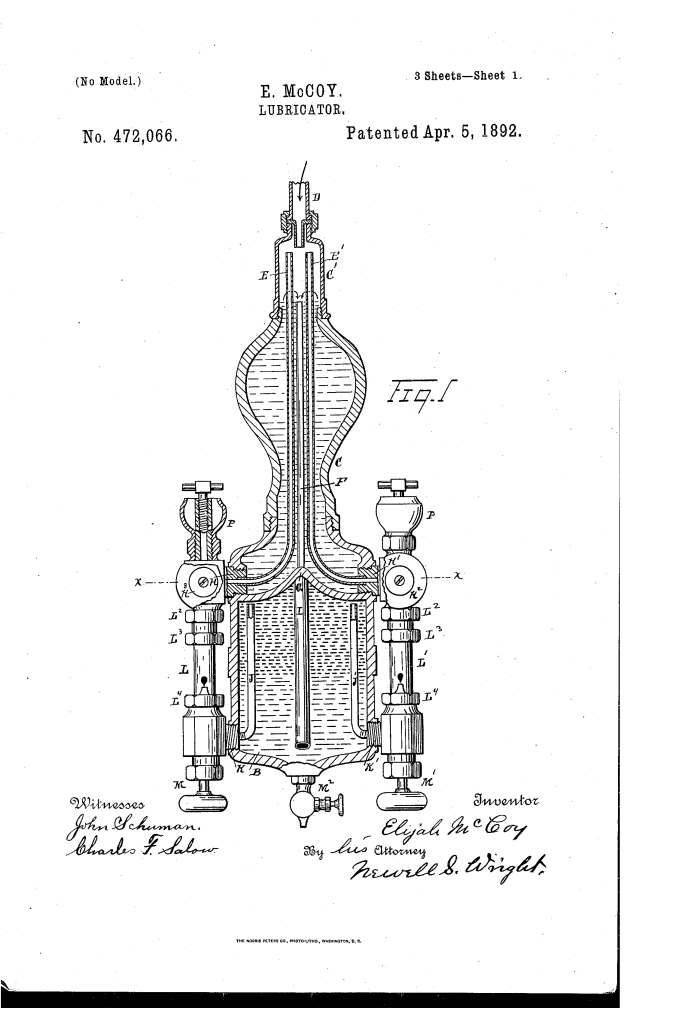
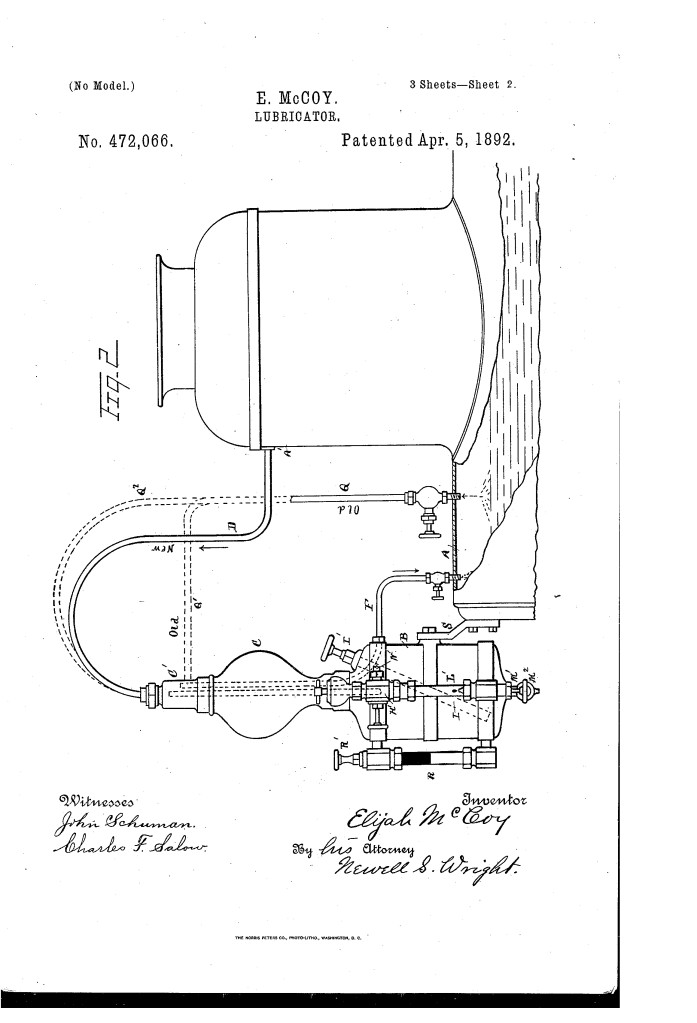
U.S. Patent No. 472,066, granted on April 5, 1892, to Elijah McCoy, details an advanced equalizing locomotive lubricator. Designed to maintain a continuous, automated flow of oil to vital engine parts under fluctuating steam pressures, this invention dramatically increased mechanical efficiency while eliminating the dangerous necessity of manual oversight during operation.
Elijah McCoy—a highly prolific engineer and pioneer in mechanical automation—developed this specific apparatus to solve a critical, chronic failure in existing locomotive systems: the frequent loss of pressure balance, which routinely disrupted the oil feed, clouded the indicator glasses, and risked catastrophic engine wear.
The Innovation: The Independent Overpressure and Overflow System
In early steam locomotives, oil required a constant overpressure of steam to properly atomize (break into a fine mist) and travel into the working cylinders. Previous lubricators forced incoming steam and surplus condensation water to share the same narrow pipe leading back to the boiler.
McCoy realized that forcing fluids in opposite directions through a single channel caused a bottleneck. If an engineer overfilled the boiler or if the water began foaming, the pipe became submerged. This stalled steam circulation, destroyed the vital pressure equilibrium, and stopped the oil from moving.
McCoy’s breakthrough relied on an absolute structural separation of these pathways:
- The Independent Steam-Inlet (D): Draws dry steam directly from the locomotive’s dome high above the water line, feeding it cleanly into the top of the condensing chamber.
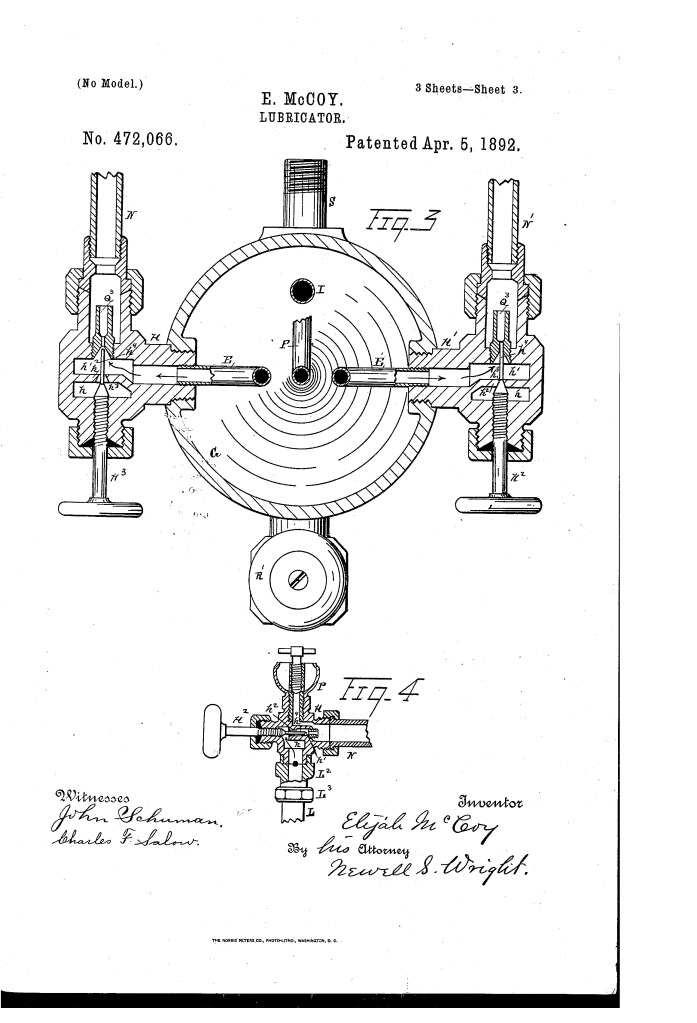
- Dual Equalizing Pipes (E, E): Extended high inside the condenser above the water level, isolated from structural sediment.
- The Independent Overflow Pipe (F): Directed strictly downward through the base of the condenser into the boiler shell, carrying away surplus water without obstructing incoming steam.
Why Separation Mattered
- Constant Overpressure: Because the steam inlet and overflow lines operate independently, steam velocity never falters, ensuring a perfectly steady, unclouded drop-by-drop visible feed.
- Thermal Protection: The equalizing pipes are constructed completely separate from the central diaphragm dividing the oil reservoir. Submerged in cool condensation water right up to their connection points, they prevent the main housing from overheating, eliminating the uneven metal expansion that routinely shattered glass components.
Key Technical Components
The apparatus works as a precisely balanced hydrostatic and pneumatic network:
| Component | Function |
| Oil Reservoir (B) | Holds the primary supply of lubricant, pressurized from the bottom by displaced condensation water. |
| Condensing Chamber (C) | A bulb-shaped upper vessel that cools live steam into water to consistently drive the oil displacement. |
| Sight-Feed Glasses (L, L) | Heavy glass tubes that allow engineers to visibly monitor the exact frequency of oil drops rising through the water. |
| Atomizing Chamber ($h’$) | A specialized upper pocket where oil mixes with high-velocity steam to form a mist before entering the engine. |
| Perforated Diaphragm ($h^2$) | A built-in metal shield that traps heavy sediment, protecting the top of the sight-glass from erosive wear. |
| Tallow Pipes (N, N) | The exit lines that deliver the atomized oil directly to the locomotive’s steam chests and cylinders. |
Performance: Operational Integrity and Safety
McCoy’s design introduced unprecedented safety mechanisms that allowed maintenance to occur at full speed, tackling structural hazards that previously crippled train schedules.
The Dual-Purpose Needle Valve
In older designs, if coal soot or oil residue clogged the narrow delivery nozzle, engineers had to shut down the throttle, slow the train to a halt, and climb onto the running boards to apply oil manually. McCoy integrated an elongated needle-point valve (h4):
- Seated Action: Closing the valve shuts off the oil path while simultaneously forcing the needle tip entirely through the nozzle opening.
- Instant Clearing: This punching action instantly clears out accumulated sediment. The engineer can clear a blockage mid-journey without dropping locomotive speed or losing sight-feed monitoring.
Hot-Swappable Components
If an operating sight-glass fractured due to thermal shock, it usually resulted in a dangerous spray of scalding oil and steam. McCoy introduced isolated upper and lower packing nuts (L3, L4). By closing the surrounding control valves, an engineer could fully isolate the broken column, unscrew the broken fragments, and pop in a fresh glass tube while the train was fully underway—all without losing a drop of system lubricant.
About the Inventor: Elijah McCoy
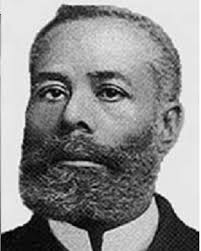
Elijah McCoy was one of the most brilliant and foundational figures in the history of mechanical engineering.
- Prolific Output: Born in Canada to fugitive slaves who escaped via the Underground Railroad, McCoy trained in Scotland as a mechanical engineer. Despite facing severe racial barriers upon arriving in the United States, he went on to secure more than 50 patents, many dedicated entirely to pioneering automatic lubrication systems.
- Industrial Impact: Before McCoy’s automated cups and equalizing lubricators, machinery had to be stopped periodically to be oiled by hand, causing massive industrial downtime and transit delays. His designs allowed trains, transoceanic vessels, and massive factory lines to run continuously for days on end.
- The Legacy of “The Real McCoy”: McCoy’s lubrication systems were so vastly superior to cheap imitations that engineers inspecting new machinery would routinely ask if the apparatus was equipped with “the Real McCoy”—coining an enduring phrase that remains synonymous with authenticity and unparalleled quality.
Summary of Claims
The patent explicitly claims:
- A locomotive lubricator featuring an independent steam pipe from the dome and a completely separate overflow pipe to maintain constant overpressure without fluid conflict.
- Equalizing pipes built completely independent of the reservoir diaphragm and submerged in condensation water to prevent thermal expansion and sight-glass breakage.
- An upper sight-feed arm containing an atomizing chamber separated by a perforated valve-seat partition, controlled by a valve with an elongated needle-point for instant sediment removal.
How This Patent Differed from Previous Lubricators
This 1892 design represented a massive evolutionary leap over McCoy’s own earlier innovations (such as his 1885 patent, No. 320,379) and other standard lubricators of the era in three distinct ways:
1. Two Dedicated Channels Instead of One Dual-Purpose Pipe
In older lubricators, a single pipe was forced to pull double duty: delivering live steam into the condenser while simultaneously draining excess condensation water back into the boiler. McCoy openly notes in this specification that it is “obviously impossible… for steam to enter and surplus water to overflow through the same channel at the same time.” By separating these into Pipe D (steam only) and Pipe F (overflow only), he completely eradicated the internal bottleneck that routinely stalled older systems.
2. Immunity to Boiler Overfilling and Foaming
Older systems pulled steam from the side or horizontal shell of the boiler. If an engineer let the boiler get too full, or if the water began violently foaming, the lower opening of the steam channel became submerged. This immediately cut off steam circulation, equalized the internal pipes, and killed the oil feed. McCoy solved this by drawing dry steam via an independent line running directly from the boiler dome—the highest physical point of the locomotive—ensuring a constant, uninterrupted supply of pressurized steam regardless of the boiler’s water level.
3. Separation of Heat to Protect Sight Glasses
A major flaw in previous lubricators was that equalizing pipes traveled through cored passages inside the main body of the oil reservoir. This transferred intense heat directly to the outer casing, causing the metal housing to violently expand and contract, which routinely shattered the delicate sight-feed glasses and overheated the oil supply. McCoy’s 1892 design completely isolated the equalizing tubes from the dividing diaphragm, wrapping them in cool, condensed water right up to the point where they meet the sight-feed arms, completely neutralizing thermal stress.
