
Lubricator Supporting-Arm (1891)
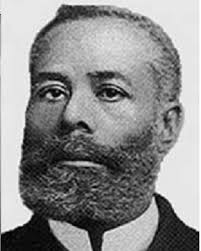
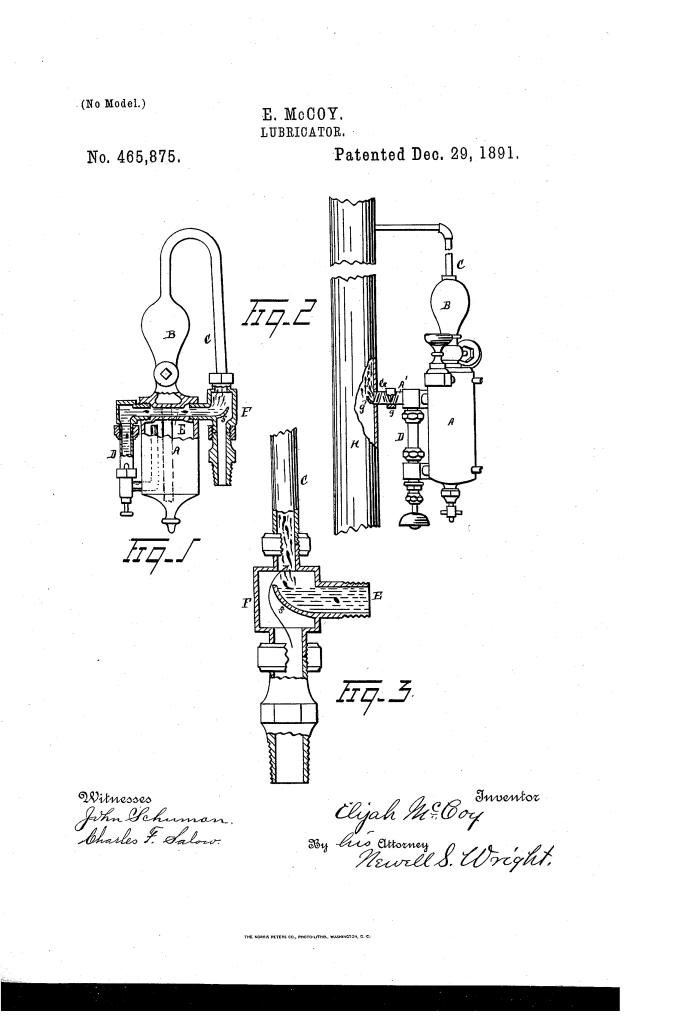
U.S. Patent No. 465,875, granted on December 29, 1891, to Elijah McCoy, introduces a critical refinement to the “sight-feed” lubricator systems used in steam engines. McCoy, a prolific inventor based in Detroit, Michigan, held dozens of patents that revolutionized how machinery was oiled, earning him a reputation for quality that many believe inspired the phrase “The Real McCoy.”
This specific invention solved a dangerous and costly maintenance issue: the frequent shattering of glass sight-feed indicators due to extreme temperature fluctuations and the slow “priming” of the lubrication system.
The Innovation: The “Diverting Lip”
In 19th-century steam engines, a “sight-feed” glass allowed engineers to see the oil dripping into the system to ensure the engine was properly lubricated. However, these systems relied on steam condensing into water to move the oil. Before McCoy’s improvement, steam would often enter the glass chamber directly, heating it intensely before it could fill with cool water. When the water finally arrived, the thermal shock often caused the glass to explode.
McCoy’s breakthrough was the addition of a diverting lip (f) located within the supporting arm of the lubricator.
Why the Diverting Lip?
- Rapid Filling: It acts as a mechanical “catch,” funneling condensed water immediately into the sight-feed chamber rather than letting it bypass the opening.
- Thermal Protection: By filling the glass with water “instantly,” it prevents live steam from entering the chamber. This keeps the glass at a stable temperature and prevents breakage.
- Component Longevity: By keeping the system filled with water, it protects the rubber gaskets and the oil reservoir from overheating and losing their structural integrity.
Key Mechanical Components
The apparatus is a sophisticated pressure-balanced system where water displacement drives the lubrication:
| Component | Function |
| Oil Chamber (A) | The reservoir holding the lubricant for the engine. |
| Condensing Chamber (B) | Where steam is converted into water to provide the hydrostatic pressure needed to move the oil. |
| Steam Tube (C) | Located outside the chamber to expose it to the atmosphere, promoting faster condensation. |
| Sight-Feed Glass (D) | The transparent tube that allows the operator to monitor the oil flow. |
| Diverting Lip (f/g) | The “key” innovation that catches descending water drops and directs them into the sight-feed channel. |
| Channel (E) | The conduit that carries the diverted water across the top of the reservoir to the glass. |
Performance: Solving the “Dry Start”
Before this patent, it took “considerable time” for the sight-feed chamber to fill with water. During this delay, the engine was at risk of running dry or the glass was at risk of bursting.
McCoy’s System Advantages:
- Instant Cooling: The water reaches the glass before the heat of the steam can stress the material.
- Consistent Flow: The lip ensures that the water column is maintained, which in turn carries the oil drops through the system with high precision.
- Versatility: The patent describes versions for vertical arms (used in air-brakes and traction engines) and horizontal arms (used in stationary engines).
The Manufacturing Logic
McCoy outlined a design that could be integrated into existing engine architectures:
- Enlarge the internal steam channel of the supporting arm.
- Project the lip entirely across the mouth of the steam pipe.
- Position the lip so that steam can still flow around it to reach the condenser, while the heavier water running down the walls is trapped and diverted.
About the Inventor: Elijah McCoy
Elijah McCoy was one of the most influential mechanical engineers of the late 19th century, specifically within the railroad industry.
- Patents: He held over 50 patents, most of which focused on “automatic lubrication.” Before his inventions, trains had to stop frequently for “tallow johns” to manually oil the axles and pistons.
- Impact: His “lubricating cup” and subsequent refinements (like this supporting arm) allowed trains to run faster and for longer distances without stopping, significantly increasing the efficiency of the American railroad.
- Legacy: Despite facing the systemic racism of the era, McCoy’s designs were so superior that engineers would specifically ask for “the Real McCoy” to avoid inferior imitations. He was inducted into the National Inventors Hall of Fame in 2001.
Summary of Claims
The patent explicitly claims:
A specific configuration where the water channel (E) extends across the top of the oil reservoir to reach a sight-feed chamber located on the opposite side.
A diverting lip arranged within a hollow arm at the intersection of the water channel.
The extension of the lip across the entrance of the steam pipe to catch descending condensation.
