
Lubricator (Improved), Elijah McCoy and Clarence B. Hodges, Patent No. 418,139
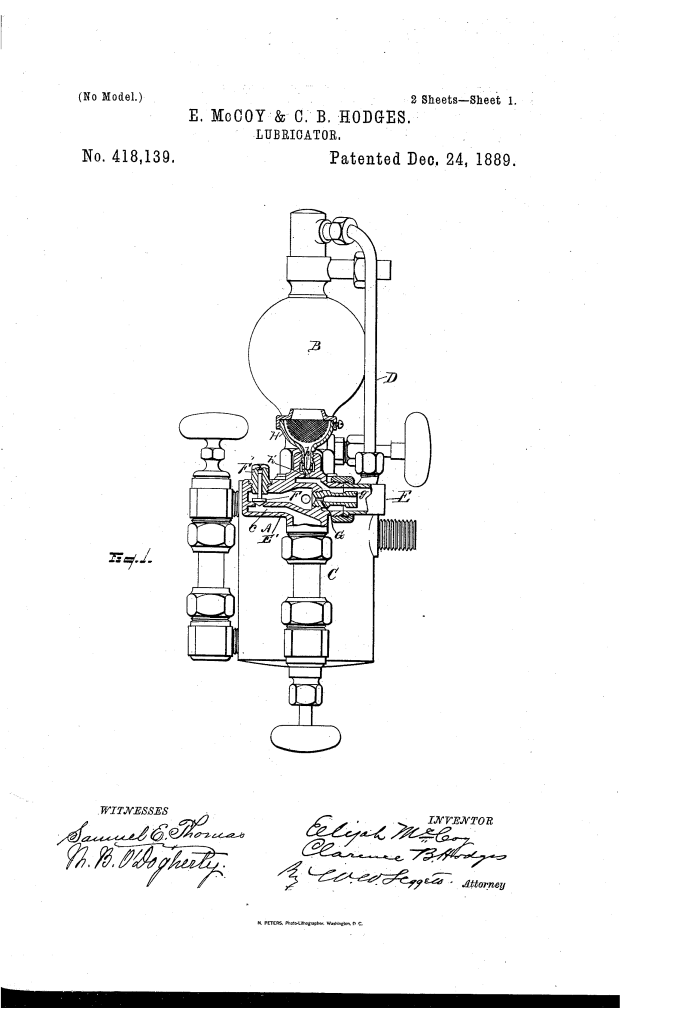
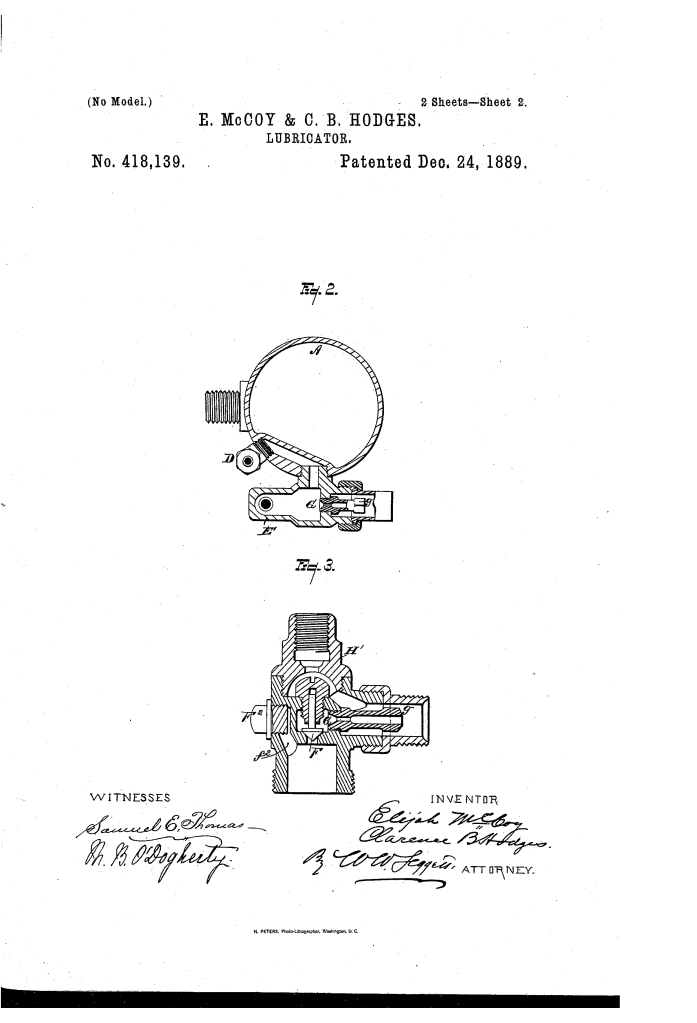
The patent by Elijah McCoy and Clarence B. Hodges of Detroit, Michigan describes an Improved Lubricator (Patent No. 418,139). This invention is a sophisticated technical evolution of McCoy’s earlier automated oiling systems. While his original 1872 “Drip Cup” proved that machines could be oiled while in motion, this 1889 iteration introduces critical safety and regulation features designed specifically for the higher pressures of late-19th-century locomotive engineering.
The “Why”: Solving the Next Generation of Problems
By 1889, the “pain point” had shifted. The original challenge—stopping the train to oil the axles—had been solved by McCoy’s earlier work. However, as steam engines became more powerful, a new danger emerged: the Sight-Feed Glass. These glass tubes allowed engineers to monitor oil flow, but they frequently shattered under high pressure, spraying the cab with scalding steam. McCoy’s “New Innovation” was designed to make these modern, high-pressure systems safe for the men operating them.
Inventor Section: The Philosophy of Iteration
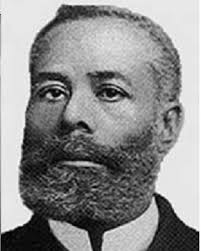
Elijah McCoy’s engineering philosophy was defined by continuous improvement. Born to parents who escaped slavery, McCoy’s transition from a “fireman” on the railroad to a world-renowned engineer was fueled by his ability to identify flaws in existing technology—including his own. He understood that a patent is not a final destination, but a version. This 1889 patent showcases his move from simple mechanical dripping to complex fluid dynamics and pressure equalization.
Key Systems Section: The Improvements
Automatic Safety Check-Valve
- Modern Term: Fail-Safe Isolation Valve.
- The Evolution: Unlike early lubricators that remained “open” to the system, this version features a valve (F) that sits in a water-filled chamber. If the sight-glass breaks, the pressure differential causes the valve to snap shut instantly, stopping the steam before it can injure the engineer.
Restricted Throat Nozzle (G)
- Modern Term: Venturi Effect Injector.
- The Evolution: Early models struggled with “pulsations” (surges of steam that disturbed the oil). This nozzle creates a localized pressure drop, allowing for a steady, metered flow of oil regardless of engine speed.
Integrated Auxiliary Oiler (H)
- Modern Term: Redundant Bypass System.
- The Evolution: Recognizing that the main system might need maintenance or cleaning, McCoy integrated a secondary “cup” that allows for manual lubrication without disabling the entire device.
Comparison Table: The Evolution of the “Real McCoy”
| Feature | The 1872 Original (V1) | The 1889 Improvement (V2) |
| Primary Goal | Stop the need for manual oiling. | Ensure safety during high-pressure operation. |
| Visual Feedback | None (Engineer “guessed” the flow). | Sight-Feed Glass (Visible monitoring). |
| Failure Mode | Relatively low-risk. | Automatic Shut-off for shattered glass. |
| Fluid Control | Gravity and simple displacement. | Venturi/Hydrostatic pressure regulation. |
Significance Section: The Legacy of Refinement
- Industrial Safety Standards: This patent moved the industry toward “passive safety,” where the machine protects the human automatically.
- Foundational Fluid Dynamics: The use of the restricted nozzle to create suction is a direct ancestor to modern fuel injection and HVAC pressure regulators.
- Defining “The Real McCoy”: This version solidified the phrase; it wasn’t just a lubricator, it was the perfected lubricator that didn’t fail under pressure.
