
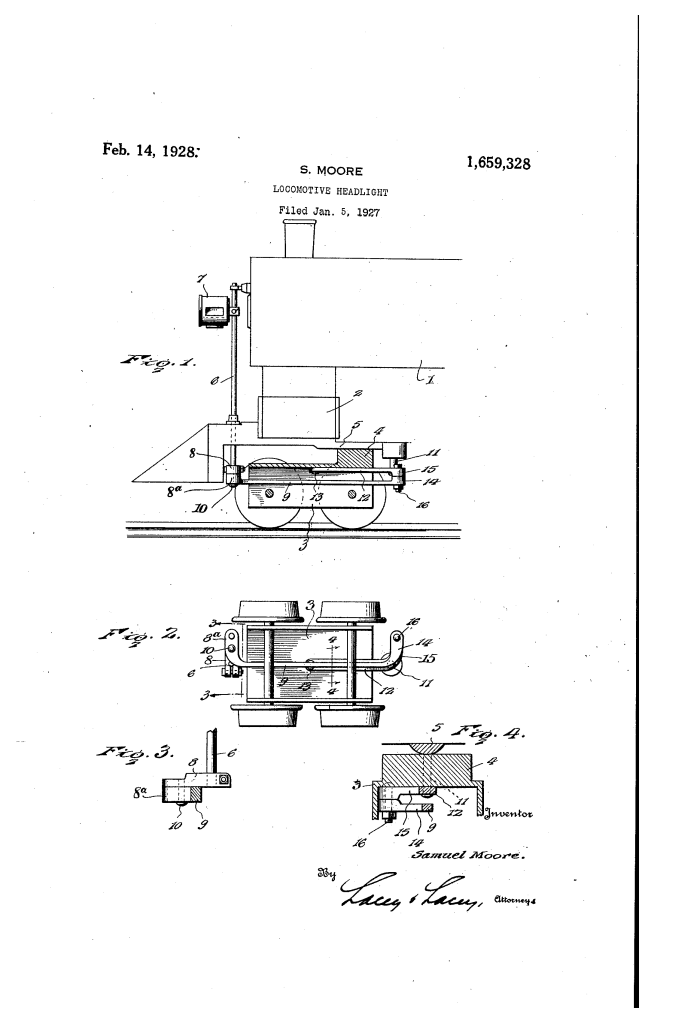
Locomotive Headlight (Samuel Moore, No. 1,659,183)
The patent by Samuel Moore of Cleveland, Ohio, describes a Locomotive Headlight mechanism (Patent No. 1,659,183, 1928). This invention is a “dirigible” lighting system that utilizes the mechanical movement of the locomotive’s pilot truck to automatically steer the headlight. Moore’s primary objective was to ensure that the track ahead remains illuminated even when the locomotive is navigating sharp curves, significantly improving night-time safety for engineers. His innovation provides a “bolt-on” solution that can be installed on existing engines without requiring expensive structural modifications to the boiler or chassis.
Inventor Background: Samuel Moore
Samuel Moore was an African American inventor and engineer who specialized in automotive and railway safety systems during the 1920s. This 1928 patent is part of a series of designs he developed to solve the “blind curve” problem in transportation. In the early 20th century, standard locomotive headlights were fixed and pointed straight ahead; on a curve, the light would shine into the woods while the track remained in total darkness. Moore’s work represents a sophisticated application of mechanical linkage logic, translating the complex lateral and tilting movements of a “floating” pilot truck into precise rotational movement for the headlight.
Key Mechanical & Functional Systems
The mechanism uses the pivoting action of the wheels to pull and push a series of bars that rotate the light.
1. The Vertical Post and Headlight (6, 7)
- The Post (6): A heavy vertical rod is mounted in bearings at the front of the locomotive boiler.
- Adjustability: The headlight (7) is mounted on this post and can be adjusted vertically to suit different locomotive sizes.
- Function: Because the light is fixed to the post, any rotation of the post results in an identical rotation of the light beam.
2. The Pilot Truck Interface (3, 4, 11)
- The Pilot Truck (3): This is the leading set of wheels that “guides” the locomotive into a turn.
- King Bolt (11): A heavy bolt projects down from the locomotive substructure to act as a pivot point for the steering linkage.
- Function: The pilot truck naturally shifts laterally (sideways) when it hits a curve. This shift is the “input signal” that powers the entire mechanism.
3. The Compounded Linkage (8, 9, 12) (Key Innovation)
The motion is transferred through three main components:
- The Steering Bar (12): Pivoted at one end to the king bolt and at the other to the truck frame. It has a lateral extension (14).
- The Longitudinal Bar (9): This bar runs the length of the truck. One end (15) is pivoted to the steering bar, and the other (8′) is curved laterally.
- The Post Arm (8): A horizontal arm clamped to the bottom of the headlight post.
- Action: As the truck (3) moves sideways in a curve, it swings Bar 12. This pulls or pushes Bar 9, which in turn pulls the Arm 8, rotating the headlight.
4. The Adjustment Pins (10)
- Variable Geometry: The connection between the longitudinal bar and the post arm features a pivot (10) with multiple adjustment holes.
- Function: This allows railroad mechanics to “tune” the sensitivity of the light. They can set the mechanism so that a small turn of the wheels results in either a large or small swing of the light, depending on the typical curvature of the specific rail line.
Improvements Over Standard Fixed Headlights
| Feature | Fixed Locomotive Headlights | Moore’s Dirigible Headlight |
| Visibility | Limited to straightaways; curves are blind. | Self-adjusting; illuminates the track ahead in curves. |
| Installation | Required factory-level integration. | Readily installed on engines already in service. |
| Mechanical Stress | No connection to moving parts. | Floating-type design accommodates truck tilting and vibration. |
| Cost | Baseline standard. | Inexpensive compared to the safety advantages provided. |
Significance to Engineering and Railway Safety
Samuel Moore’s locomotive headlight influenced the development of dynamic illumination and synchronized steering systems.
- Adaptive Lighting Logic: Moore’s mechanical solution for “seeing around corners” is the direct ancestor of the active swiveling headlights found on modern high-speed trains and luxury automobiles.
- Mechanical Translation: The ability to convert the lateral “floating” movement of a railway truck into the rotational movement of a lamp required a deep understanding of kinetic linkages and tolerance for vibration.
- Active Safety Engineering: Moore’s design prioritized the “engineer’s observation,” recognizing that human reaction time is dependent on the quality of visual data provided by the machine.
- Standardization: By creating a system that didn’t necessitate “any change in the construction or arrangement of parts,” Moore practiced an early form of modular engineering, allowing for rapid safety upgrades across entire fleets.
