
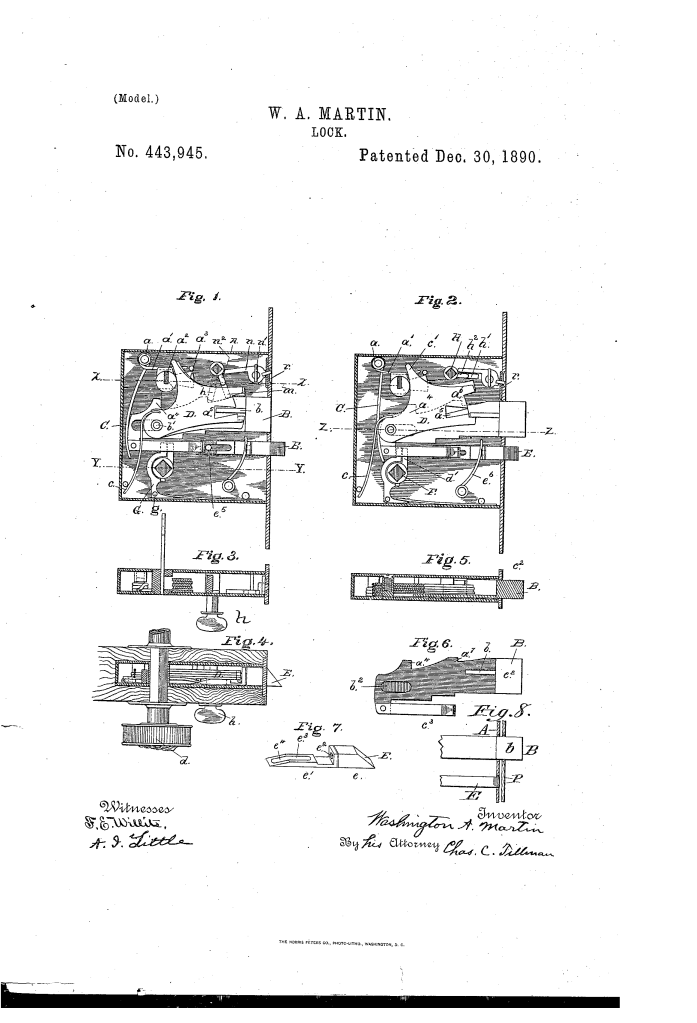
Mortise Lock, Washington A. Martin, Patent Number: 443,945
The patent by Washington A. Martin of Chicago, Illinois describes a Lock (Patent No. 443,945), dated December 30, 1890. This invention is an improved mortise lock mechanism featuring an automatic triggering system and a universal swivel-end latch, designed to enhance the security and adaptability of door hardware.
The “Why”
In the late 19th century, door locks were often cumbersome and “handed”—meaning a lock bought for a right-swinging door could not be used on a left-swinging door without significant modification. Furthermore, standard locks of the era required manual locking or relied on simple spring latches that were easily “shimmied” or bypassed. Martin sought to solve the pain point of hardware inflexibility and the need for a self-bolting mechanism that secured the door automatically upon closing.
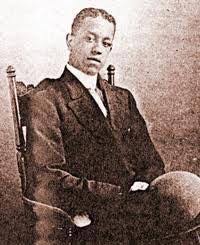
The Inventor: Washington A. Martin
Washington A. Martin was an innovator operating during the height of the American Industrial Revolution in Chicago. His engineering philosophy centered on mechanical modularity. By designing components that could be adjusted or inverted (like his swivel-end trigger), he anticipated the modern need for standardized, “one-size-fits-all” industrial parts. His work reflects the era’s transition from hand-forged, specific hardware to precision-engineered, mass-producible security devices.
Key Systems Section
Universal Swivel-End Trigger
- Modern Equivalent: Reversible Latch Bolt.
- Martin’s “trigger” (Piece E) features a beveled head connected via a swivel pin. This allows the bevel to be rotated to face either direction, enabling the lock to function on both right and left-handed doors without disassembling the entire internal casing.
Automatic Bolt-Release Mechanism
- Modern Equivalent: Deadlocking plunger.
- The system uses a trigger and a trip spring (Spring 0). When the door closes, the trigger is depressed by the strike plate, which “liberates” the main bolt (Bolt B). A heavy-duty spring (Spring C) then “shoots” the bolt forward into the socket, ensuring the door is deadbolted automatically.
Multi-Tumbler Security Stack
- Modern Equivalent: Lever tumbler system.
- The lock utilizes four pivotally secured tumblers (D) with varying “gates” (recesses a and a’). These tumblers must be perfectly aligned by the bits of the key to allow the bolt’s locking lug (Lug b) to pass, providing a high level of pick resistance for the 1890s.
Comparison: 19th Century Security
| Feature | Standard Methods of the Time | The Martin Innovation |
| Handing | Fixed; required specific left/right models. | Universal; swivel-end trigger fits any door. |
| Locking Action | Manual key turn or simple spring latch. | Automatic; trigger “shoots” the deadbolt on contact. |
| Complexity | Simple single-lever or warded designs. | Compound; utilizes a 4-tumbler combination system. |
| Components | Rigid, non-adjustable internal parts. | Adjustable; features a “swivel” and “sliding slot” geometry. |
Significance
- Precursor to Modern Mortise Locks: The use of a separate trigger to release a deadbolt is a direct ancestor of the high-security “fire-rated” locks used in commercial buildings today.
- Standardization of Hardware: Martin’s swivel design was a major step toward the “Universal Handing” standards used by modern locksmiths.
- Improved Security Physics: By separating the latching function from the deadbolting function, he ensured that the door couldn’t just be pushed open if the spring was weak—the shear strength of the quadrilateral bolt provided the primary defense.
