
Lock and Latch, Washington A. Martin, Patent No. 407,738
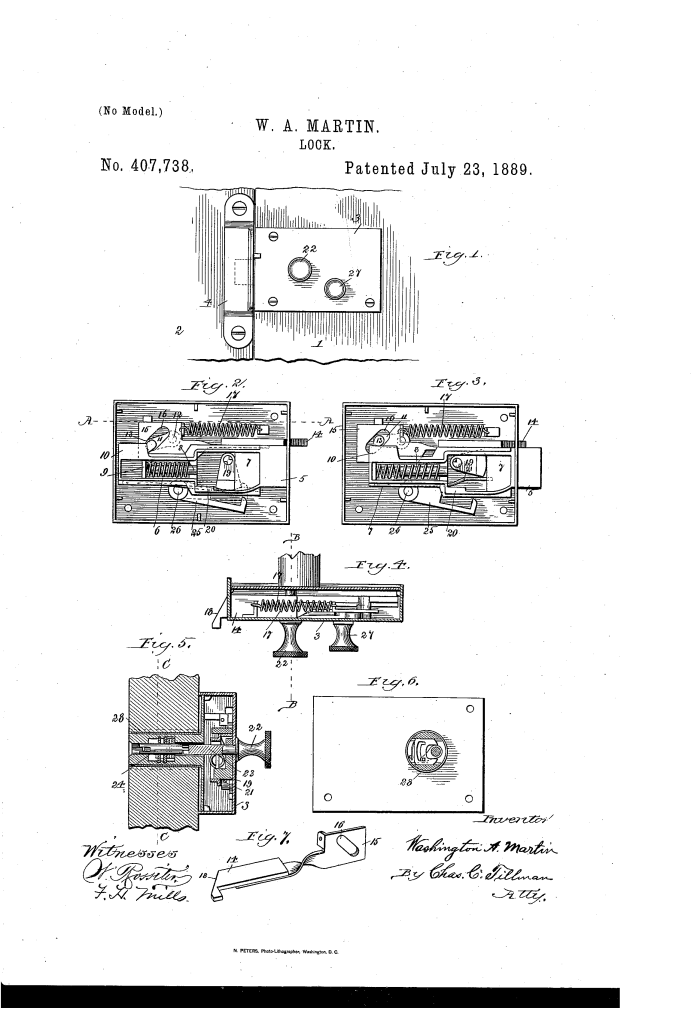
The patent by Washington A. Martin of Chicago, Illinois, describes a Lock (Patent No. 407,738). This invention is an automated security latch system designed to project a deadbolt immediately upon the closing of a door, utilizing a specialized trigger mechanism rather than a traditional beveled latch.
The “Why” (The Pain Point)
In the late 19th century, the standard door latch was a major security vulnerability. Most latches used a beveled bolt—a slanted piece of metal that retracted when it hit the strike plate. Because of this slant, an intruder could easily “shim” the lock by inserting a thin blade or tool between the door and the jamb to force the bolt back. Martin sought to create a lock that provided the convenience of an automatic latch with the unyielding security of a square deadbolt.
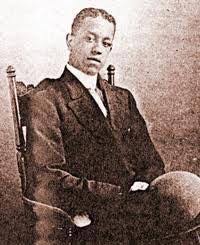
Inventor Section: Washington A. Martin
Washington A. Martin was a Black inventor and machinist operating in Chicago during the post-Reconstruction era. His engineering philosophy centered on mechanical automation as a means of safety. During a time when urban centers like Chicago were expanding rapidly and personal security was becoming a premium commodity, Martin’s work reflected a sophisticated understanding of kinetic energy storage (springs) and mechanical logic (triggers). Despite the systemic barriers faced by Black innovators in the 1880s, Martin’s patent was assigned in part to Henry Reuter, suggesting a level of savvy in navigating the industrial partnerships of the time.
Key Systems Section
1. The Trigger and Oblique Slot Mechanism
Unlike a standard latch, the bolt (5) is held back by a “dog” or pin (13). The trigger (14) features a diagonal (oblique) slot. When the door closes, the trigger is depressed, and the geometry of the slot forces the pin to move laterally, releasing the bolt.
2. The Potential Energy Storage System
The device uses a robust helical spring (6) seated on a stem (8). This system stores mechanical energy while the door is open. The moment the trigger is tripped, the stored energy is converted into linear kinetic energy, “shooting” the bolt into the socket.
3. The Cam and Yoke Retraction
To unlock the door, a cam (19)—essentially a rotating lobe—is turned via a knob or key. This cam engages a shoulder on the yoke (7), pulling the entire bolt assembly back into the casing until it is once again “cocked” and locked in place by the trigger pin.
Comparison Table
| Feature | Standard 1889 Latch | Martin’s Innovation |
| Bolt Shape | Beveled (Slanted) | Square (Deadbolt) |
| Vulnerability | Susceptible to “shimming” with a knife. | Impossible to shim; no lead-in angle. |
| Engagement | Physical impact pushes bolt back. | Trigger release “shoots” bolt forward. |
| Security Level | Low (Convenience-focused) | High (Security-focused) |
Significance
- Early Automated Security: Martin’s design is a direct ancestor to modern “autobolting” locks used in high-security commercial facilities.
- Mechanical Logic: The use of a slotted trigger to translate depth-movement into lateral-locking movement is a fundamental principle in modern fire-exit hardware (crash bars).
- Integration: The patent specifically mentions compatibility with Yale locks, showing Martin’s foresight in designing modular hardware that could integrate with established high-end security brands.
