

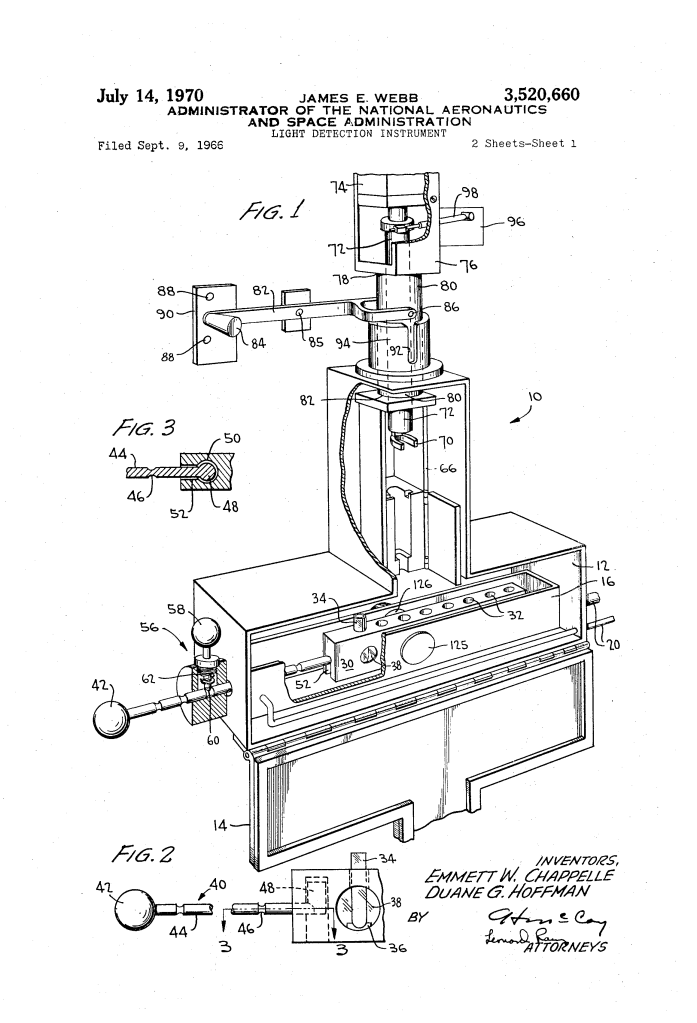
Light Detection Instrument (1970)
U.S. Patent No. 3,520,660, granted on July 14, 1970, to Emmett W. Chappelle of Baltimore, Maryland, and Duane G. Hoffman of Fairfax, Virginia (assigned to James E. Webb, Administrator of the National Aeronautics and Space Administration), describes a precision bioluminescent assay instrument designed to detect and quantify living cellular matter by measuring the faint light emitted when adenosine triphosphate (ATP) reacts with firefly-lantern enzymes. Because ATP is present in all known living cells, detecting it serves as a definitive indicator of biological life—a critical capability for NASA’s planetary exploration missions, spacecraft sterilization verification, and medical diagnostics. Previously, using the firefly luciferin-luciferase reaction for quantitative measurements was hindered by two major technical obstacles: precisely metering minute quantities of the ATP test sample into the enzyme mixture and capturing the extremely dim flash of bioluminescent light without interference from stray ambient illumination or electronic background noise. Chappelle and Hoffman solved both challenges by combining a temperature-controlled, light-tight reaction chamber with a timer-gated hydraulic injection system and a cooled photomultiplier detector.
The Core Design: Synchronized Injection & Faint-Photon Capture
The brilliance of the Chappelle and Hoffman instrument lies in how it mechanically and electronically synchronizes fluid injection with photon counting inside a sealed, T-shaped reaction housing (10) whose interior walls are painted matte black to eliminate stray reflections.
- Temperature-Controlled Cuvette Channel (16) & Indexed Positioning (40) Inside the light-tight chamber recess (12), closed by a latched hinged door (14), a U-shaped channel (16) circulates temperature-regulated immersion fluid via a small vane pump (18), an electrical resistance heater (22), and a cold-water jacket (24) governed by a fluid temperature controller (26). This keeps the firefly-lantern enzyme inside multiple test-tube-like cuvettes (34)—held in a rectangular cuvette holder (28, 30)—at optimal reaction temperature. From outside the closed chamber, an operator pulls a spring-biased snap-lock bolt (56, 60) and slides an indexed positioning rod (40, 44) featuring spaced alignment grooves (46) to center each cuvette (34) sequentially beneath the injection needle without opening the door.
- Hydraulically Metered Syringe System (64, 74) A syringe (64) filled with the ATP sample sits in a vertically movable holder (66) directly above the active cuvette. Pulling an external lever handle (84) lowers the sliding carrier (80) so the syringe needle dips directly into the enzyme solution before injection, and raises it clear afterward so the next cuvette can slide into place. Rather than relying on hand pressure, an external hydraulic cylinder (74) pressurized by a regulated gas supply (102, 104) and controlled by fast-acting solenoid valves (108, 110, 116) drives the piston (72) against the syringe plunger (68). A rotary position transducer (96) linked to the piston records exact injection displacement on a two-channel strip-chart recorder (100).
- Conical Light Collector (126) & Gated Photomultiplier Detection (128) When ATP meets the luciferin-luciferase mixture, the biochemical cascade emits a faint burst of photons. A front reflector plug bounces light toward the rear of the channel into an internally reflectorized, cone-shaped Plexiglas light collector (126), which funnels the photons into a sensitive photomultiplier tube (128). To prevent stray heat from creating false “dark current” electrons, a thermoelectric cooler (132) paired with a water-cooled heat sink (134) chills the photocathode, while a sliding shutter (“dark slide” 130) seals off the phototube whenever the chamber door (14) is opened. Crucially, a shared time-base generator (120) and digital counters (122, 124, 144, 146) open a diode gate (148) to the electronic pulse counter (136) only during the exact millisecond window when hydraulic injection occurs.
Key System Components
The instrument integrates fluidic thermoregulation, precision hydraulics, optics, and gated pulse-counting electronics:
| Component | Reference | Function |
| Light-Tight Reaction Chamber | 10, 12, 14 | Matte-black T-shaped housing with a latched door (14) that blocks ambient light from corrupting faint bioluminescent readings. |
| Circulating Thermal Bath | 16, 18, 22, 24 | Closed-loop immersion channel using a vane pump (18), heater (22), and cold-water jacket (24) to maintain stable enzyme temperature. |
| Indexed Cuvette Holder & Rod | 28, 34, 40, 46 | Holds multiple enzyme-filled cuvettes (34) and indexes each one into alignment via external grooves (46) and a spring snap-lock (56). |
| Hydraulic Syringe Actuator | 64, 72, 74, 116 | Uses gas-pressurized hydraulic fluid and solenoid valves (116) to inject a precise, repeatable volume of ATP sample into the cuvette. |
| Conical Plexiglas Light Collector | 126, 130 | Captures photons radiated through cuvette window openings (38) and channels them past a protective dark-slide shutter (130). |
| Cooled Photomultiplier & Gated Counter | 128, 132, 136, 148 | Converts light quanta into amplified electrical pulses counted via diode gate (148) strictly during the active injection window. |
How the ATP Detection Assay Operates
Running a batch of cellular life-detection tests follows a tightly controlled, contamination-free sequence:
| Step | Action | Scientific & Operational Purpose |
| 1. Sample Loading | Cuvettes (34) filled with excess firefly luciferin-luciferase enzyme are loaded into holder (28) inside bath channel (16); syringe (64) is filled with test sample. | Ensures enzyme reagents are in excess so total light output is strictly proportional to sample ATP concentration. |
| 2. Sealing & Alignment | Positioning rod (40) locks cuvette #1 into place; handle (84) lowers the syringe needle into the enzyme; chamber door (14) is latched shut and dark slide (130) is withdrawn. | Protects the photomultiplier tube (128) from room-light saturation while positioning the needle directly in the reaction zone. |
| 3. Timer-Gated Injection | Switches (112, 118) trigger timer (120) and solenoid valve (116), driving hydraulic piston (72) to inject a metered burst of ATP sample. | Produces reproducible fluid mixing and simultaneously opens diode gate (148) so counter (136) records only true reaction photons. |
| 4. Quantification & Indexing | Amplifier (134) and discriminator (142) feed digital readout (138) and chart recorder (100); handle (84) lifts the syringe and rod (40) advances the next cuvette. | Enables rapid, sequential testing of multiple samples without reopening the chamber or disturbing thermal equilibrium. |
Historical and Scientific Impact
Developed at NASA’s Goddard Space Flight Center during the height of the Apollo space program, Chappelle and Hoffman’s light detection instrument established the hardware foundation for modern ATP bioluminescence testing across aerospace, medicine, and public health.
- Planetary Quarantine & Extraterrestrial Life Detection: NASA commissioned the technology to verify that outbound lunar and planetary spacecraft were free of terrestrial microbes—and to provide an automated chemical assay capable of detecting cellular life on other worlds.
- Rapid Clinical & Environmental Diagnostics: Prior to ATP bioluminescence instrumentation, identifying bacterial contamination in urine, blood, drinking water, or hospital sterilization equipment required 24 to 48 hours of petri-dish culturing. Chappelle’s instrument reduced bacterial detection to mere minutes.
- Standard for Food Safety & Hygiene Monitoring: Today’s handheld ATP luminometers used in hospitals, pharmaceutical cleanrooms, and food-processing plants descend directly from the gated optical-chamber principles pioneered in this 1970 NASA patent.
About the Inventors: Emmett W. Chappelle and Duane G. Hoffman
Emmett W. Chappelle (1925–2019) was a pioneering African American biochemist and National Inventors Hall of Fame inductee whose career spanned defense aerospace research and over three decades at NASA’s Goddard Space Flight Center in Greenbelt, Maryland. Born in Phoenix, Arizona, and educated at the University of California, Berkeley, and the University of Washington, Chappelle unlocked the practical chemistry of firefly bioluminescence—demonstrating that combining luciferase and luciferin with extracted cellular ATP provides an exact quantitative measure of living bacteria. Beyond his 14 U.S. patents in bioluminescence and laser-induced plant fluorescence for remote crop monitoring, he mentored generations of minority scientists and students. Duane G. Hoffman was an aerospace instrumentation engineer who collaborated with Chappelle on NASA’s life-detection systems, contributing precision hydraulic, optical, and electronic timing designs that translated biochemical reactions into reliable quantitative measurements.
Summary of Claims
The patent explicitly claims:
- An ATP detection instrument comprising a light-tight reaction chamber, a fluid-circulating channel for regulating reactant temperature, a slidably mounted multi-cuvette reactant holder, test-material injection means, a conical reflectorized light collector, and a photomultiplier tube converting bioluminescent light into electrical signals.
- An external indexed positioning rod with spaced grooves and a spring-loaded snap lock for advancing individual reactant cuvettes into alignment beneath the injection syringe without opening the reaction chamber.
- A vertically movable syringe holder paired with a fluid-actuated hydraulic piston, regulated gas supply, and fast-acting solenoid valves to meter exact sample volumes into the enzyme reactant.
- Synchronized time-base control and gating electronics ensuring that the pulse-counting indicator operates exclusively during the active sample-injection interval.
