
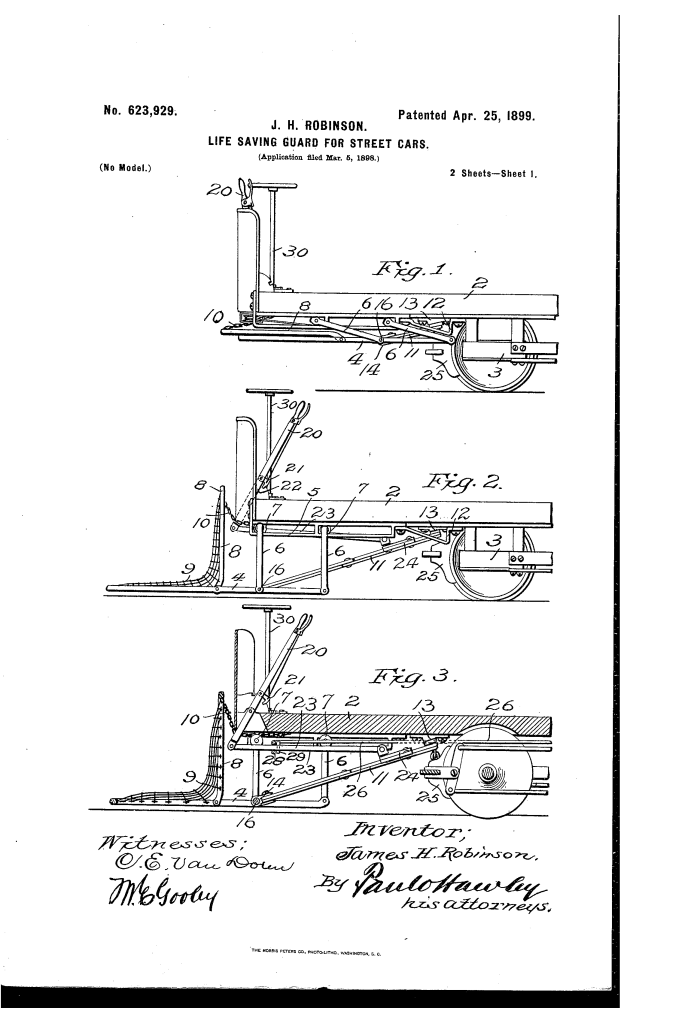
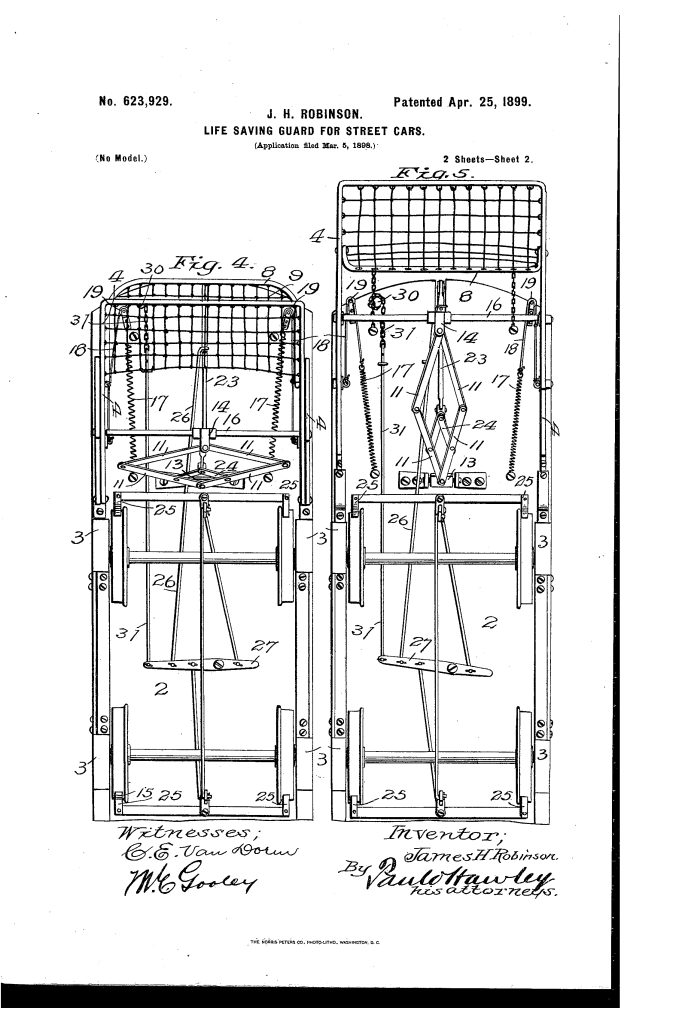
Life-Saving Guard for Street-Cars (James H. Robinson, No. 623,929)
The patent by James H. Robinson of Minneapolis, Minnesota, describes an improved Life-Saving Guard for Street-Cars (Patent No. 623,929, 1899), commonly known as a streetcar fender. The primary objects are to provide a fender that is particularly adapted for streetcar use, can be projected onto the track in front of the car, and can be simultaneously deployed with the brakes by a single movement of a lever.
Inventor Background: James H. Robinson
James H. Robinson was an inventor focused on transit safety. His invention addresses the critical public safety crisis caused by the rapid expansion of electric streetcar systems in American cities during the late 19th century. His design focused on providing the motorman with a fast, reliable, and integrated emergency mechanism to minimize injury upon impact.
Invention and Mechanism
The device is a folding, net-filled frame that uses a combination of parallel links and toggle levers to shoot out and drop down onto the track.
1. Folding Fender Structure
- Main Frame (4) and Pivoted Frame (8): The fender consists of two frames, the main frame (4) and a hinged folding member (8). The space between them is filled with a netting (9) or apron.
- Normal Position: The fender is held snugly beneath the car platform (2) by retracted toggle-levers (11) and buffers (12).
2. Deployment Mechanism (Key Innovation: Integrated Motion)
- Parallel Links (6): The main frame (4) is supported by parallel links (6) that hang from guides (5) beneath the platform.
- Toggle-Levers (11): The main deployment force comes from large toggle-levers (11) pivoted beneath the platform and connected to the frame (4).
- Operating Lever (20): A single lever is placed on the platform, within the motorman’s control.
- Function: When the motorman throws the lever (20) forward, the toggle-levers (11) are distended (straightened). This action forces the frame (4) to slide forward and swing downward simultaneously. The parallel links (6) ensure the frame remains parallel to the track as it drops to a point near the ground. The hinged member (8) drops and is held taut by chains (10), creating the scoop.
3. Simultaneous Brake Actuation (Safety Interlock)
- Brake Rod (26) and Slip Connection (28): The operating lever (20) is connected to the fender linkage (via rod 23) and is also connected to the brake rod (26). The connection between the brake rod (26) and the fender rod (23) is a slip connection (a loop 28 on one rod sliding to engage a collar 29 on the other).
- Function: As the motorman throws the lever (20) to project the fender, the brake rod (26) is drawn forward during the final movement of the fender rod (23). This causes the brakes to be simultaneously set with the full projection of the fender.
- Result: With one single movement, the motorman can project the life-saving net and apply the emergency brakes, minimizing response time.
Concepts Influenced by This Invention
Robinson’s fender influenced subsequent transportation safety by pioneering integrated, single-input emergency systems that control multiple safety functions.
- Integrated Emergency Systems (Single-Input Control): The most significant influence is the design philosophy of using a single, mechanical input (Lever 20) to simultaneously initiate two distinct, critical safety actions (Fender Deployment and Brake Setting). This concept is foundational to modern industrial and vehicle safety, where emergency controls are designed for maximum effectiveness with minimum cognitive burden.
- Parallel Linkage Deployment: The use of parallel links (6) to ensure a complex, folding structure (the fender) drops from a retracted position to a working position while remaining parallel to the ground influenced the design of various access platforms, folding stages, and specialized vehicle equipment requiring precise deployment geometry.
- Phased Actuation (Slip Connection): The use of a slip connection (28) to delay the brake application until the final movement of the fender rod influenced the design of sequenced mechanical controls, ensuring that actions occur in the correct order (e.g., fender must be projected before brakes lock up the wheels).
- Folding and Retracting Safety Guards: The design of the fender to fold snugly beneath the platform influenced the engineering of modern vehicle guards and snow plows that must be fully retractable to maintain normal vehicle clearance.
