
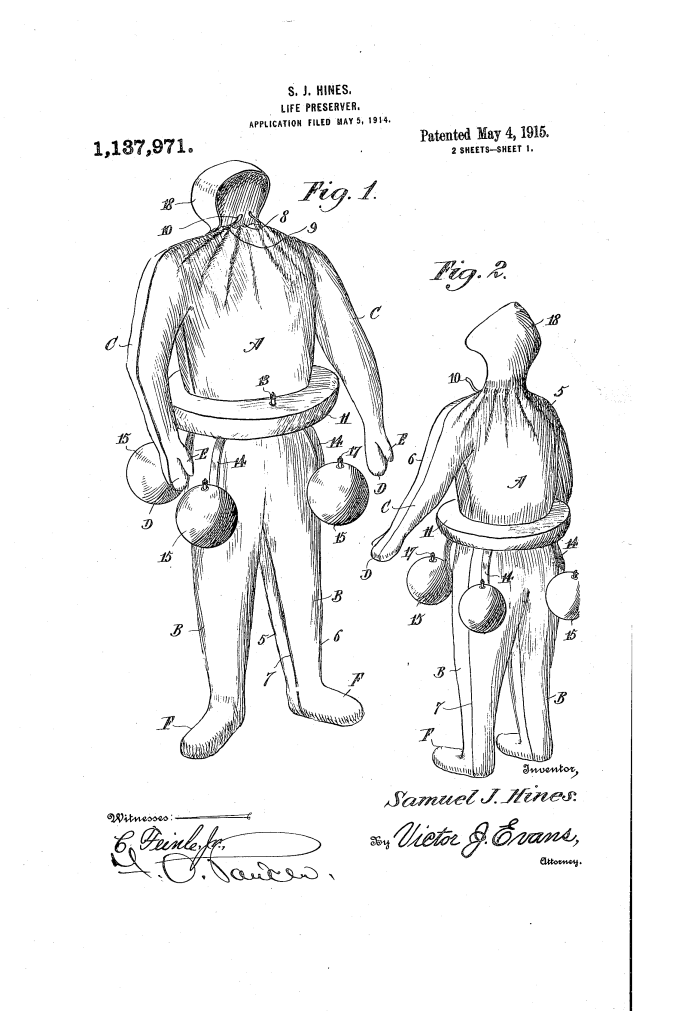

⚓ Life-Preserver (Samuel J. Hines, No. 1,137,971)
The patent by Samuel J. Hines of Plaquemine, Louisiana, describes a Life-Preserver (Patent No. 1,137,971, 1915). This invention is a full-body waterproof “preserving garment” designed to protect the wearer from both drowning and exposure. Unlike standard life vests of the era, Hines’s design was a complete suit—including integrated gloves and boots—that could be folded into a compact space when not in use.
Inventor Background: Samuel J. Hines
Samuel J. Hines was an African American inventor based in Plaquemine, Louisiana. Living in a region defined by its proximity to the Mississippi River and the Gulf of Mexico, Hines understood the dangers of water-based travel and labor. His invention addressed the limitations of early life jackets, which often failed to protect against hypothermia or “water creep.” By engineering a watertight seal at the neck and integrating buoyant chambers directly into a flexible suit, Hines created a precursor to the modern immersion suit (often called a “Gumby suit”) used by sailors and offshore workers today.
Invention and Mechanism (Simplified)
The garment is a one-piece suit made of waterproofed canvas and rubber that keeps the wearer dry while providing multiple layers of flotation.
1. The Watertight Suit (A, B, C)
- Integral Construction: The suit includes a body portion (A), legs (B), and sleeves (C). Crucially, the hand coverings (D) and foot coverings (F) are built into the suit itself.
- Overlapped Seams (7): To prevent water from leaking in through the joints, Hines used overlapped, waterproofed seams.
- Neck Entry (8, 10): The wearer enters the suit through a large neck opening (8). Once inside, the lacing (10) is drawn tight around the neck to form a seal, preventing water from “creeping” into the body of the suit.
2. The Primary Buoyant Element (11, 12)
- Pneumatic Waist Belt: Secured to the outside of the suit at the waistline is a waterproof casement (11).
- Inner Tube (12): Inside this casement sits a pneumatic inner tube (12) with a filling stem (13).
- Function: This tube can be inflated using a pump to provide the primary upward lift, keeping the wearer’s torso above the water line.
3. Auxiliary Buoyant Spheres (15, 16)
- Detachable Elements: Below the main waist belt, Hines added several straps (14).
- Spherical Bodies (15): These straps hold spherical waterproof bodies (15) containing inflated balls (16).
- Function: These smaller, independent buoyant units act as stabilizers and backups. If the main waist tube were to fail, these spheres provide distributed buoyancy to help maintain the wearer’s balance in rough seas.
4. The Protecting Hood (18)
- Head Protection: Attached to the neck area is a hood (18).
- Function: This protects the wearer’s head from spray and rain, further reducing the risk of heat loss and exhaustion while awaiting rescue.
Improvements Over Existing Life-Saving Equipment
| Feature | Standard 1910s Life Vests | Hines’s Life-Preserver |
| Exposure Protection | Only provided flotation; left limbs exposed to cold. | Full-body coverage protects against hypothermia. |
| Water Intrusion | Often “crept” up under the vest. | Watertight neck lacing and integral boots/gloves. |
| Buoyancy Logic | Single-point (cork or air). | Multi-point (main waist tube + auxiliary spheres). |
| Portability | Bulky and rigid. | Flexible materials allow for compact folding and storage. |
Significance to Safety Engineering
Samuel J. Hines’s life-preserver influenced the evolution of maritime survival gear and immersion technology.
- The Immersion Suit Concept: Hines was among the first to argue that a life preserver should be a garment rather than just a vest. This is the fundamental principle behind the modern survival suits required on commercial vessels today.
- Redundant Flotation: The use of independent auxiliary spheres attached by straps anticipated the safety logic of modern life rafts and lifeboats, which utilize multiple air chambers to ensure that a single puncture does not lead to total failure.
- Human Factors and Mobility: By providing a thumb stall (E) in the integral gloves, Hines acknowledged that a person in the water still needs the dexterity to operate signaling devices or grab onto rescue lines.
- Compact Storage: His focus on making the garment “compact” for storage reflected an early understanding of logistics, recognizing that life-saving equipment is only useful if it can be easily stored in large quantities on ships.
