
Lever-Derrick (James W. Benton, No. 658,939)
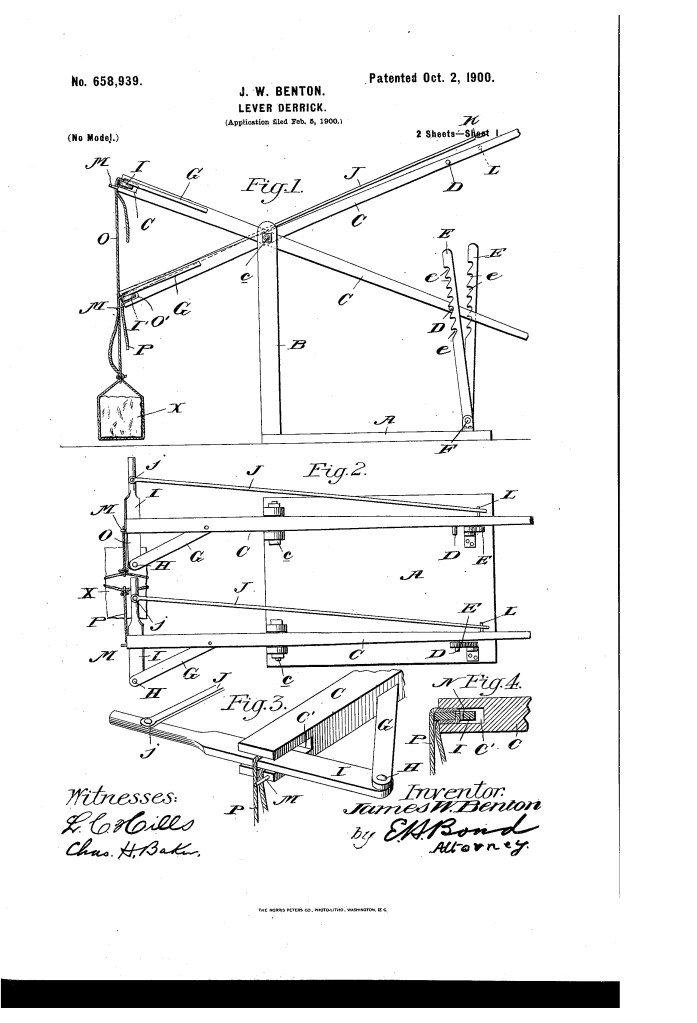
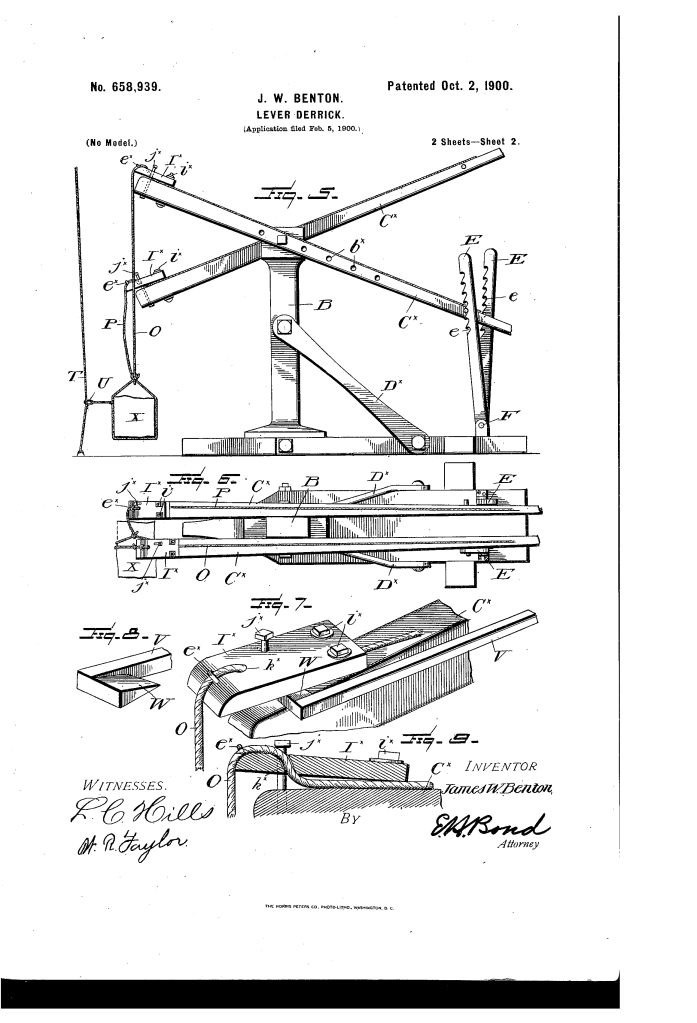
The patent by James W. Benton of Kings Station, Kentucky, describes a new and useful Lever-Derrick (Patent No. 658,939, 1900). The object is to provide a simple, cheap, strong, and portable device for raising and lowering heavy weights (such as stone or lumber, or for pulling stumps). The operation is accomplished by using a pair of levers alternately, akin to a mechanical crawl.
Inventor Background: James W. Benton
James W. Benton was an inventor focused on creating robust, portable utility and construction tools for heavy work. His derrick addressed the need for simple, high-leverage lifting equipment that could be easily moved and operated on farms (pulling stumps, lifting stone) or at rail stations.
Invention and Mechanism (Simplified)
The derrick uses two independent, hand-operated levers that work alternately to lift a load bit by bit, holding it securely at each stage.
1. Frame and Levers
- Base (A) and Standards (B): A base plate or platform with two upright standards (B) for stability.
- Levers (C): A pair of long, strong levers, each pivotally mounted in the bifurcated ends of the standards (B).
2. The Gripping and Lifting Action (The Mechanical Crawl) (Key Innovation)
- Gripping Lever (I): A smaller lever pivotally mounted on the forward end of each main lever (C) via an arm (G). This gripping lever is what secures the rope or wire (O, P) attached to the heavy object (X).
- Alternating Operation:
- Lever 1 Lifts: The rope is secured in Lever 1’s gripping mechanism (I). The operator pushes down the rear (handle) end of Lever 1, raising the load.
- Lever 1 Locks: A projection (D) on Lever 1 engages a notch ($e$) on a fixed, notched bar (E), locking the lever and holding the load securely in the raised position.
- Lever 2 Reset: The rope attached to Lever 2 is now slack. The operator releases the gripping lever (I) on Lever 2, takes up the slack, and takes a new, high bight (new hold) in the rope.
- Lever 2 Lifts: Lever 1 is unlocked, and Lever 2 is pushed down, lifting the load further.
- Result: By alternately lifting and locking the two levers, the load is raised incrementally, like a mechanical crawl or inchworm.
3. Locking the Grip
- Locking Bar (J): A locking bar is pivotally attached to the gripping-lever (I) and locks over a pin (L) on the main lever (C).
- Function: This secondary lock ensures the gripping lever (I) cannot release the rope while the main lever (C) is doing the work.
Concepts Influenced by This Invention
Benton’s derrick influenced subsequent designs for heavy-duty lifting and tensioning mechanisms by establishing principles for alternating, incremental actuation with fail-safe locking.
- Alternating Incremental Actuation (Climbing/Crawl Mechanism): The core principle of using two parallel, independent actuator arms (levers C) that work alternately (one lifts while the other resets) to move a load along a fixed line influenced the design of modern:
- Manual Winches and Hoists: Systems like cable pullers (come-alongs) that use two opposing clamps or levers to move a cable incrementally.
- Climbing Mechanisms: Linear actuators and robotic systems designed for incremental, high-force movement.
- Fail-Safe Pawl/Ratchet Locking: The use of the lever’s own motion to automatically engage a fixed stop (E) to lock the load at the end of every lift influenced the design of various ratchet and pawl safety systems in hoists, jacks, and tensioning devices, ensuring the load is never momentarily unsecured.
- Integrated Safety Clamping: The use of the locking bar (J) to secure the gripping mechanism (I) during the main lift is an essential safety feature. This redundancy ensures the load rope cannot slip due to accidental pressure release, influencing industrial hoisting equipment.
- Portable High-Leverage Tools: The design reinforced the engineering goal of creating high-leverage, heavy-duty tools that are nevertheless lightweight and easily portable (suitable for field use).
