
Level (Thomas H. Brittain, No. 941,625)
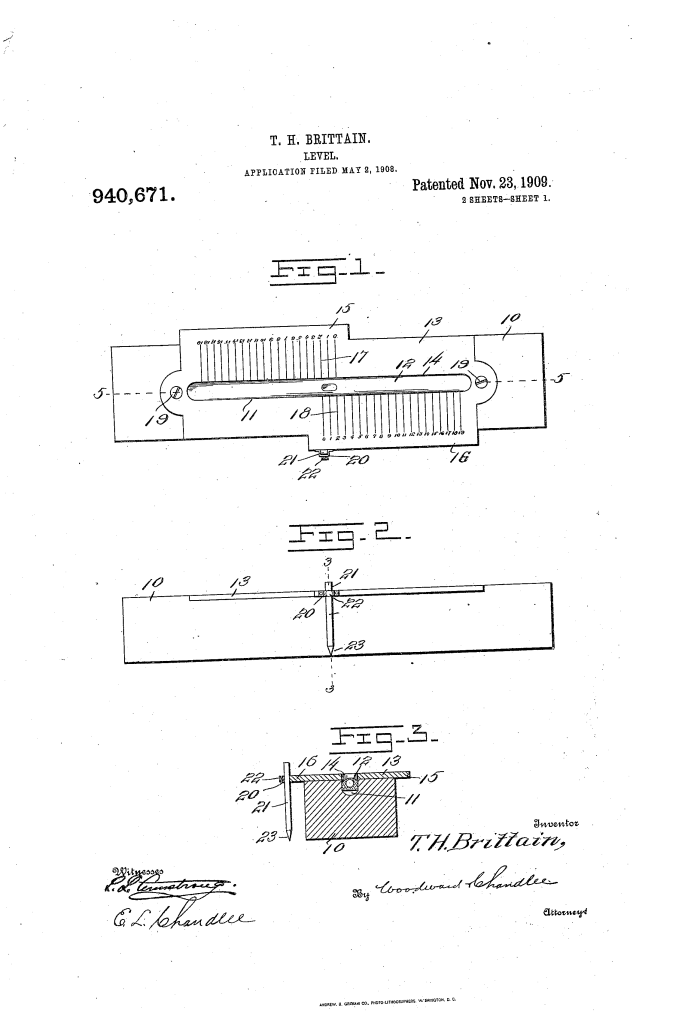
The patent by Thomas H. Brittain of Prairie View, Texas, describes certain new and useful Improvements in Levels (Patent No. 941,625, 1909), specifically relating to spirit levels. The primary objects are to produce a more accurate instrument and, crucially, to provide a method by which the user can readily calculate the exact distance that a portion of the object being leveled should be raised or lowered to bring it to the horizontal.
Inventor Background: Thomas H. Brittain
Thomas H. Brittain was an inventor residing in Prairie View, Texas. His invention addresses a critical technical challenge in carpentry, surveying, and construction: translating the small, angular deviation shown by a spirit bubble into a precise, large-scale linear correction required on a beam or structure. His work focused on enhancing the precision and practical application of standard measuring instruments.
Invention and Mechanism (Simplified)
The level is a standard spirit level that integrates a unique dual-scale and pointer system designed to facilitate rapid, calculated measurements and adjustments.
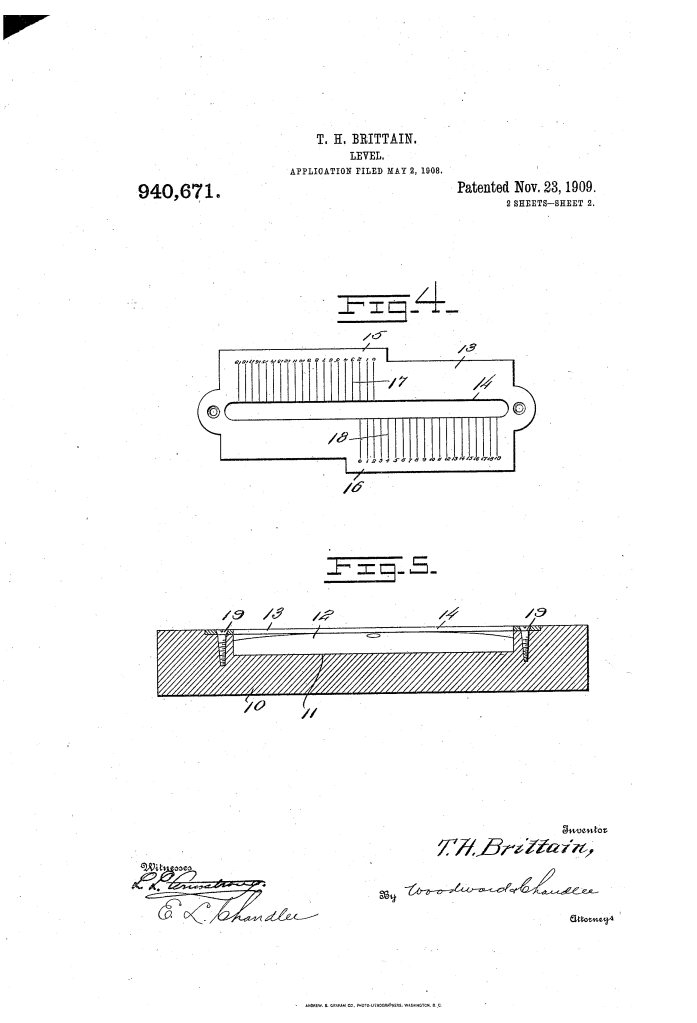
- Level Stock and Spirit Tube: The instrument has an ordinary stock (10) (the body) and a curved spirit tube (12) with an air bubble, set into a pocket (11).
- Dual Scales (Overlapping Zero Points) (Key Innovation): A metal plate (13) is secured to the stock (10). This plate carries two diagonally disposed offset portions (15 and 16) with scales (17 and 18).
- Zero Alignment: The offset portions are arranged so that the two scales overlap, with their zero points spaced longitudinally a distance equal to the length of the air bubble.
- Function: This design positions a scale on each side of the air bubble, with the zero point placed at the farthermost end of the bubble relative to its own scale. This makes reading the displacement easier and more accurate.
- The Calculation Pointer:
- Pointer (21): A rod or pointer is rigidly secured in a sleeve (20) on the offset portion (16) and extends downward to the base of the stock (10).
- Function: This pointer indicates the exact zero point of the level on the object being measured.
- The Measurement Ratio (The Practical Advantage):
- Definite Ratio: The curvature of the tube and the scaling intervals are manufactured to establish a definite ratio between the bubble’s position and the actual linear distance required to raise the object.
- Example: If the bubble is displaced by three divisions, and the measurement is taken one foot from the pointer, the object must be raised/lowered by a distance equal to three divisions to level it. If the measurement is taken three feet away, the distance must be raised/lowered by three times the indicated scale displacement.
Concepts Influenced by This Invention
Brittain’s level influenced subsequent metrology and precision tooling by pioneering the direct-reading conversion of angular displacement into linear corrective action.
- Direct-Reading Calibration: The core concept of engineering the tool (matching the tube curvature to the scale intervals) so that the bubble’s displacement directly corresponds to the linear correction distance (e.g., $1/8$ inch per foot) influenced the design of specialized levels, inclinometers, and precision instruments.
- Integrated Referencing Pointer: The inclusion of a fixed zero-point pointer (21) that marks the precise longitudinal location of the angular measurement influenced the design of modern laser levels and alignment tools that require a definite point of origin for calculating offset corrections.
- Ergonomic Scale Reading: The overlapping scale design, which places the zero point adjacent to the end of the bubble, influenced the ergonomic design of measuring tools, prioritizing greater facility and reduced error in reading displacement.
- Calculated Adjustment Tool: The invention formalized the process of translating a relative measurement (bubble position) into a required absolute movement (correction distance), which is a key concept in all precision alignment jigs and leveling fixtures used in construction and machinery setup.
