

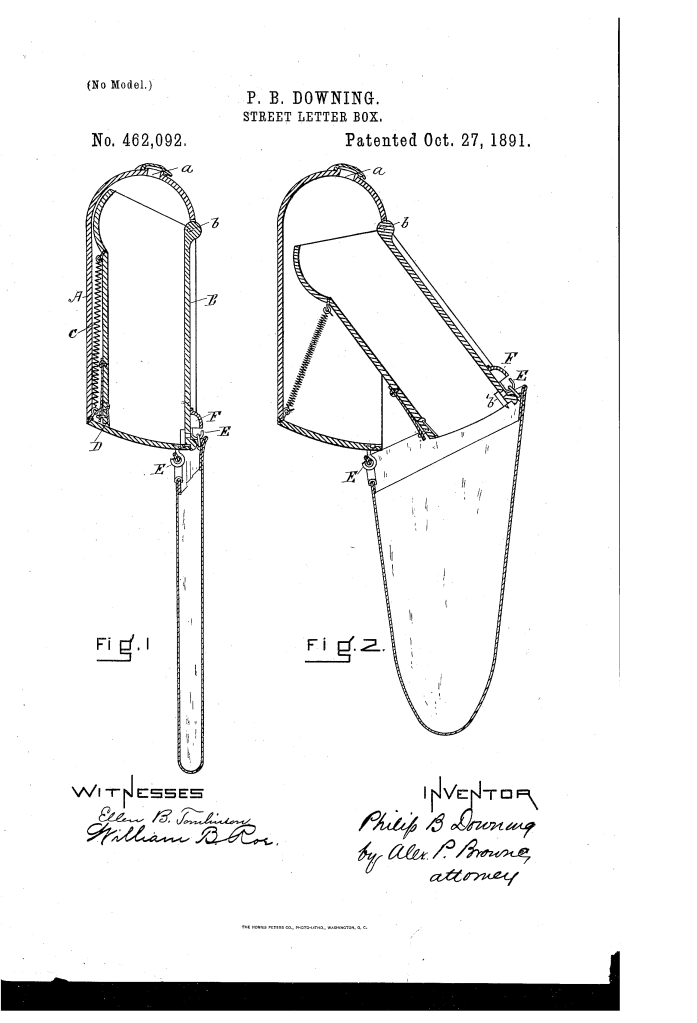
Street Letter Box (1891)
U.S. Patent No. 462,092, granted on October 27, 1891, to Philip B. Downing, revolutionized the way mail was collected in American cities. Before this invention, mailboxes were often simple tubs or wall-mounted boxes that required postal carriers to manually reach in and grab handfuls of mail, a process that was slow and prone to losing letters in bad weather.
Downing, a Black inventor based in Boston, designed a “chute-style” box that prioritized speed, security, and the protection of the mail from the elements. His design was so effective that its core mechanics—the hinged outer door and internal safety features—became the blueprint for the blue USPS mailboxes still seen on street corners today.
The Innovation: The “Gravity Chute” System
The primary problem Downing sought to solve was the inefficiency of mail collection. His invention transformed the mailbox from a stationary storage bin into a mechanical dispensing device.
By using a two-part system—a fixed outer housing and a pivoting internal chute—he ensured that the mail could be dumped directly into a carrier’s bag without the carrier ever needing to touch the individual envelopes.
How the Apparatus Functions
The box operates through a clever interaction between gravity and a spring-loaded pivot:
- Mailing: The public drops mail through a protected slot (a) at the top of the fixed case. The letters rest at the bottom of the internal chute (B).
- Unlocking: The postal carrier inserts a key into the lock (p).
- Automatic Discharge: Once unlocked, a heavy-duty spring (C) forces the internal chute to swing outward.
- The “Scoop” Action: As the chute swings, its back edge—fitted with a hinged transverse strip (D)—acts as a scoop, clearing the floor of the box to ensure no letters are left behind.
- Gravity Feed: The mail slides down the tilted chute and falls directly into the collection bag attached to the front hooks.
Key Mechanical Components
The design is a masterclass in 19th-century mechanical simplicity:
| Component | Function |
| Fixed Case (A) | The “standing” part of the box that remains bolted to a post or wall; it provides the roof and floor. |
| Pivoting Chute (B) | An internal four-walled tube, open at the top and bottom, that holds the mail and swings out for collection. |
| Spring (C) | Provides the tension needed to automatically “throw” the box open the moment the lock is released. |
| Hinged Strip (D) | A spring-backed safety strip at the bottom-back of the chute that “hugs” the floor to sweep out every last letter. |
| Hooks (E) | Four attachment points (two on the case, two on the chute) designed to hold the rings of a standard mail bag. |
Historical and Social Impact
Philip B. Downing’s invention was a milestone in both postal history and African American excellence in STEM.
- Postal Efficiency: By allowing “hands-free” collection, Downing’s box allowed carriers to service far more boxes in a single shift, facilitating the rapid growth of the U.S. Postal Service during the industrial boom.
- Protection from Elements: The “box-within-a-box” design created a double barrier against rain and snow, significantly reducing the amount of damaged mail.
- Safety: The design prevented unauthorized people from reaching into the slot to “fish” for mail, as the internal chute blocked access to the storage area when the mailing slot was used.
About the Inventor: Philip B. Downing
Philip B. Downing (1857–1934) was a prolific inventor whose career spanned over thirty years.
- Background: He came from a prominent family of activists and entrepreneurs; his father, George T. Downing, was a well-known abolitionist and businessman.
- Other Inventions: While the letter box is his most famous patent, he also held patents for an improved electric switch for streetcars and a device for moistening envelopes.
- Legacy: Downing’s 1891 patent represents one of the earliest examples of a Black inventor successfully integrating a mechanical design into the essential infrastructure of the United States government.
Summary of Claims
The patent explicitly protects:
- A letter-box consisting of a fixed case and a movable tube or chute pivoted to work in tandem.
- The use of a spring to automatically swing the chute outward when unlocked.
- The specific combination of hooks (E) arranged on both the fixed and moving parts to “distend” the mail bag automatically as the box opens.
