

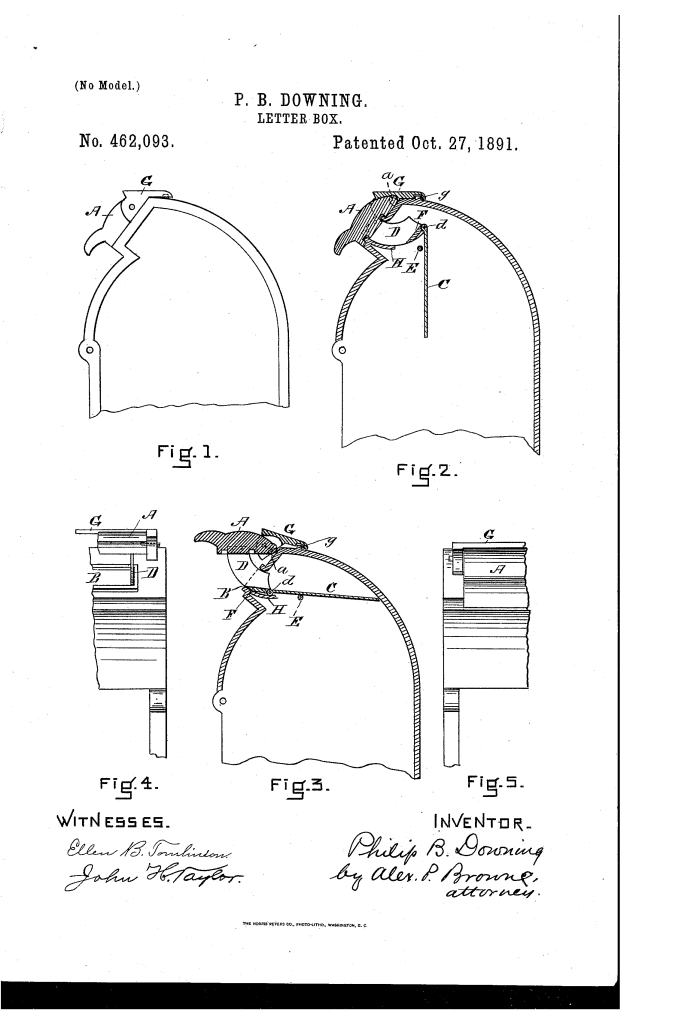
Letter Box Lid (1891)
U.S. Patent No. 462,093, granted on October 27, 1891, to Philip B. Downing, revolutionized the way citizens interacted with the postal system. Before Downing’s invention, those wishing to mail letters often had to travel to a main post office or find specialized “street letter boxes” that were cumbersome and offered little protection against the elements or theft.
Downing, an African American inventor based in Boston, Massachusetts, designed a functional, secure, and weatherproof street mailbox that became the direct ancestor of the iconic blue USPS collection boxes seen across America today.
The Innovation: The Protected Gravity-Feed System
The primary challenge with 19th-century mail collection was security. Older designs often had simple slots that allowed rain to enter or permitted “fishing”—where thieves could use a string or tool to pull mail back out of the box.
Downing’s breakthrough was a hinged, double-door mechanism that acted as a safety airlock for mail.
Key Structural Features
The invention focused on a “street letter box” characterized by its durability and the specific mechanics of the lid:
- The Outer Lid (Hinged Cover): A curved, heavy metal lid that the user pulls toward them to reveal the opening.
- The Internal Safety Plate: When the outer lid is opened, an internal plate shifts to block access to the main storage compartment below. This prevents anyone from reaching into the box to steal letters while the door is open.
- Weather Shielding: The overlapping design of the lid ensures that even in heavy rain or snow, water is diverted away from the mail slot, keeping the correspondence dry.
- Gravity Deposit: Once the user releases the handle, the lid closes automatically, and the internal plate tilts, allowing the mail to drop securely into the lower receptacle.
Component Breakdown
Downing’s design was modular and built for the rigors of urban environments:
| Component | Function |
| Hinged Lid (A) | The primary user interface; designed to be easily operated with one hand. |
| Inner Safety Flap | A “security gate” that closes the storage area when the lid is opened. |
| Supporting Frame | A rugged iron casing that could be bolted to posts or building walls. |
| Internal Chute | Guided the letters into a central pile to prevent jams. |
| Locking Door | Located at the bottom or side, accessible only by the postal carrier to collect mail. |
Impact: Transforming the Postal Service
Downing’s patent moved the “post office” to the street corner. The impact was immediate and widespread:
- Public Convenience: Citizens no longer had to walk long distances to a central post office to mail a letter.
- Safety and Security: The “anti-fishing” design gave the public confidence that their private correspondence was safe until the mail carrier arrived.
- Efficiency: Postal carriers could follow a set route to collect mail from multiple “Downing boxes,” significantly speeding up the logistics of the late 19th-century communication network.
About the Inventor: Philip B. Downing
Philip B. Downing was a remarkably versatile inventor whose career spanned several decades and multiple industries.
- Legacy of Innovation: Beyond the letter box, Downing held patents for an improved electric cigar lighter and a streetcar/railway switch system that allowed for easier navigation of track intersections.
- Family Heritage: He came from a prominent family of achievers; his father, George T. Downing, was a well-known abolitionist and successful businessman.
- Historical Context: Operating during the post-Reconstruction era, Downing was one of several Black inventors who fundamentally shaped the infrastructure of modern American life, despite the systemic barriers of the time.
Summary of Claims
The 1891 patent explicitly protected:
- A pivoted lid combined with an internal guard to prevent the extraction of letters.
- The specific curved housing design that prevented moisture from entering the letter-space.
- The mechanical linkage that ensured the box remained “closed” to the outside world even while the user was inserting their mail.
