

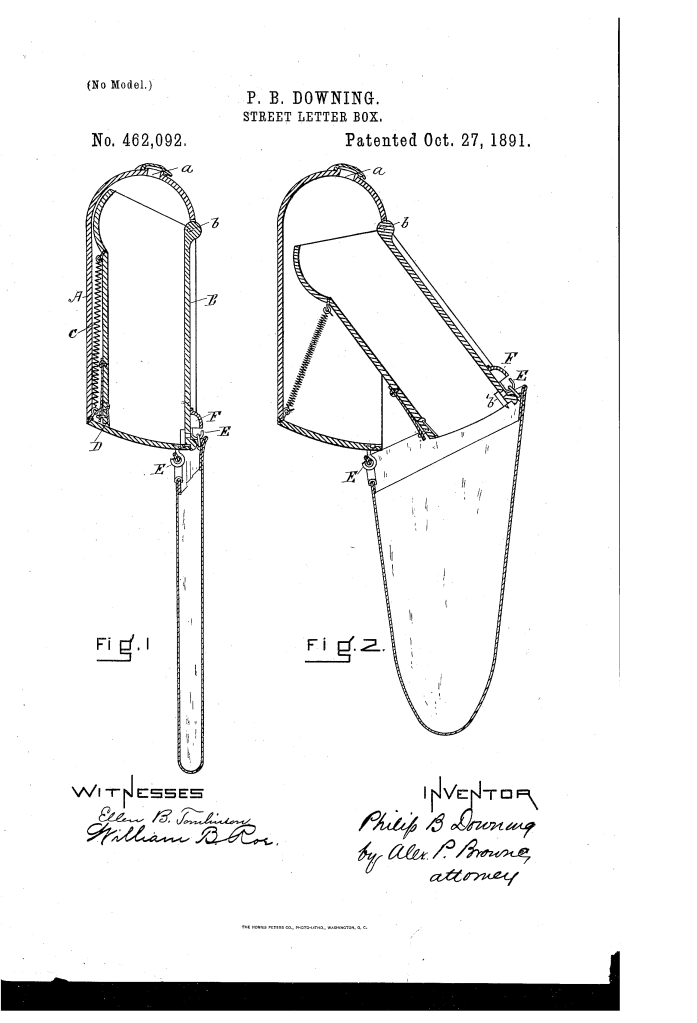
Philip B. Downing’s patent for a “Street Letter Box” was a significant improvement to the public mailbox. His invention addressed the inefficiency and security risks of previous designs. Patented on October 27, 1891, the letterbox featured a two-part case. The upper and lower parts were fixed, while the front and sides were made of a hinged movable chute. When a postal worker unlocked the box, a spring would cause the chute to automatically swing outward, discharging all the mail into a waiting collection bag. This design meant the collector did not have to reach inside the box, making the process faster and more sanitary. It also ensured that no letters were missed during collection, as the chute’s hinged strip acted as a scoop.
Societal Impact
Downing’s mailbox design was a simple yet transformative innovation that had a direct impact on the efficiency of the U.S. postal system and the daily lives of Americans.
- Improved Postal Service: Before Downing’s invention, postal workers had to manually empty mailboxes, a slow and cumbersome process that often left letters behind. The automated, self-emptying design of his box streamlined mail collection, allowing for more frequent and efficient pickups. This was critical for the growing postal service in a rapidly expanding country.
- Public and Worker Safety: The design was more sanitary for postal workers, who no longer had to reach into dark, potentially unsanitary boxes. It also improved security by reducing the risk of theft or vandalism, as the mail was instantly transferred to a locked bag upon opening.
- Legacy of the Inventor: Philip B. Downing was an African American inventor who also held patents for a street railway switch. His inventions, though not always widely known, were crucial to the development of public infrastructure. He is credited with designing the basis for the modern public mailbox, a ubiquitous piece of urban furniture. His work serves as a powerful reminder of the key role Black innovators played in shaping modern American life, from transportation to communication.
