
Letter-Box (1892)
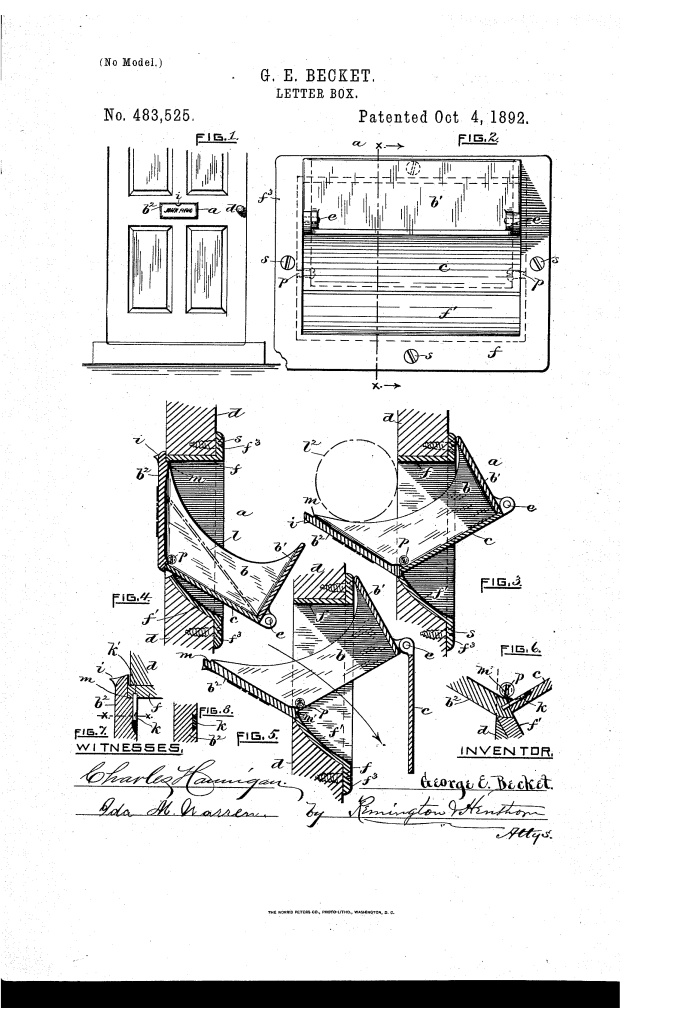
U.S. Patent No. 483,525, granted on October 4, 1892, to George E. Becket, introduces a clever, dual-purpose mail receptacle designed for private residences. In the late 19th century, as residential mail delivery became more standardized, homeowners needed a way to receive mail securely without constantly opening the door for the carrier.
Becket, a resident of Providence, Rhode Island, designed a system that was not just a container, but a mechanical “pass-through” built directly into the front door. It solved the problem of mail accumulation and provided a way for large packages to be delivered safely inside the home.
The Innovation: The “Tilting Receptacle”
The brilliance of Becket’s design lies in its pivoted, self-closing mechanism. Unlike a standard stationary slot, this box is a three-dimensional pocket that tilts outward to receive mail and then automatically swings back into a flush, sealed position.
- The Counterweighted Design: The box is pivoted at the bottom. Because of the way it is weighted, gravity acts as a “self-closing” spring. Once the mail carrier releases the handle, the box tips back into the door frame, sealing the opening.
- The Door-Plate Integration: Becket designed the front face of the box to be aesthetically pleasing. Because it sits flush with the door, he suggested it be used as a door-plate for the resident’s name, blending utility with Victorian home decor.
Versatile Delivery Modes
Becket recognized that mail comes in different sizes and that residents have different preferences for how they receive it. His patent allows for three distinct “modes” of operation:
- The Secure Holder: With the hinged bottom locked, the box acts as a standard cradle, holding letters until the resident retrieves them from the inside.
- The Pass-Through: By leaving the hinged bottom open, the box becomes a chute. When the carrier drops mail in, it slides through the door and falls directly onto the hallway floor—preventing the box from ever getting “full.”
- The Large Package Solution: For items too bulky for the box, the carrier can tilt the box forward and pass the package through the wide opening created in the door frame.
Key Technical Components
The apparatus consists of a few rugged, simple parts designed to survive constant use:
| Component | Function |
| Frame (f) | A rectangular housing let into a hole cut through the front door; it acts as the “seat” for the box. |
| Pivoted Box (b) | The moving receptacle that vibrates back and forth to receive mail. |
| Hinged Bottom (c) | A movable floor that can be locked to hold mail or unlocked to let mail drop to the floor. |
| Dovetail Bolt (k) | An internal security lock that allows the resident to “lock” the box from the inside so it cannot be opened from the street. |
| Projection (i) | A small lip or handle at the top of the box to help the mail carrier pull it open. |
Practical and Security Features
Becket’s patent emphasizes that this isn’t just about convenience; it’s about visibility and safety:
- At-a-Glance Checking: Because the back of the box is open to the interior of the house, a resident standing in the front hall can see immediately if mail is waiting without having to touch the apparatus.
- Weatherproofing: The front side of the box (b2) is “rabbeted” (notched), allowing it to fit snugly against the frame. This prevents wind and rain from whistling through the mail slot into the home.
- Internal Control: The inclusion of the sliding bolt meant that at night or when the family was away, the letter box could be “deadbolted” from the inside, preventing anyone from tampering with it from the porch.
About the Inventor: George E. Becket
George E. Becket was an inventor active in the late 19th-century manufacturing hub of Providence, Rhode Island. His work focused on improving the hardware of daily life. By creating a box that was “comparatively inexpensive,” he aimed to bring the convenience of professional office mail systems to the average middle-class Victorian home.
Summary of Claims
The patent explicitly covers:
- A letter-box with a frame increasing in width vertically from the front to allow the box to tilt.
- A pivoted receptacle that automatically returns to its normal position (self-closing).
- A hinged bottom that can be secured or released depending on the desired method of delivery.
