
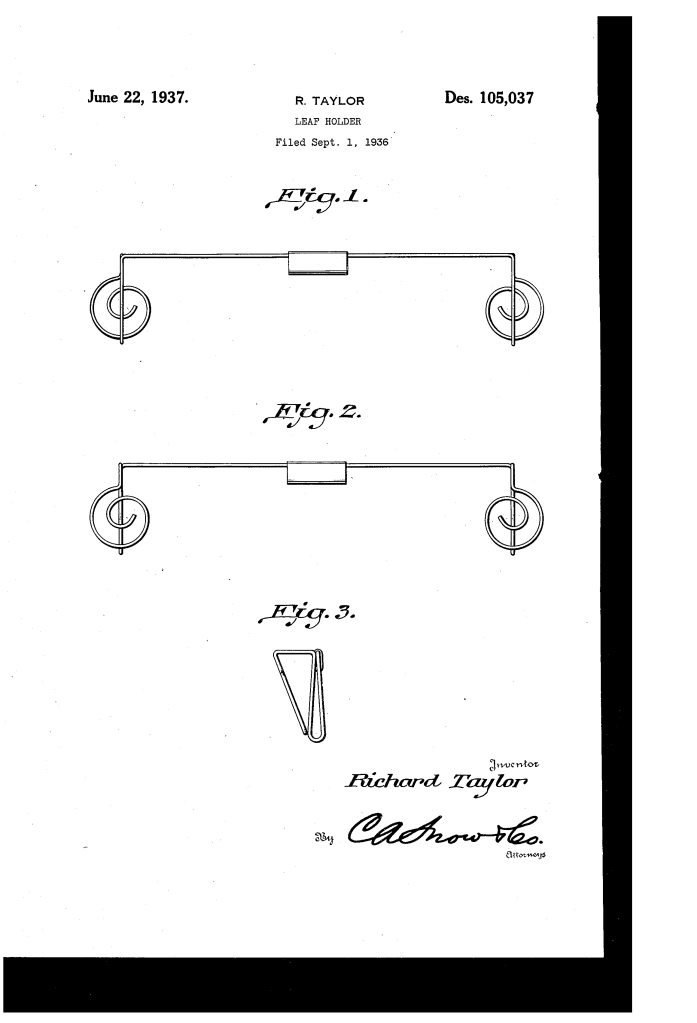
Ornamental Leaf Holder, Richard Taylor, Design Patent No. 105,037
The patent by Richard Taylor of Chicago, Illinois, describes an Ornamental Design for a Leaf Holder (Design Patent No. 105,037), filed in 1936 and granted in 1937. This invention is a specialized stationery or botanical accessory designed to secure loose leaves—either botanical specimens or paper sheets—within a structured, aesthetically pleasing frame.
The “Why”
In the mid-1930s, the “Nature Study” movement and the hobby of scrapbooking were at a peak in American households. However, the existing methods for displaying or holding individual leaves (whether from a tree or a notebook) were often utilitarian and lacked visual appeal. Taylor identified a pain point: the lack of a dedicated, ornamental device that could serve as both a functional fastener and a decorative desk element. His design sought to bridge the gap between industrial utility and Art Deco elegance.
Inventor Section: Engineering Philosophy
Richard Taylor’s work represents the “Functional Ornamentation” movement of the Great Depression era. During this time, designers in Chicago—a hub of industrial manufacturing—focused on making everyday objects beautiful to encourage consumer spending. Taylor’s philosophy was rooted in symmetry and structural rigidity; he believed that even a simple holder should possess a formal silhouette that complemented the professional or domestic environment in which it was placed.
Key Systems Section
1. Symmetrical Clamp Architecture
The design features a dual-arm structure that provides uniform pressure across the object being held.
- Mechanical Principle: The holder utilizes a tensioned cantilever system. The arms are shaped to distribute clamping force evenly, preventing the delicate edges of a leaf or paper from tearing.
- Modern Term: This is a precursor to the ornamental spring-clip, designed for low-profile attachment.
2. Art Deco Profile
The 1937 design reflects the high Art Deco period, characterized by its streamlined, tiered geometry.
- The Aesthetic: As seen in Figure 1, the holder features stepped molding and a vertical emphasis. This was not just for looks; the ridges provided structural reinforcement to the thin metal or celluloid material, preventing the holder from bending under stress.
3. Integrated Base-Mount Logic
Unlike a simple paperclip, this design was intended to be viewed from all angles, suggesting it was part of a larger assembly or a standalone display piece.
- Function: Figures 2 and 3 show a rear mounting interface. This suggests the leaf holder could be slotted into a primary ledger, a botanical press, or a decorative stand.
Comparison Table: Utility Fasteners vs. The Taylor Design
| Feature | Standard 1930s Paperclip/Clip | The Taylor Leaf Holder |
| Primary Intent | Temporary utility. | Ornamental display and utility. |
| Material Profile | Wire-form or flat steel. | Sculpted geometry with tiered edges. |
| Pressure Distribution | Point-contact (high risk of damage). | Surface-contact (protective clamping). |
| Visual Integration | Hidden/Insignificant. | Decorative Focal Point (Art Deco style). |
| Durability | Disposable. | Permanent desk/album accessory. |
Significance
While a design patent focuses on appearance, Taylor’s Leaf Holder influenced the evolution of Office Aesthetics:
- Corporate Branding: It was an early example of “branded” office hardware, where the look of the tool was as important as its function.
- Botanical Preservation: The design provided a way to display nature in a period where “bringing the outdoors in” became a popular interior design trend.
- Streamline Moderne Influence: The clean, vertical lines influenced the design of later 1940s and 50s executive desk sets.
