
Lawn-Sprinkler (Joseph H. Smith, No. 581,785)
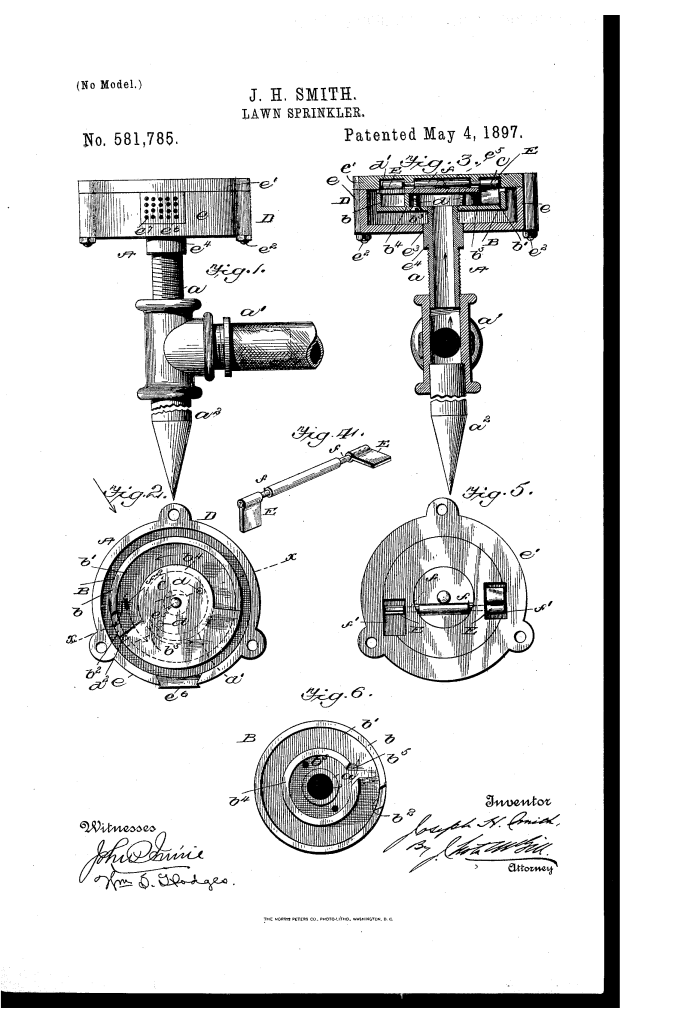
The patent by Joseph H. Smith of Washington, D.C., describes an improved Lawn-Sprinkler (Patent No. 581,785, 1897). The objective is to provide a durable, simple, and inexpensive sprinkler design that can operate under a small water force or supply and avoids wasting water.
Inventor Background: Joseph H. Smith
Joseph H. Smith was an inventor contributing to domestic and utility accessories in the late 19th century. His sprinkler design demonstrates a focus on fluid dynamics and mechanical simplicity, addressing the need for efficient water use in home gardening and lawns.
Invention and Mechanism
The sprinkler is a stationary device that converts the force of the water supply into continuous rotary motion using an internal paddlewheel system.
1. Stationary Base and Water Flow
- Support: A pipe-section (
) connected to a T-joint for the hose. A supporting rod () is secured below for staking the sprinkler into the ground.
- Stationary Head (B): A disk mounted on the pipe (
) that serves as the base for the rotary mechanism.
- Circular Passage-Way (): The head (B) has an outer flange (
) and an inner flange (
), forming a surrounding circular passage-way (
).
- Inlet and Outlet: Water flows up the pipe (
), enters the passage-way (
) through an inlet opening (
), and is directed toward a single outlet (
) in the outer flange.
- Bridge (C): A disk with a widened portion (
) that extends over half the passage-way, acting as a bridge or cover over the flow path.
2. Rotary Head and Actuation (Key Innovation)
- Rotary Head (D): A cylindrical box (
) and a cover (
) that incloses the stationary head (B) and is loose to revolve around it. The rotary head has outlet holes (
) around its flange for the final water discharge.
- Rock-Shaft and Blades (E, E): A rock-shaft (
) is loosely mounted in the rotary head’s cover (
). It has two blades or wings (E, E) mounted at right angles to each other on its ends.
- Alternating Action: A curved lug () projects upwardly from the bottom of the passage-way (
).
- Function: As the rotary head turns, one blade hits the lug (
), causing the shaft (
) to partially rotate. This rotation closes the first blade into a pocket () while lowering the second blade into the circular passage-way () just as it clears the outlet of the bridge (C).
- Function: As the rotary head turns, one blade hits the lug (
- Self-Propulsion: The force of the water discharged from the stationary head (B) hits the newly lowered blade, causing the rotary head (D) to turn, bringing the next blade into position for activation by the lug. This creates continuous, self-propelled rotation.
Concepts Influenced by This Invention
Smith’s sprinkler utilized principles of fluid dynamics and mechanical self-propulsion that are still key to simple rotating machinery.
- Fluid-Dynamic Self-Propulsion: The core concept of using internal baffles or paddles (blades E) driven by the water stream in a circular chamber to generate rotational motion is the foundation of modern impulse sprinklers and self-rotating lawn sprinklers .
- Alternating/Index Mechanism: The use of the rock-shaft and two perpendicular blades in conjunction with the fixed lug () is a mechanical solution for sequencing. It ensures that one blade is always poised to receive the water stream just as the previous blade is exiting the power zone, maintaining continuous torque. This influenced the design of simple indexing mechanisms and alternating valve systems in fluid control.
- Minimal Flow Efficiency: The design that concentrates the small supply of water into a single, powerful stream directed against a sensitive internal paddle (E) was engineered to ensure the sprinkler could operate under a small water force, influencing later designs focused on water conservation and low-pressure utility.
