
Venetian Blind Restringer (1958)
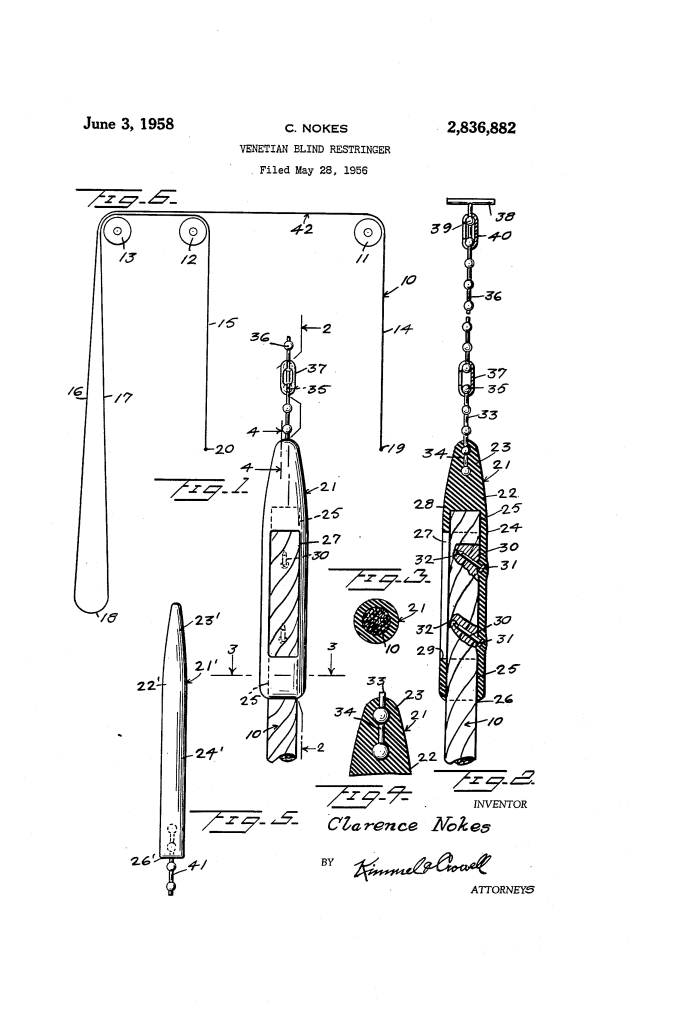
The Venetian Blind Restringer (U.S. Patent 2,835,832), invented by Clarence Nokes in 1958, is a tool designed to solve a common household frustration: replacing worn or broken lifting cords in Venetian blinds. Traditionally, this required complete disassembly of the blind structure, which is time-consuming and mechanically complex. Nokes’ invention allows a new cord to be “fished” through the blind by using the old cord as a guide.
Core Design and Mechanics
The device is essentially a high-friction coupling link that joins an old cord to a new one (or to a lead chain).
1. The Flexible Body (22)
The tool consists of a small, bullet-shaped body made of a soft, flexible material like rubber. This flexibility is crucial because it allows the restringer to bend and navigate through the narrow pulleys and slats of the blind without snagging.
- Tapered End (23): The front is pointed to lead the way through the blind’s internal hardware.
- Cylindrical Portion (24): The rear contains a hollow bore (25) where the end of the Venetian blind cord is inserted.
2. The Internal Gripping Pins (30)
To ensure the cord doesn’t slip out while being pulled through the pulleys, the cylindrical portion features a pair of sharpened pins.
- These pins are molded into the rubber and angled toward the tapered front.
- When a cord is inserted and then pulled from the front, the pins dig into the fabric of the cord, creating a “Chinese finger trap” effect—the harder you pull, the tighter the grip.
Components of the Restringing Kit
| Component | Description | Function |
| Ball Chain (33) | A short segment of chain molded into the tapered tip. | Provides a flexible attachment point for pull-chains or other restringers. |
| Chain Connector (37) | A standard metal coupling. | Joins the restringer to a longer lead chain or to a second restringer. |
| Long Lead Chain (36) | A length of metal ball chain. | Replaces the cord temporarily; its small diameter passes through tight pulleys more easily than the thick cord. |
| T-Handle (38) | A handle that clips onto the ball chain. | Provides a comfortable grip for the user to pull the assembly through the blind. |
How the Process Works (Restringing)
- Preparation: The user cuts the loop at the bottom of the old, frayed cord.
- Coupling: The cut end of the old cord is pushed into the rubber bore of the Restringer.
- The “Lead” Pull: A long metal chain is connected to the front of the Restringer. The user pulls the old cord out of the blind, which draws the metal chain in behind it.
- Replacing: Once the chain is in place, the new cord is attached to the other end of the chain. The user pulls the chain back through, drawing the brand-new cord into the exact path of the old one.
Variations: The “Needle” Form (21′)
Nokes also patented a modified version (Figure 5) for cases where the cord is already missing or snapped.
- This version acts more like a flexible needle.
- Instead of a bore at the back, it has a ball chain at both ends.
- The user threads this through the slats manually to pull a new cord through from scratch.
Significance
Before this tool, a broken blind cord often meant buying a new blind or paying for professional repair. The Nokes Restringer transformed a complex mechanical task into a simple “pull-through” operation, making it possible for homeowners to maintain their own window treatments with minimal effort.
