
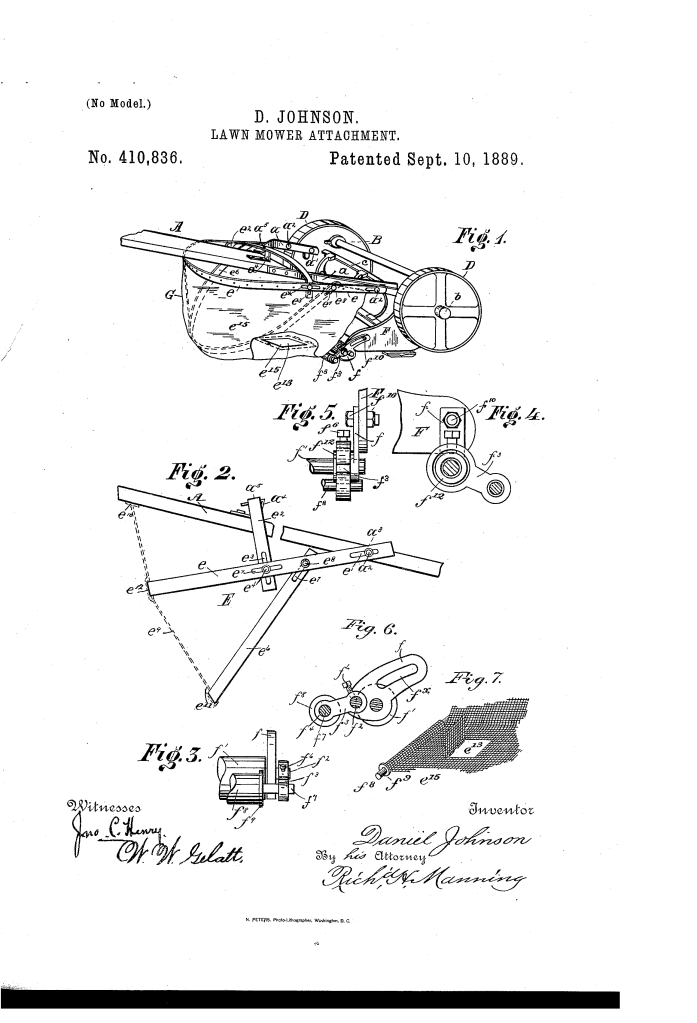
Adjustable Lawn-Mower Attachment, Daniel Johnson, Patent No. 410,836
The patent by Daniel Johnson of Kansas City, Missouri, describes a Lawn-Mower Attachment (Patent No. 410,836). This invention is a modular, flexible grass-receiver (catch-bag) system designed to be retrofitted onto standard manual mowers of the late 19th century, featuring an adjustable frame to accommodate varying volumes of grass clippings.
The “Why” (The Pain Point)
In the 1880s, lawn mowers typically discharged clippings directly onto the turf. While some “grass catchers” existed, they were often rigid, heavy, and difficult to empty. Furthermore, they did not account for different grass lengths or moisture levels; a fixed-size box would either be too small for high-growth areas or unnecessarily bulky for light trimming. Johnson recognized the need for a collapsible, adjustable system that could scale with the task and allow for easy debris removal through a dedicated dumping aperture.
Inventor Section: Daniel Johnson
Daniel Johnson was a Black inventor whose work in Kansas City highlights the transition from purely manual labor to mechanized landscaping efficiency. His engineering philosophy focused on modular adaptability. By utilizing “U-shaped” strips and slotted adjustments, Johnson moved away from the “one size fits all” manufacturing constraint. His design shows a deep understanding of structural tension and the behavior of flexible materials (cloth) under the weight of a payload.
Key Systems Section
1. The Telescoping U-Frame (E)
The primary support structure consists of several nested, U-shaped flat strips (e, e’, e”). These strips feature longitudinal slots, allowing the operator to slide the bolts to expand or contract the receiver’s frame. This is a classic example of a variable-geometry framework.
2. The Floating Receiver Rod (f7)
At the base of the mower, near the ground roller, Johnson implemented a receiver-carrying rod. This rod is mounted on adjustable arms (f9) that can be raised or lowered. This ensures the mouth of the cloth bag is always perfectly positioned to catch clippings as they are thrown by the rotating blades, regardless of the mower’s height setting.
3. Gravity-Fed Dumping Aperture
In the bottom of the flexible cloth receiver (G), Johnson placed a rectangular opening (e3) with a hinged cover (e4). This allowed the operator to invert the handle and dump the clippings without detaching the entire apparatus—a significant improvement in ergonomic workflow.
Comparison Table
| Feature | Standard 1880s Disposal | Johnson’s Attachment |
| Material | None (Discharge to ground) | Flexible Cloth with Metal Ribs |
| Capacity | Fixed (if using a box) | Adjustable via slotted strips |
| Emptying | Raking the lawn manually | Inverting handle; hinged trap-door |
| Ground Clearance | Fixed | Variable via adjustable rod arms |
Significance
- Modern Bagging Ancestry: This is a direct precursor to the modern grass-catcher bags found on almost every push and riding mower today.
- Ergonomic Design: The use of a “trap door” for emptying clippings anticipates modern industrial waste management systems.
- Retrofit Engineering: Johnson designed this to be “attached to the handle,” making it an early example of an aftermarket accessory rather than a built-in, proprietary component.
