
Lasting Machine (1891)
U.S. Patent No. 459,899, granted on September 22, 1891, to Jan E. Matzeliger, represents one of the most significant industrial advancements in the history of footwear manufacturing. Matzeliger, a Dutch-Surinamese inventor based in Lynn, Massachusetts, developed a mechanical solution for the most difficult step in shoemaking: “lasting.”
Before this invention, while machines could cut and stitch leather, the process of pulling the leather upper over the wooden mold (the last) and nailing it to the sole could only be done by highly skilled “hand-lasters.” Matzeliger’s machine could last between 400 and 700 pairs of shoes a day, compared to the 50 pairs a human expert could produce, effectively revolutionizing the global shoe industry.
The Innovation: Mimicking the Human Hand
The primary challenge of lasting is that leather is an organic, irregular material. A machine had to be able to “feel” the tension and adjust its grip to prevent tearing. Matzeliger designed a complex system of mechanical pinchers and wipers that reproduced the rhythmic pulling and folding motions of a human artisan.
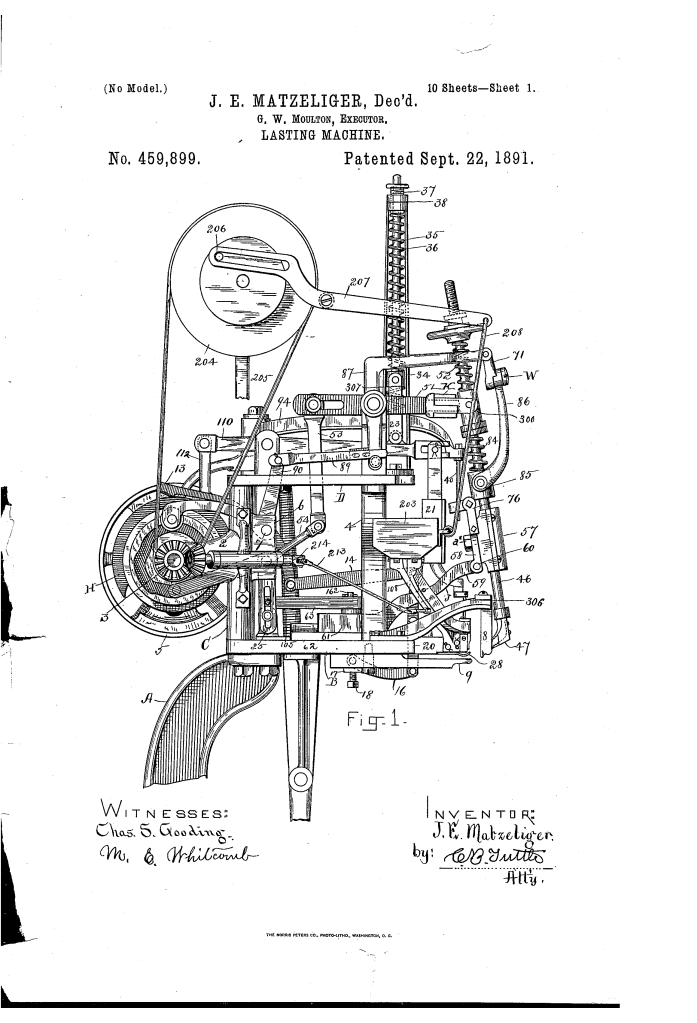
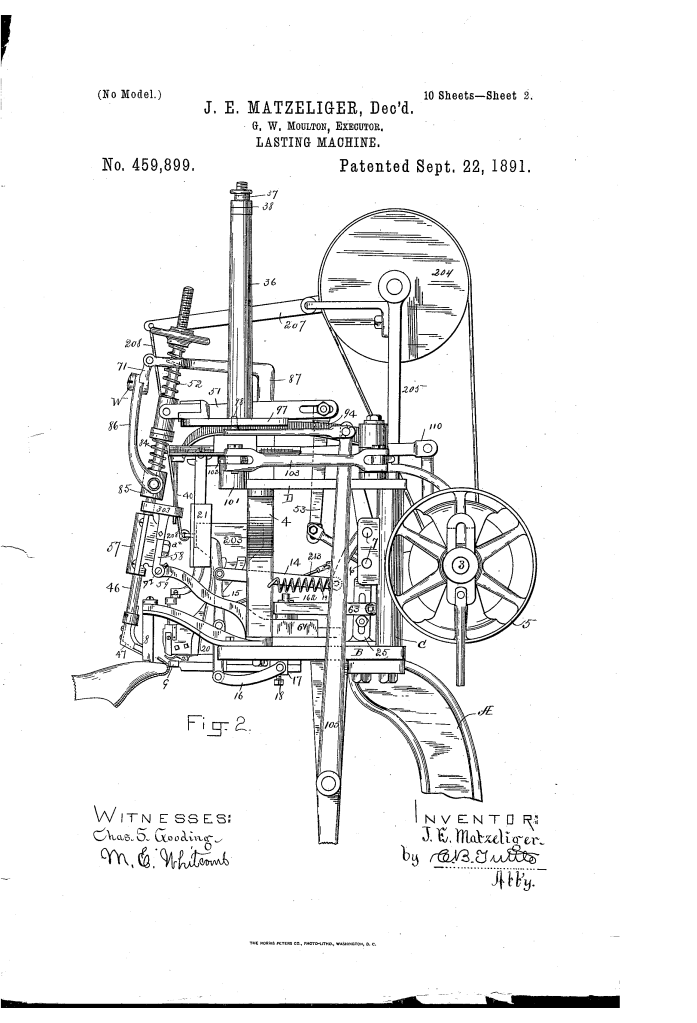
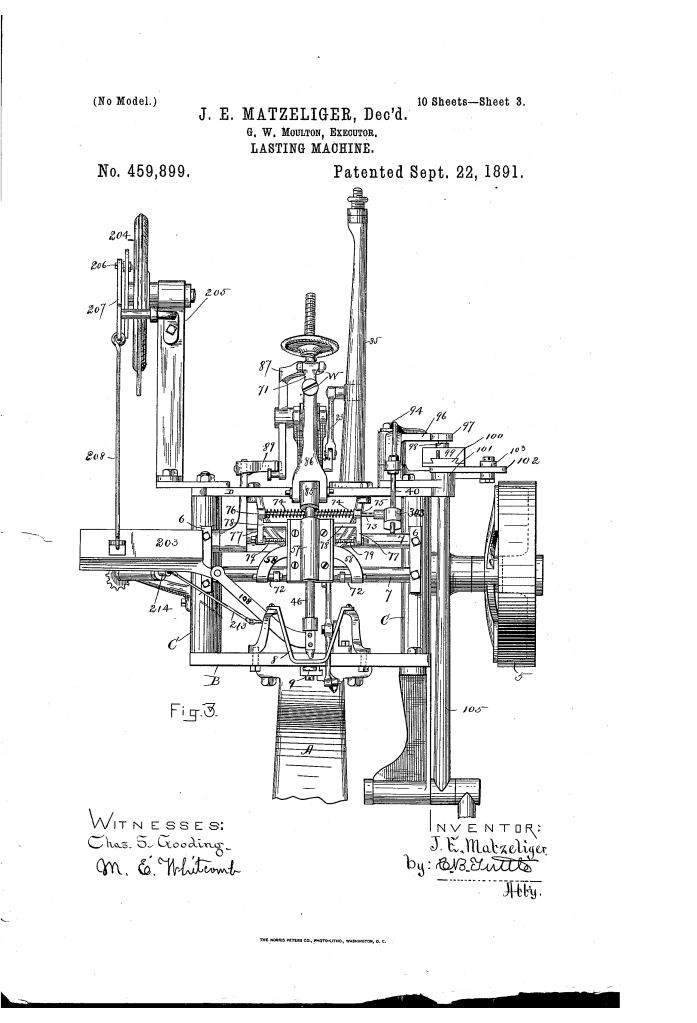
1. The Pinchers (S)
The heart of the machine is a pair of automatic jaws that seize the edge of the leather upper.
- Vertical & Forward Movement: The pinchers lift the leather to stretch it vertically and then pull it forward over the edge of the last.
- Yielding Tension: To prevent the leather from ripping, the pinchers are supported by coil springs (52). If the leather is too tight, the springs allow the machine to “give” slightly, mimicking a human’s sense of touch.
2. The Lateral Plaiting (The “Toe and Heel” Problem)
The most difficult parts to last are the curved toe and heel. Matzeliger solved this by adding a lateral carrier that allows the pinchers to move side-to-side.
- This creates “plaits” or folds in the leather, ensuring it lays flat against the curved sole without bunching.
How the Apparatus Functions
The operator holds the last (the shoe mold) in their hands, allowing for real-time adjustments based on the quality of the leather.
| Step | Action | Mechanical Purpose |
| 1. Presentation | The operator presses the last against a Fixed Rest (8) and Gage (9). | Establishes the exact position for the pinchers to grip the leather. |
| 2. Stretching | The Pinchers (S) rise and swing forward. | Stretches the upper tightly over the mold to ensure a snug fit. |
| 3. Wiping | An elastic Wiper (28) advances over the edge. | Smooths the leather down against the sole, holding it flat for the nail. |
| 4. Tacking | The Driver (306) fires a tack into the fold. | Permanently secures the upper to the sole; the wiper then retreats. |
Technical Components
- The Tack Distributer (203): A vibrating box that automatically aligns tacks. It uses a double-incline ridge (209) to ensure tacks are fed head-first into the delivery channel.
- The Shifter (N): A knee-operated lever (108) that allows the workman to turn the side-to-side “plaiting” motion on or off without using their hands.
- The Main Driving Shaft (3): Uses a series of specialized cams (Figures 10, 11, and 12) to synchronize the opening of the jaws, the fall of the hammer, and the movement of the wiper.
Performance: Industrial Transformation
Matzeliger’s machine provided a massive leap in efficiency. By automating the bottleneck of the factory, the cost of shoes was reduced by nearly 50%, making high-quality footwear affordable for the general public for the first time.
- Manual Output: ~50 pairs per day per expert.
- Machine Output: ~400 to 700 pairs per day.
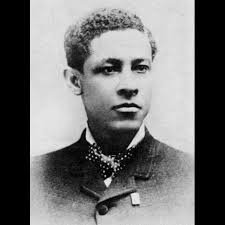
About the Inventor: Jan E. Matzeliger
Jan Ernst Matzeliger (1852–1889) was a pioneer whose life was cut short by tuberculosis just two years before this patent was fully realized in its final form.
- Background: Born in Dutch Guiana (now Suriname), he moved to the U.S. and settled in Lynn, MA—then the shoe capital of the world.
- Persistence: He spent years developing prototypes out of cigar boxes and scrap wood, facing skepticism from established shoemakers who believed lasting could never be mechanized.
- Legacy: Despite his early death, his invention became the foundation of the United Shoe Machinery Company. In 1991, the U.S. Postal Service issued a Black Heritage stamp in his honor, recognizing him as one of the greatest inventors of the industrial era.
Summary of Claims
The patent explicitly covers:
- The combination of a fixed rest with a single pair of suspended pinchers that move vertically, laterally, and forward/back.
- An elastic wiper that works independently of the pinchers to hold the leather in place for nailing.
- A yielding spring mechanism within the pinchers to adjust for variations in leather quality.
- A knee-shifter allowing the operator to control complex plaiting motions while keeping their hands free to guide the shoe.
