
Knockdown Wheeled Toy, Lydia M. Holmes (1950)
Patented on November 14, 1950, this invention (U.S. Patent No. 2,529,692) is a clever combination of an inlay puzzle and a functional construction set. Designed by Lydia M. Holmes, it was created specifically for homes and nursery schools to foster concentration and manual dexterity in young children.
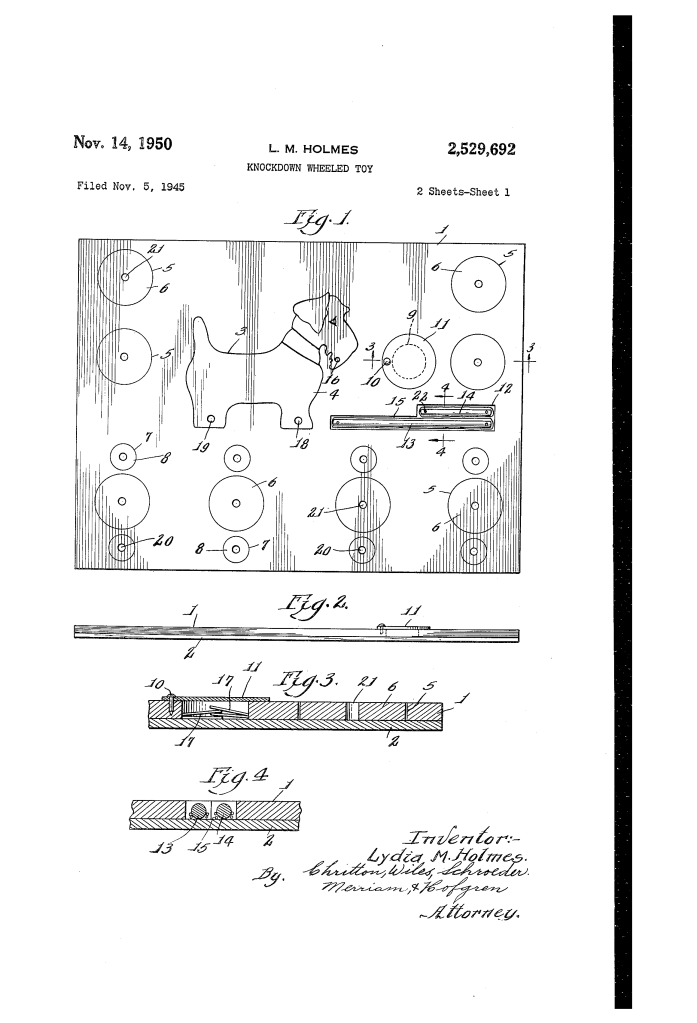
The brilliance of the design lies in its “flat-to-functional” transition. Before assembly, the toy exists as a flat board where every part—the animal body, the wheels, the spacers, and even the pull string—fits into a specific die-cut opening. This teaches the child not only how to build the toy but also how to “tidy up” by returning each piece to its matching “home” in the board.
The “Why”
- Concentration and Ingenuity: Unlike a pre-assembled pull toy, this requires the child to select the correct parts and understand the mechanics of an axle-and-wheel system.
- Compact Storage: Because the toy is “knockdown” (collapsible), it can be stored in a flat envelope or box, making it ideal for classrooms or small homes.
- Instructive Cleanup: The inlay board naturally encourages children to organize their toys, as the empty slots serve as a visual guide for where pieces belong.
Key Systems Section
1. The Inlay Storage Board
The base of the toy is a composite board made of two layers:
- The Front Board (1): This layer has various shapes die-cut or jig-sawed out of it (an animal, circles for wheels, small disks for spacers).
- The Backing Board (2): A solid sheet of stiff material (like Masonite or wood) glued to the back of the front board to create “bottoms” for the holes, turning them into shallow trays.
2. The Assembly Components
Once the child removes the pieces from the board, they have a complete kit to build a stable pull toy:
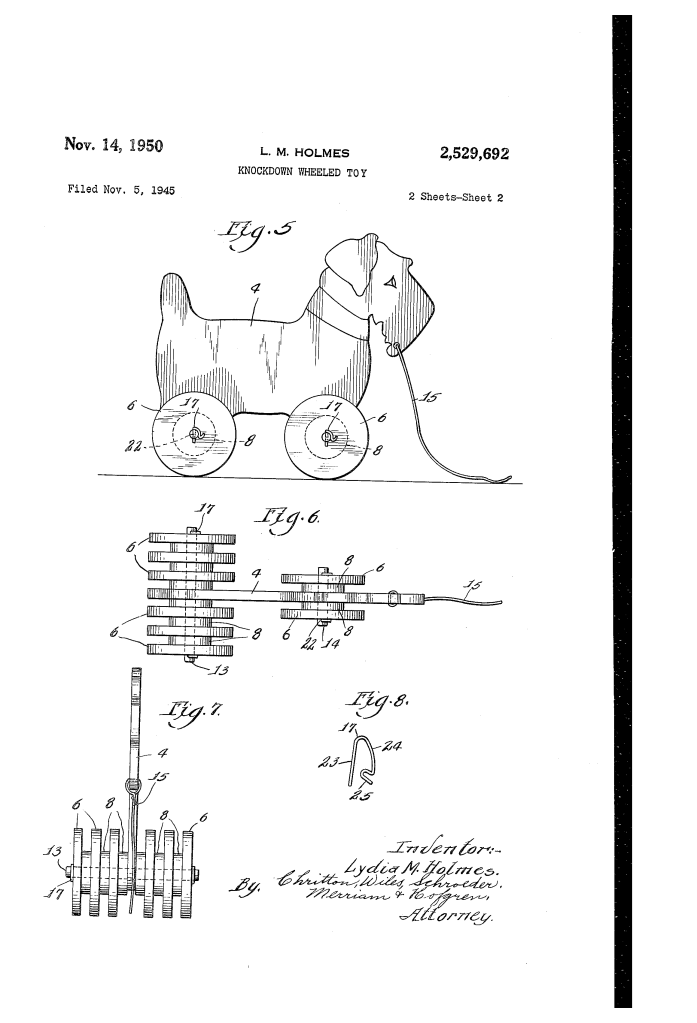
- The Body (4): In the patent drawings, the body is a dog, but Holmes noted it could be any animal or bird. It features holes (18 & 19) for the axles.
- Wheels (6) and Spacers (8): The toy can be customized. For example, Fig. 6 shows a dog with two front wheels and six rear wheels separated by spacers. This wide rear wheelbase makes the toy exceptionally stable so it won’t tip over when pulled.
- The Axles (13 & 14): Simple rods that hold the assembly together.
3. The Resilient Locking Pin
To ensure the wheels don’t fall off during play, Holmes invented a specific locking pin (17):
- The Mechanism: The pin has a straight arm (23) that slides through a hole in the axle and a curved, resilient arm (24) with a “cam” (25).
- The “Snap” Fit: As the child pushes the pin in, the curved arm flexes over the rounded surface of the axle and then “clicks” into place. It is secure enough for play but easy enough for a child to pull out when disassembling.
Component Breakdown (Table I)
| Part | Source Opening | Role in Toy |
| Body Piece | Opening 3 | The central chassis (e.g., a dog or bird). |
| Wheel Disks | Openings 5 | Provides mobility; can be stacked for stability. |
| Spacers | Openings 7 | Keeps wheels separated and reduces friction. |
| Axles & String | Opening 12 | The structural frame and the pull mechanism. |
| Locking Pins | Opening 9 | Keeps the wheels secured; stored under a swinging cover (11). |
Significance
Lydia Holmes’s design was a precursor to modern “STEM” toys and flat-pack design philosophies:
- Multi-Sensory Learning: It moves from 2D (the flat puzzle) to 3D (the assembled dog).
- Customization: The child can decide how many wheels to use or how to space them, allowing for creative experimentation.
- The “Newness” Factor: Holmes suggested that parents could have multiple “envelopes” with different animal boards. When a child grew bored with the dog, they could swap it for a bird or a different animal using the same mechanical principles.
Final Insight: Holmes created a toy that respects both the child’s need for play and the teacher/parent’s need for order. By turning “putting toys away” into a puzzle-solving activity, she solved a universal nursery school problem through clever industrial design.
