
Dough Kneading Machine (1894)
U.S. Patent No. 524,042, granted on August 7, 1894, to Joseph Lee, describes a mechanical kneading apparatus designed to automate and improve the preparation of large quantities of bread and pastry dough. Joseph Lee, a master caterer and hotelier based in Auburndale, Massachusetts, was a pioneer in automated food preparation equipment.
This specific invention solved a persistent problem in commercial kitchens, hotels, and large households: the heavy, time-consuming, and inconsistent nature of hand-kneading large batches of dough. Lee’s machine automated this process, drastically reducing labor while producing dough of superior quality and fineness.
The Innovation: The Reciprocating Pestle and Conveyor Loop
The brilliance of Lee’s apparatus lies in its dual-action system. Rather than simply stirring the ingredients, the machine mimics the heavy folding and pressing motions of human hands, using a synchronized system that ensures no portion of the dough is left unworked.
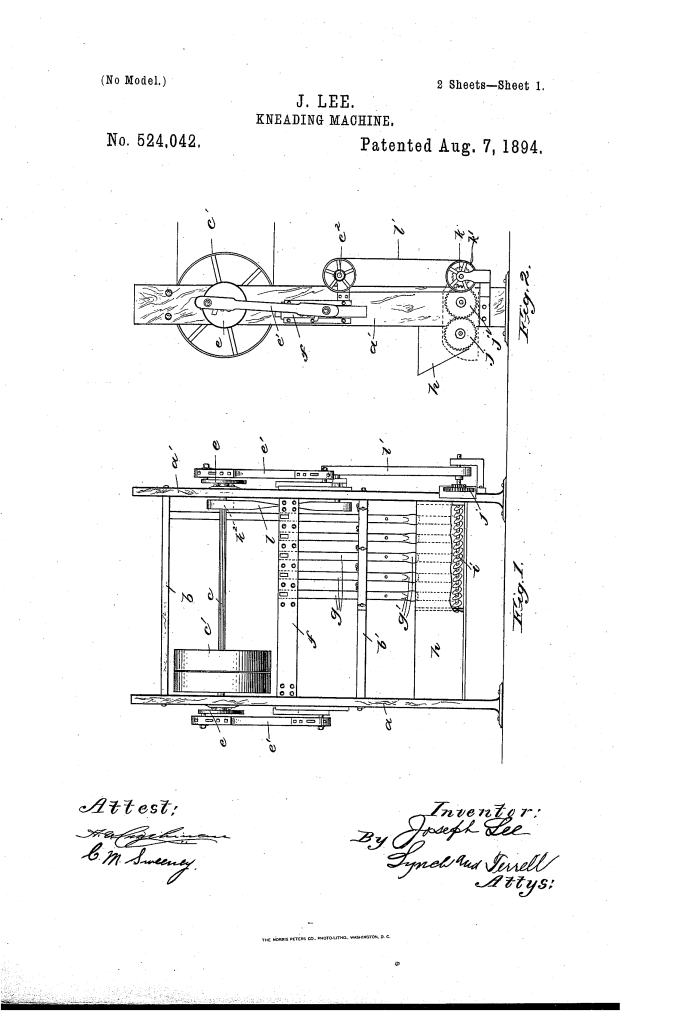
1. The Vertically Reciprocating Pestles (g,g)
- The core mechanical action comes from a series of heavy, depending arms equipped with kneading pestles (g) at their base.
- Driven by a main rotary shaft (c) and connected via cranks ($e$) and pitmen (e), these pestles are forced up and down in a powerful, continuous pounding motion.
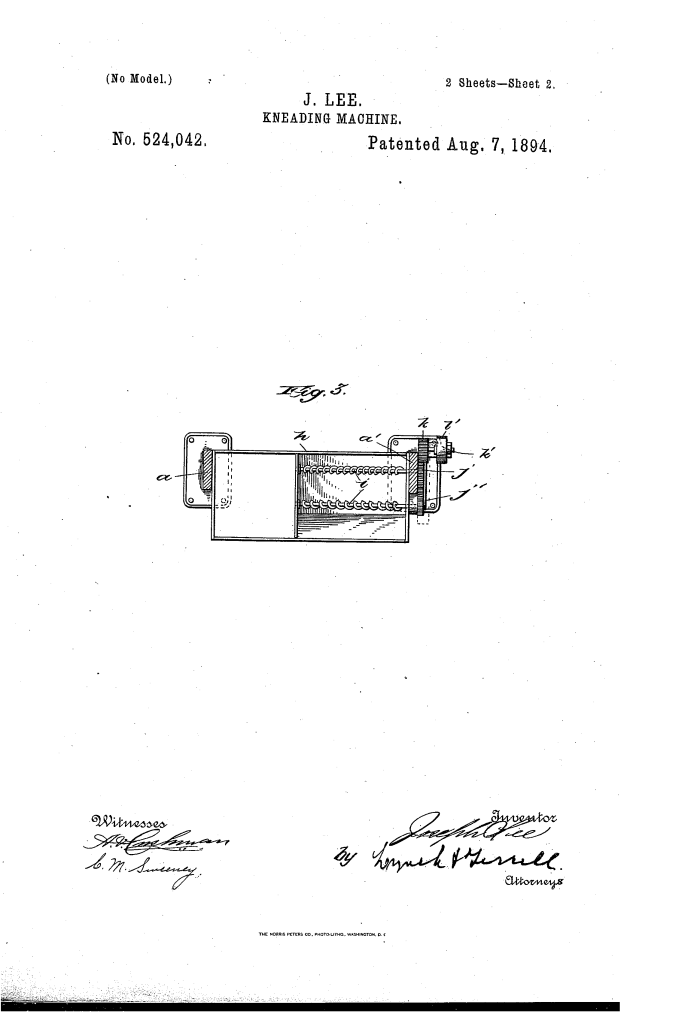
2. The Oppositely Rotating Screw Conveyors (i)
- As the pestles smash into the center of the trough (h), they naturally displace the dough, forcing it outward toward the walls of the container.
- To prevent the dough from sticking to the sides, Lee installed two horizontal screw conveyors (i) running along the bottom edges. Turning in opposite directions, these screws continuously catch the displaced dough, carry it forward, and flip it back into the center path of the descending pestles.
How the Apparatus Functions
The machine operates in a continuous, automated loop to transform raw ingredients into a perfectly developed dough:
| Step | Action | Mechanical Purpose |
| 1. Charging | Ingredients are placed into the main dough trough (h). | Establishes the mixing zone beneath the pounding mechanism. |
| 2. Compression | Main shaft (c) rotates, converting circular motion into vertical motion via a sliding beam (f). | Drives the heavy pestles into the center of the ingredients with great force. |
| 3. Displacement | The downward stroke forces the mass from the center out to the sides. | Simulates the flattening and stretching phase of hand-kneading. |
| 4. Redistribution | Intermeshing gears (j, j) turn the screw conveyors in opposite directions. | Catches the outer dough and throws it back under the pestles for the next strike. |
Key Technical Components
The entire system is structurally integrated to withstand the high mechanical stress of dense dough mixtures:
- The Supporting Frame (a, b): Heavy upright posts equipped with fixed vertical ways that guide the reciprocating beam ($f$) and prevent the mechanism from shaking loose.
- The Steadying Cross-Beam: A stabilization bar through which the pestle arms pass, ensuring they travel in a perfectly straight line during high-velocity impacts.
- The Gearing Assembly (j, k): A continuous belt-and-pinion drive system linked directly to the main shaft, ensuring that the timing of the side conveyors matches the rhythm of the central pounding pestles perfectly.
Historical and Commercial Impact
Joseph Lee’s kneading machine marked a significant leap forward in the industrialization of the baking industry during the late 19th century.
- Labor Efficiency: It successfully replaced the arduous, grueling manual labor required to mix mass quantities of dough in hotels and large-scale commercial kitchens.
- Enhanced Quality: Because the automated cycle maintained a steady, tireless rhythm, the gluten structure of the dough was developed more uniformly than hand-kneading allowed, resulting in an unprecedented fineness in the final bread crumb.
- Foundation for Future Success: This invention was a cornerstone of Lee’s career as an innovator. He later adapted these mechanical principles to invent automated bread-crumbing machines, eventually licensing his technology to major manufacturing companies and operating a highly successful industrial bakery.
About the Inventor: Joseph Lee
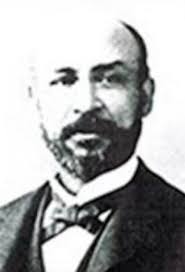
Joseph Lee was a prominent African American businessman, hotelier, and inventor who left a lasting mark on the hospitality and food service industries.
- Entrepreneurship: Based in Massachusetts, Lee owned and managed the historic Woodland Park Hotel in Auburndale, as well as several catering enterprises, which directly inspired his drive to automate kitchen operations.
- Prolific Inventor: Beyond the Kneading Machine, Lee is widely celebrated for his Bread-Crumbing Machine (Patent No. 540,553), which turned day-old bread into a valuable culinary commodity for frying and baking.
- Legacy: At a time when black innovators faced extraordinary systemic barriers, Lee successfully leveraged his mechanical ingenuity to improve commercial food production, proving that automation could elevate both kitchen economy and culinary quality.
Summary of Claims
The patent explicitly claims:
- The unique combination of a driving shaft with vertically reciprocating kneading devices operating inside a specialized trough.
- The cooperation between the central pounding pestles and the rotary mixing devices (conveyors) within the trough.
- A timing and drive mechanism utilizing intermeshing gear wheels powered by the main rotary shaft to turn the internal conveyors in opposite directions.
- A structural alignment system featuring a cross-beam and guided upright ways to steady the pestles during continuous operation.
