
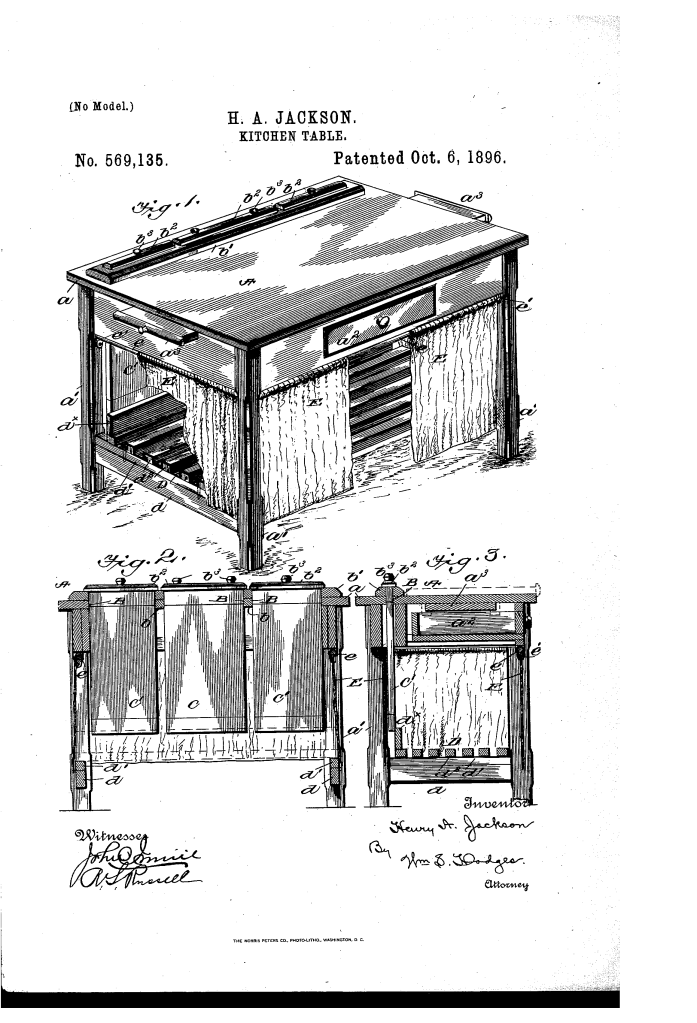
Kitchen-Table (Henry A. Jackson, No. 569,135)
The patent by Henry A. Jackson of Washington, D.C., describes certain new and useful Improvements in Kitchen-Tables (Patent No. 569,135, 1896). The object is to produce an improved, inexpensive article of manufacture adapted for use in small rooms and places of limited floor-space by integrating various features and storage options.
Inventor Background: Henry A. Jackson
Henry A. Jackson was an inventor focused on domestic and utility furniture. His invention addresses the practical challenges of urban living in the late 19th century, where kitchens were often small, requiring furniture to be multi-functional and space-saving.
Invention and Mechanism (Simplified)
The kitchen table is a highly compact, multi-functional unit featuring recessed cutting boards, sliding side shelves, and concealed bottom storage.
- Integrated Cutting/Work Boards (Key Innovation):
- Slots (B): Three or more longitudinal slots are cut into the table top ($a$), near the rear edge. The entire set of slots is surrounded by a protective flange or raised portion ($b’$ ).
- Removable Boards (C, $C’$): Boards (e.g., a breadboard $C$ or a fish-cleaning board $C’$) are provided with a shoulder ($b^{2}$) that fits into the slots.
- Function (Storage): When not in use, the boards are stored vertically in the slots, where the shoulders rest on the flange ($b’$), suspending them entirely out of the way within the thickness of the tabletop.
- Function (Use): When needed, the boards are pulled out and placed horizontally on the table surface. The shoulder ($b^{2}$) can also rest against the outer edge of the tabletop.
- Additional Storage and Utility:
- Sliding Shelves ($a^{3}$): Sliding shelves or panels are arranged in each end of the table.
- Function: These shelves can be pulled out to support utensils currently being used.
- Drawer ($a^{2}$): A standard drawer is arranged in the front face.
- Supplemental Storage (D): A lower frame or platform (D), made of slats, is secured to the lower braces of the table legs.
- Function: This platform is designed as a rest or support for pans and utensils. It can be concealed from view by a curtain (E) sliding on rods.
- Sliding Shelves ($a^{3}$): Sliding shelves or panels are arranged in each end of the table.
Concepts Influenced by This Invention
Jackson’s kitchen table influenced subsequent furniture design by pioneering the use of vertical storage within the tabletop itself and integrated, concealed utility.
- Vertical Storage in Working Surfaces: The most significant influence is the concept of using slots in the primary work surface to vertically store auxiliary working tools (cutting boards, strainers). This space-saving technique influenced the design of modern kitchen islands and cutting boards with integrated storage slots or vertical knife blocks.
- Integrated, Convertible Utility: The successful combination of a central drawer, sliding side shelves, and vertical internal storage influenced the design philosophy of modular and compact furniture where every plane of the object is designed for maximum function and minimal footprint.
- Concealed Storage for Aesthetics: The provision for a curtain (E) to conceal the lower supplemental storage frame (D) influenced the design of consumer furniture where aesthetics and tidiness are prioritized by hiding utility or clutter.
- Multi-Functional Design for Small Spaces: The explicit goal of producing a multi-advantageous table for “places of limited floor-space” influenced the long-term trend in furniture design toward space-saving, convertible products.
