
Key-Fastener (1894)
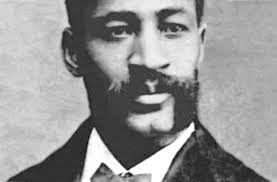
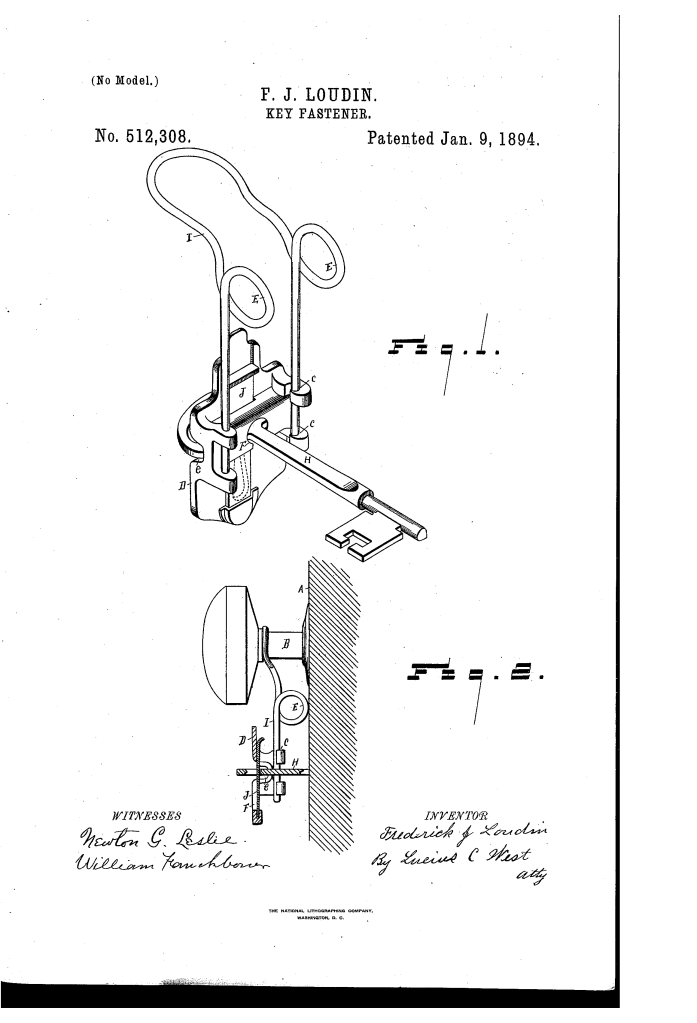
U.S. Patent No. 512,308, granted on January 9, 1894, to Fredrick J. Loudin, describes a clever home security device designed to prevent intruders from unlocking a door from the outside. Fredrick J. Loudin, an inventor based in Ravenna, Ohio, was a world-renowned leader and director of the Loudin Jubilee Singers (and formerly of the Fisk Jubilee Singers). Beyond his historic musical achievements, Loudin engineered practical solutions for everyday protection.
This specific invention solved a critical vulnerability in 19th-century home security: the ease with which a burglar could insert a tool or specialized pliers through a keyhole from the outside, grip the “eyed-end” of a resident’s key, turn it, and gain entry.
The Innovation: The Spring-Actuated Plate
Loudin’s design relies on a suspended, spring-loaded mechanism that captures and immobilizes the key inside the lock, making it completely impossible to turn from the exterior.
Instead of a rigid bracket, Loudin engineered an elastic metal wire system that attaches to the doorknob shaft. This wire hangs down to support a specialized metal plate directly over the keyhole. The plate yields under pressure when a resident inserts the key but snaps back dynamically to trap the key in place once the door is locked.
Why the Spring Mechanism?
- Constant Tension: The reaction of the spring continually pushes the plate away from the door face, ensuring the key handle remains deeply embedded in the plate’s protective groove.
- Tool Prevention: It prevents a lock-picker from pushing the key out of the lock or twisting it, as any force applied from the outside is met with immediate mechanical resistance.
- Tool-Free Installation: The entire unit can be clipped and unclipped from the door handle without needing screws or modifications to the door woodwork.
Key Mechanical Components
The apparatus uses a precise combination of tension, physical barriers, and dual-purpose locking components:
| Component | Function |
| Suspension Spring (I) | An elastic metal wire looped over the doorknob shaft. It features built-in spirals (E) that rest against the door to generate the necessary spring resistance. |
| Fastener Plate (D) | The heavy metal interface containing a central keyhole (F) and a transverse open recess (e) on its front face that fits around the head of the key. |
| Open Eyes (c) | Small hooks on the rear face of the plate that allow the free ends of the suspension spring to easily snap into place. |
| Locking Slide (J) | A vertical metal deadbolt that drops down through the plate and directly through the eye of the key. |
How the Apparatus Functions
The process follows a strict sequence to lock the door and arm the security device:
| Step | Action | Safety & Security Purpose |
| 1 | Insertion | The key is passed through the plate’s central hole and pushed into the door lock. |
| 2 | Compression | The user pushes the plate flat toward the door face against the resistance of the wire spirals. |
| 3 | Locking | The key is turned to throw the main door bolt into the frame. |
| 4 | Engagement | The user releases the plate. The spring snaps back, seating the key handle perfectly into the plate’s front recess. |
| 5 | Deadlocking | The Locking Slide (J) is pushed down through the plate and the eye of the key. |
Historical and Scientific Impact
Fredrick J. Loudin’s invention represents a significant advancement in late 19th-century residential security architecture.
- Privacy Protection: By utilizing the vertical slide to completely cover the keyhole, the device eliminated a common nineteenth-century espionage and voyeurism issue, making it impossible to see through the door from the outside.
- Mechanical Efficiency: Unlike contemporary security chains or heavy secondary deadbolts, Loudin’s device was lightweight, highly portable, and relied entirely on the tension of a single engineered piece of wire.
- Adaptability: It accommodated varying door thicknesses and handle heights due to the flexibility and give of the upper spring coils.
About the Inventor: Fredrick J. Loudin
Fredrick J. Loudin was an extraordinary 19th-century African American inventor, lyric bass singer, and international businessman.
- The Jubilee Singers: Born in Ohio, Loudin achieved global acclaim as a member and eventual director of the Jubilee Singers, touring Europe, Australia, and Asia, and performing for royalty including Queen Victoria.
- Industrial Leadership: Beyond his musical genius, Loudin was a sharp entrepreneur who owned a manufacturing company in Ravenna, Ohio. He leveraged his travels to advocate for civil rights and global cross-cultural education.
- Invention Legacy: Loudin held multiple patents. His work on the key-fastener demonstrated an elegant mastery of metallurgy and mechanical engineering, applying simple physics to solve pressing privacy and property protection problems.
Summary of Claims
The patent explicitly claims:
- A key-fastener featuring a plate with a front-facing recess and a spring mechanism designed to suspend the unit directly from a doorknob shaft.
- The specific configuration of a spring with rear-facing open eyes on the plate for quick, detachable installation.
- The inclusion of a vertical slide operating inside the plate bearings that passes directly through the eyed-end of an inserted key to lock it into the recess.
- The combination of a spring-actuated plate that yields during the act of locking and automatically reacts to preserve the engagement of the recess with the key handle.
