
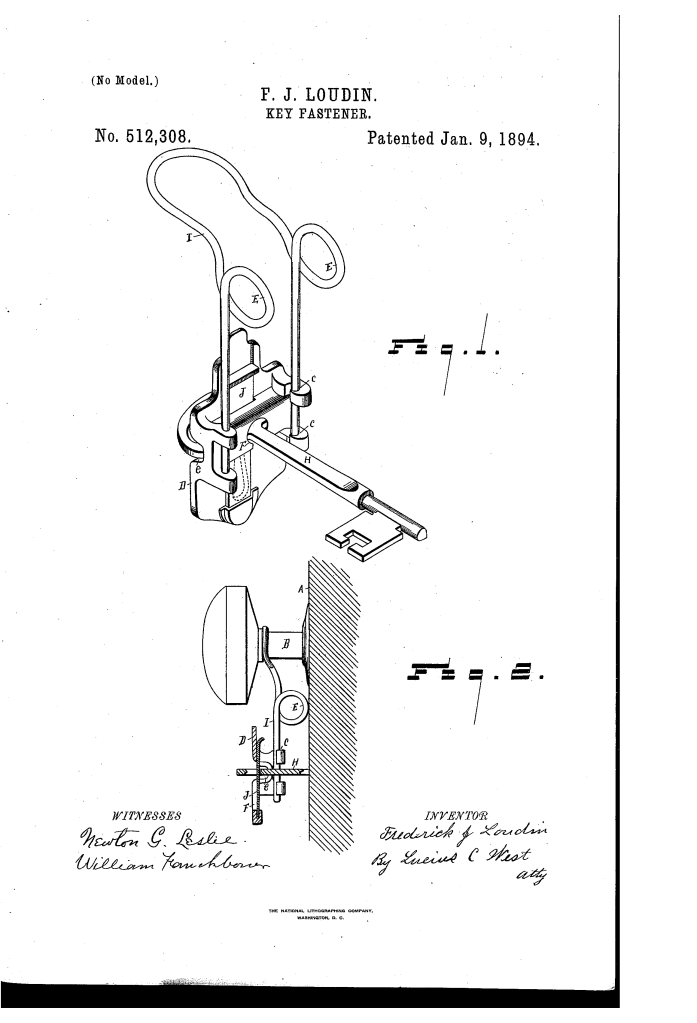
Key-Fastener (Fredrick J. Loudin, No. 512,308)
The patent by Fredrick J. Loudin of Ravenna, Ohio, describes a Key-Fastener designed to prevent a key from being turned in a lock from the outside, primarily for security against burglary. It is an accessory that attaches to the door’s knob-shaft or handle.
Invention and Mechanism
The key-fastener is a spring-actuated plate that engages the eye (hole) of a key once it’s locked.
- Plate (D): A main body plate with three key features:
- Open Recess (e): A transverse recess on the front face designed to receive the eyed-end (the top loop) of the key. The shoulders of this recess prevent the key from being rotated.
- Central Key-Hole (F): A hole leading from the recess through the plate, used to guide the key’s shank into the lock.
- Open Eyes (c): Eyes on the back face for detachable attachment of the suspension spring.
- Suspension Spring (I): An elastic metal wire bent to form a loop placed over the knob-shaft (B). Below the shaft, it forms spirals (E) that rest against the door. The free ends of the wire detachably catch into the plate’s eyes (c).
- Function: The spring suspends the plate in front of the key-hole and provides a spring resistance when the plate is pushed toward the door.
- Operation (The Spring-Action Lock):
- The key (H) is inserted through the plate’s hole (F) and into the lock.
- The user pushes the plate (D) toward the door, compressing the spring (I).
- The user locks the door.
- The user releases the plate, and the reaction of the spring (I) carries the plate back until the open recess (e) receives and engages the eyed-end of the key.
- Security Slide (J):
- A slide that has vertical bearings in the plate (D).
- Function: Once the key is engaged, the slide (J) can be pushed down through the eyed-end of the key, locking the key within the recess (e).
- The slide also covers the key-hole (F) in the plate, making it impossible to see through the key-hole from the outside. This prevents a burglar from attempting to manipulate the key from the outside, or from drawing the plate toward the door to disengage the key.
Historical Significance and the Inventor
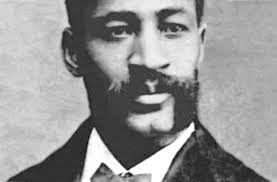
This patent, Key-Fastener No. 512,308 (1894), is another invention by Fredrick J. Loudin, the prominent African-American inventor, singer, and entrepreneur previously noted for his sash-fastener patent.
- Security in the Home: Like his sash fastener, this invention addresses a fundamental security concern of the 1890s: preventing entry via lock manipulation while the resident is home. At the time, if the key was left in the lock, burglars could use simple tools inserted through the key-hole to turn the key or manipulate the lock mechanism.
- Preventing Key-Hole Manipulation: The slide (J) feature that covers the key-hole is a specific defense against tools being inserted through the hole to either pick the lock or disengage the security device. This reflects a practical understanding of contemporary burglary techniques.
- The Inventor’s Dual Focus: Loudin’s patents for both a complex window lock and this ingenious, spring-actuated key-fastener demonstrate his versatile engineering mind and his focus on the safety and utility of household hardware, balancing his demanding career as a worldwide musical artist and cultural figure with his pursuit of practical innovation.
Relation to Current Items
Loudin’s Key-Fastener principle of physically blocking or covering the key is highly relevant to modern security solutions:
- Key-In-Lock Security: The core purpose—to prevent an intruder from turning the key (or the lock mechanism) from the outside when the key is left in the lock inside—is now largely handled by modern deadbolts and double-cylinder locks, which often lack an exterior cylinder or are designed to resist key-hole manipulation.
- Key-Hole Covers: The slide (J) that covers the key-hole is the functional precursor to modern key-hole blockers or dust/draft covers , which are sometimes used for weatherproofing or simple visual obstruction, though they are rarely employed for high-security measures now.
- Passive Engagement Clamps: The mechanism that uses the spring reaction to automatically engage and secure the key after the locking action is an early example of a passive engagement or retention system. This principle is seen today in various security clips, tool holsters, and quick-release fasteners where the removal or release of user force automatically activates a locking or holding function.
