
Ironing-Board (1892)
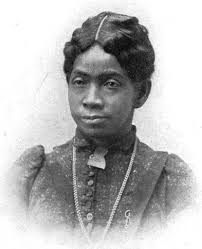
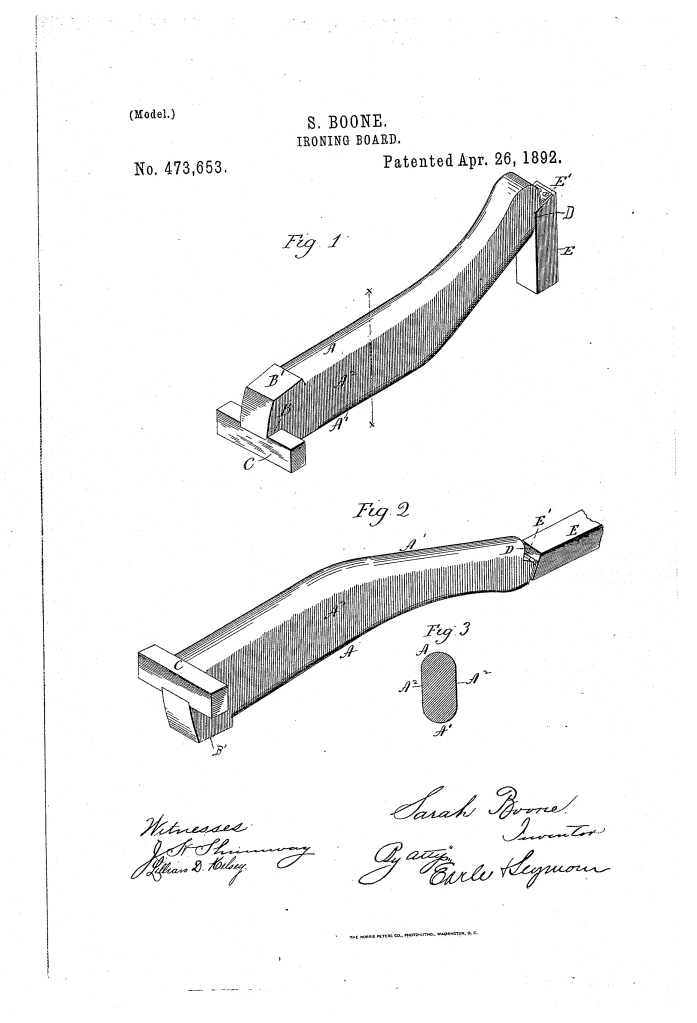
U.S. Patent No. 473,653, granted on April 26, 1892, to Sarah Boone, describes a highly specialized, collapsible, and reversible ironing board designed specifically to facilitate the pressing of sleeves and curved seams on women’s and men’s garments. Sarah Boone, living in New Haven, Connecticut, was a pioneering African American inventor whose design fundamentally upgraded the standard, flat ironing surfaces of the 19th century into specialized tools for precision tailoring.
This specific invention solved a persistent problem in both home laundering and professional dressmaking: the extreme difficulty of ironing the complex, contoured seams of sleeves and bodices without introducing unwanted creases into the opposite side of the garment.
The Innovation: The Contoured, Reversible Sleeve Board
Standard ironing boards of the era were wide, flat, and completely straight, making them ill-suited for the tight, tailored fit of Victorian-era clothing. Boone’s breakthrough was a narrow, custom-shaped board that mimicked the natural, human curvature of a garment’s sleeve.
By tailoring the wooden edges to match the actual lines of clothing construction, the garment could be slipped over the board, allowing a person to press an individual seam cleanly without wrinkling the fabric underneath. Furthermore, the board was engineered with a unique, collapsible dual-support mechanism that allowed it to be flipped over to accommodate different types of seams.
Why the Contoured Design?
- Anatomical Alignment: The board featured distinct outward and inward curvatures, with the most pronounced bend located precisely at the “elbow-point” of a sleeve.
- Double-Edge Utility: One side of the board was specifically shaped for the outside seam of a sleeve, while the opposite edge was curved to perfectly fit the inside seam.
- Crease Elimination: Its narrow profile allowed sleeves and tight waist-seams to be slipped entirely over the body of the board, isolating the seam being ironed.
Key Structural Components
The apparatus is an elegant mechanical assembly where the shape of the wood and the placement of the hinges allow for rapid re-configuration:
| Component | Function |
| Main Board (A, A’) | The core pressing surface, made flat on its sides but cut with a longitudinal outward curve on one edge (A) and an inward curve on the other (A’). |
| Fixed Transverse Support (C) | A stationary wooden bar set into a notch (B) at the wide end of the board, providing a sturdy, crosswise base when ironing inside seams. |
| Bearing-Face (B’) | A flat extension at the wide base that stabilizes the board on a table when it is flipped over for outside seam ironing. |
| Movable Support (E) | A hinged wooden leg set into a notch (D) at the narrow end of the board that can extend outward or fold downward. |
| Hinge (E’) | The hardware connecting the movable support to the tail of the board, enabling the tool to switch configurations seamlessly. |
How the Apparatus Functions
The board relies on a strict mechanical sequence to change shapes depending on whether the tailor is working on an inside or outside seam:
| Step | Action | Practical Purpose |
| 1. Inside Seam Setup | The Movable Support (E) is turned down at a right angle, acting as a vertical leg. | It co-operates with the fixed transverse support to raise the board off the table, allowing a sleeve to slide over it. |
| 2. Dressing the Board | The sleeve of a lady’s waist or man’s coat is pulled over the narrow end of the board. | Aligns the inner seam of the sleeve perfectly with the inward-curved edge (A’). |
| 3. Outside Seam Reversal | The board is flipped edge-for-edge. The Movable Support (E) is swung outward so it is completely in line with the board. | Flips the board to use the outward-curved edge (A) while moving the leg out of the way so it doesn’t obstruct the fabric. |
| 4. Stabilizing | The board is rested directly on its built-in Bearing-Face (B’). | Safely steadies the narrow board against a tabletop while the user applies heavy pressure with a hot flatiron. |
Historical and Scientific Impact
Sarah Boone’s invention significantly advanced the efficiency of the textile and garment industries during the late Industrial Revolution.
- Tailoring Precision: Before this patent, pressing the curved waist-seams of corseted bodices and billowing sleeves required stuffing them with rags or specialized tailor’s “hams,” which were unstable and difficult to maneuver.
- Mass Production Compatibility: As the garment industry shifted from custom dressmaking to ready-to-wear, factory manufacturing required tools that could quickly press mass-produced clothing items uniformly.
- Democratization of Garment Care: By designing a tool that was “cheap, simple, [and] convenient,” Boone brought professional-grade tailoring capabilities into the average 19th-century home.
About the Inventor: Sarah Boone
Sarah Boone was a remarkable African American inventor born into slavery in Mississippi in 1832.
- Overcoming Adversity: After achieving her freedom, she relocated to New Haven, Connecticut, where she worked as a dressmaker.
- Pioneering Achievement: When her patent was approved in 1892, Boone became one of the first African American women in United States history to receive a federal patent.
- Legacy: Operating in a specialized trade during an era when both women and African Americans faced severe systemic barriers, Boone leveraged her direct, hands-on experience with textiles to engineer an elegant solution to an everyday industrial problem. Her work is celebrated as a foundational milestone for Black women in STEM and manufacturing.
Summary of Claims
The patent explicitly claims:
- An ironing board characterized by edges respectively curved to match the outside and inside seams of a sleeve, equipped with a fixed transverse support on one end and a hinged, movable support on the opposite end.
- A specific design where the board is constructed with a tail-end notch to cleanly house the movable support, allowing it to extend perfectly in line with the body of the board.
- The specific application of a built-in bearing face at the wide base to steady the narrow board when reversed, ensuring structural stability without requiring permanent mounting hardware.
