
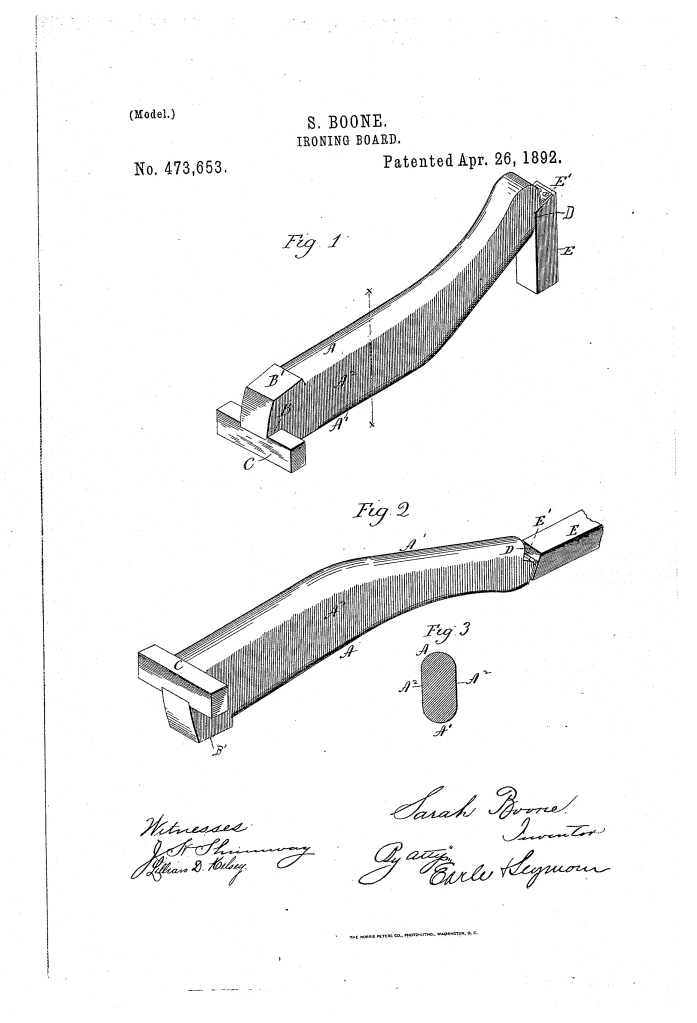
Sarah Boone was granted patent 473,653 on April 26, 1892, for an ironing board specifically designed to iron women’s garments. Her invention was a narrow, double-sided board with distinct curves. One side had a pronounced outward curve, while the other had an inward longitudinal curve. These curves were shaped to match the seams and natural shape of a sleeve, particularly around the elbow. The board had a fixed transverse support at one end and a movable, hinged support at the other. This design allowed the board to be reversed, providing a perfect fit for ironing both the inside and outside seams of a sleeve without creating creases.
Societal Impact
Boone’s invention was a crucial, yet often overlooked, innovation in the history of domestic life. In the late 19th century, women’s fashion featured complex garments with intricate sleeves, making ironing a difficult and time-consuming task.
- Domestic Convenience: Boone’s ironing board transformed a tedious and physically demanding chore. By creating a tool perfectly suited for the task, it saved immense amounts of time and labor for women who were responsible for household work.
- Specialized Tools: Her patent is an excellent example of an inventor designing a specialized tool to solve a practical problem. It moved beyond the general-purpose ironing board to provide a more effective and convenient solution for a specific need.
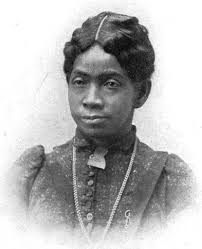
- Legacy of the Inventor: Sarah Boone was an African American inventor. Her patent is a powerful testament to the ingenuity of black women who, despite facing immense racial and gender discrimination, made foundational contributions to American society. Her work is a reminder that innovation comes in many forms, from large-scale industrial machinery to the small, practical tools that improved daily life.
