

Invalid-Cot (Benjamin F. Cargill, No. 629,658)
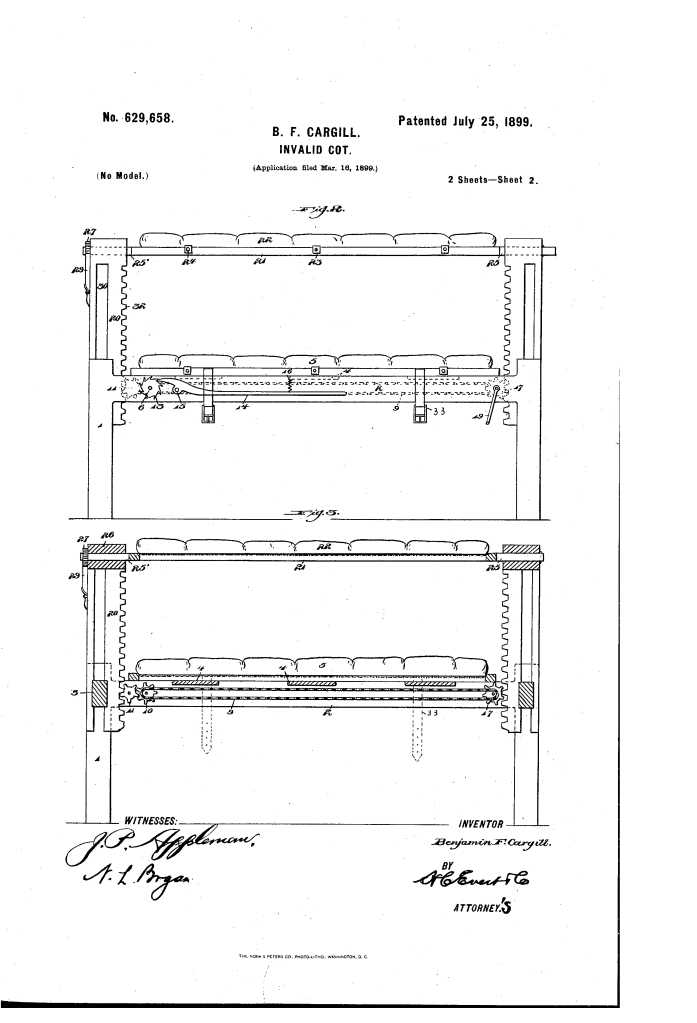
The patent by Benjamin F. Cargill of Carnegie, Pennsylvania, describes an improved Invalid-Cot (Patent No. 629,658, 1899). The main object of the invention is to provide a mechanical means for turning an invalid upon their back without causing any inconvenience, and then lowering the patient to a desired position. This is achieved using two stacked cots that are temporarily strapped together.
Inventor Background: Benjamin F. Cargill
Benjamin F. Cargill was an inventor focused on utility and safety solutions, particularly in the medical and care-giving fields. His invention addresses a critical, difficult, and repetitive task in patient care—repositioning a bedridden person—by creating a mechanical system that minimizes strain on both the patient and the caregiver.
Invention and Mechanism (Simplified)
The cot is a dual-deck system where the upper deck (the turning platform) moves up and down via a crank and gears, and then rotates to flip the patient.
- Dual Cot Setup: The system uses two cots: a lower cot (5), which rests on the main frame, and an upper cot (22), which is mounted on a separate, movable platform (21).
- The Turning Process:
- Strapping: The two cots are strapped together (33) with the invalid lying on the lower cot.
- Elevation (Key Innovation): The upper platform (21) is mounted on standards (20) that have rack-teeth (32) (like a gear track) on their inner faces. A crank handle (19) drives a gear train (10, 11, 17) that engages the rack, elevating the upper platform (21) and the invalid (who is strapped to the lower cot).
- Rotation: Once elevated to the desired position, the caregiver uses a handle on a shaft (25) to revolve the upper cot (22) and the entire patient assembly (the patient, the lower cot, and the upper cot) to turn the invalid onto their back.
- Lowering: The platform is then lowered back down, the straps are removed, and the upper cot is taken away, leaving the patient turned and safely resting on the lower cot (5).
- Mechanical Drive: The raising and lowering motion is driven by a gear train and chain (9) connecting the crank shaft (7) to the gears (11) that mesh with the vertical rack (32), providing controlled, mechanical ascent and descent.
Core Concepts Utilized Today
Cargill’s cot influenced subsequent medical equipment by pioneering integrated rack-and-pinion elevation and rotational platforms for patient handling.
- Integrated Lift and Rotation: The core concept of combining vertical mechanical elevation (rack 32 and gears 11) with a horizontal rotational bearing (shafts 25) to reposition a load influenced the design of modern:
- Patient Hoists and Lifts: Mechanical lifts that use vertical tracks and rotational pivots to safely move patients.
- Adjustable Hospital Beds: Beds with rotational sections and powered vertical elevation mechanisms.
- Rack-and-Pinion Drive for Vertical Lift: The use of a rack (32) and gear-wheels (11, 17) to convert rotational input (from a crank) into stable, controlled vertical motion is a foundational mechanism in industrial and medical equipment, ensuring precision and stability under heavy loads.
- Modular Safety Strapping: The use of securing straps (33) to temporarily bind two surfaces (the two cots) around the patient ensured a rigid unit for the turning process, eliminating the risk of the patient falling or moving independently during rotation.
