
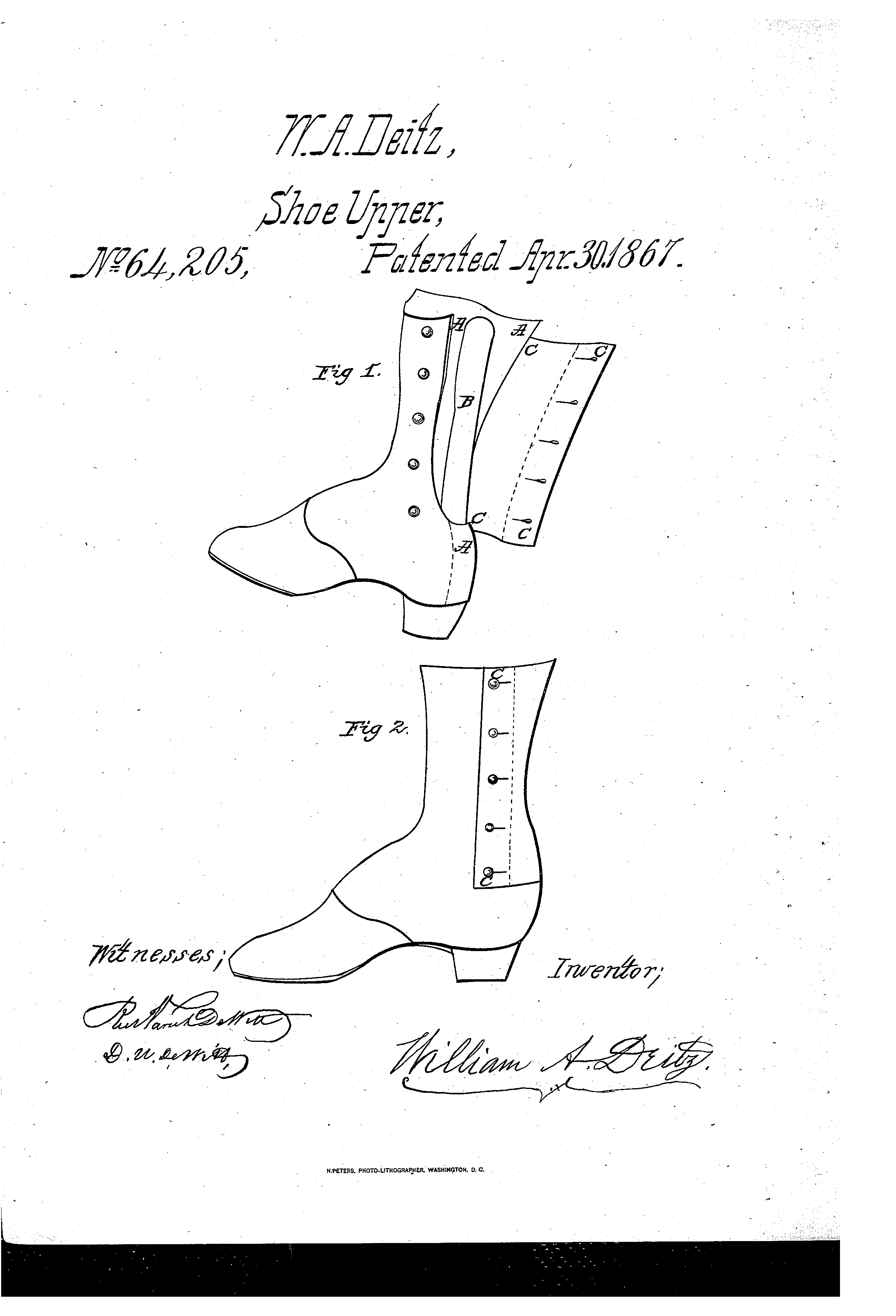
William A. Dietz was an African-American inventor who made an “Improvement in Shoes,” specifically women’s boots. He received U.S. Patent No. 64,205 on April 30, 1867.
His invention focused on a more comfortable and convenient design for women’s boots, particularly those that were typically laced or buttoned.
Here are the key aspects of William A. Dietz’s shoe improvement:
- Rear Opening Design: The most significant feature of Dietz’s invention was the placement of the boot’s opening. Instead of the usual front or side opening, he designed an opening in the rear of the boot. This opening extended from the top down to the upper part of the counter (the part of the boot that cups the heel).
Tongue and Flap System:
- A small space was left between the edges of the opening, which was closed on the inside by a tongue of soft, flexible leather. This tongue was fastened at its lower edge to the top of the counter.
- On the outside, this opening was covered by a flap of stout leather that extended around the sides of the boot and was secured with buttons.
Advantages of the Design:
- Ease of Putting On and Taking Off: Dietz claimed that this rear opening made it significantly easier to put the boot on and take it off, especially new or tight-fitting boots, without stretching the front of the boot out of shape.
- Improved Fit and Comfort: By allowing the front of the boot to maintain its form, it likely contributed to better comfort and fit over time.
- Protection from Water: He also highlighted that this design offered better protection from water when stepping through gutters or puddles. When the heel was raised (as when stepping on the toe), the rear opening was carried above the level of openings at the front and side, reducing the chance of water entering the boot.
- Potential for Cheaper Manufacture: The patent also suggested that boots made with this design might be cheaper to manufacture than those with front or side openings of similar quality.
William A. Dietz was a former slave from Albany, New York. His ability to secure a patent shortly after the end of the Civil War (when patent rights were extended to all citizens, including former slaves) highlights his ingenuity and determination. His invention aimed to solve a practical problem in everyday wear for women, demonstrating a keen understanding of both design and user comfort.
