
Improved Sugar-Making Apparatus (1846)
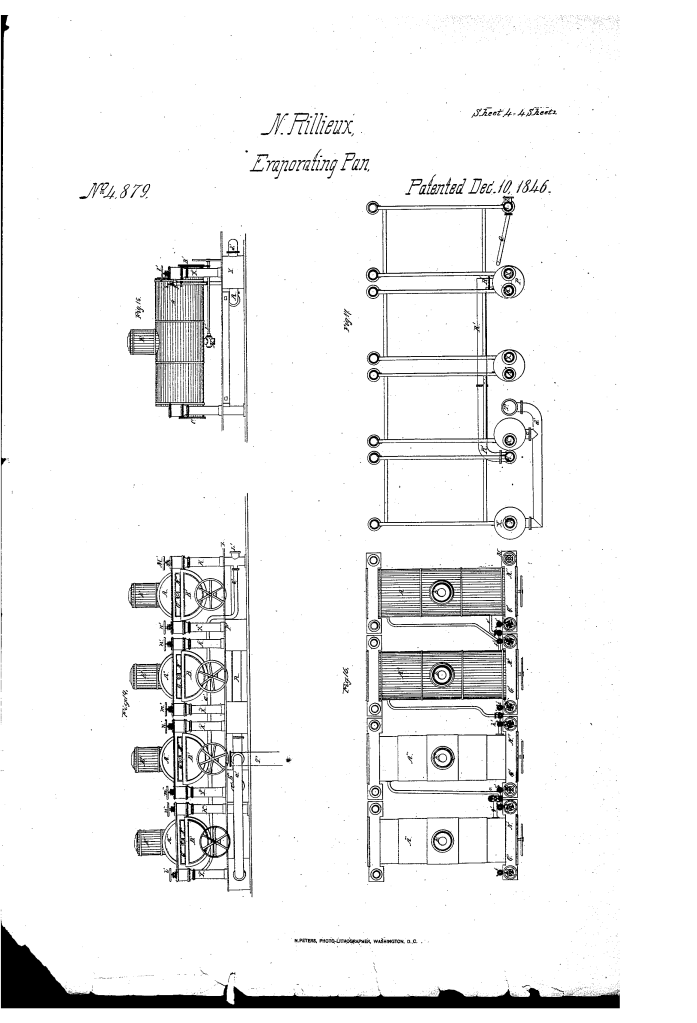
U.S. Patent No. 4,870, granted on December 10, 1846, to Norbert Rillieux, represents the definitive perfection of his “Multiple Effect Evaporator.” While his 1843 patent established the core physics of heat recycling, this 1846 improvement introduced a holistic factory system that managed the entire lifecycle of sugarcane juice—from raw clarification to the final “strike” of the sugar crystals—all while solving the critical problem of water scarcity on plantations.
This invention transformed sugar refining from a series of disconnected, manual tasks into a continuous, automated industrial “loop” that maximized every unit of thermal energy.
The Innovation: The Integrated Triple-Threat System
Rillieux’s 1846 patent introduced three primary advancements that addressed the physical and economic limitations of 19th-century sugar production.
1. The Advanced Juice Heater & Clarifier
Rillieux developed a way to use the “waste” hot water and escape steam from the boiling pans to pre-heat raw juice.
- The Physics: Juice travels through internal tubes surrounded by hot waste fluids.
- The “Scum” Spout: By heating the juice to approximately 175°F without reaching a violent boil, impurities rise to the top as scum. Rillieux designed a specialized bent-up discharge pipe that ensures only the clear, clarified juice is drawn from the bottom, while the impurities are skimmed off through a dedicated spout.
2. The Atmospheric Cooler (The “Waterless” Solution)
In many sugar-growing regions, water for condensing steam was scarce. Rillieux’s “Cooler” functioned as an early industrial cooling tower.
- Spray & Air: Saccharine juice is pumped to the top of a tower and falls as a fine spray.
- The Fan-Blower: A rotary fan blows a current of air upward, meeting the falling spray. This cools the juice and causes partial evaporation before it even reaches the boiling pans.
- Dual Purpose: This cooled juice then acts as the cooling agent for the Hall Condenser, eliminating the need for external water sources.
3. The Independent “Striking” Pan
In older systems, stopping the final pan (the “striking-pan”) to remove the finished sugar meant the entire factory had to shut down. Rillieux engineered a bypass:
- The Independent Vapor Connection: By connecting the striking-pan to the first vapor-producer via a governed cock, the rest of the “sirup-pans” can continue concentrating juice even when the final pan is being emptied or cleaned.
Key Technical Components
Rillieux utilized the structural frame of the machine itself to move fluids, a precursor to modern integrated factory design.
| Component | Function |
| Hollow Pillars | The framework of the machine doubles as pipes to conduct vapor and liquids between the pans. |
| Hall Condenser | A specialized heat exchanger where cooled juice condenses the steam from the vacuum pans. |
| Diaphragm Heater | A vessel divided into sections that progressively heat the juice as it moves toward the top. |
| Rotary Fan-Blower | Mechanically driven to provide a constant air current for cooling the juice spray. |
Performance: Efficiency and Continuity
The 1846 system moved the industry toward “Total Heat Management,” where no energy was allowed to escape without doing work.
- Water Conservation: The system could run indefinitely on its initial charge of liquid, as the water evaporated during cooling was balanced by the water recovered during condensation.
- Continuous Operation: The independent striking-pan meant the “Jamaica Train” style of stop-and-go production was replaced by a 24/7 industrial flow.
- Sugar Purity: The precise control of the clarifier meant fewer chemical additives were needed to achieve a high-grade, white sugar.
About the Inventor: Norbert Rillieux
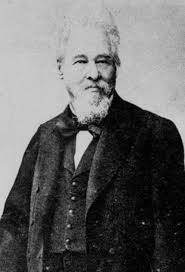
By 1846, Norbert Rillieux was recognized by sugar planters in Louisiana as a mechanical genius, though he still navigated the extreme prejudices of the era.
- Engineering Prowess: This patent shows Rillieux’s shift from a pure physicist to a systems engineer, designing not just a vat, but a factory-wide network of hollow supports and valves.
- Economic Impact: His machines were expensive but paid for themselves in fuel savings alone within a few seasons, making them the gold standard for high-end Louisiana and Cuban plantations.
- Social Barrier: Despite his success, New Orleans laws eventually restricted the movements of free people of color so severely that Rillieux left the U.S. for France in the 1850s, where he applied his engineering mind to the study of Egyptology and the Paris steam-engine network.
Summary of Claims
The 1846 patent explicitly claimed:
- The method of pre-heating juice using waste hot water/steam from the boiling process.
- The specific geometry of the clarifier, using a bent pipe and spout to separate scum from clear juice based on fluid levels.
- The combination of a spray-chamber and fan-blower to cool and concentrate juice simultaneously, especially when used as a condensing medium for the vacuum pans.
- The independent vapor connection allowing the final striking-pan to operate without interrupting the series of concentration pans.
